Subscribe
Show notes
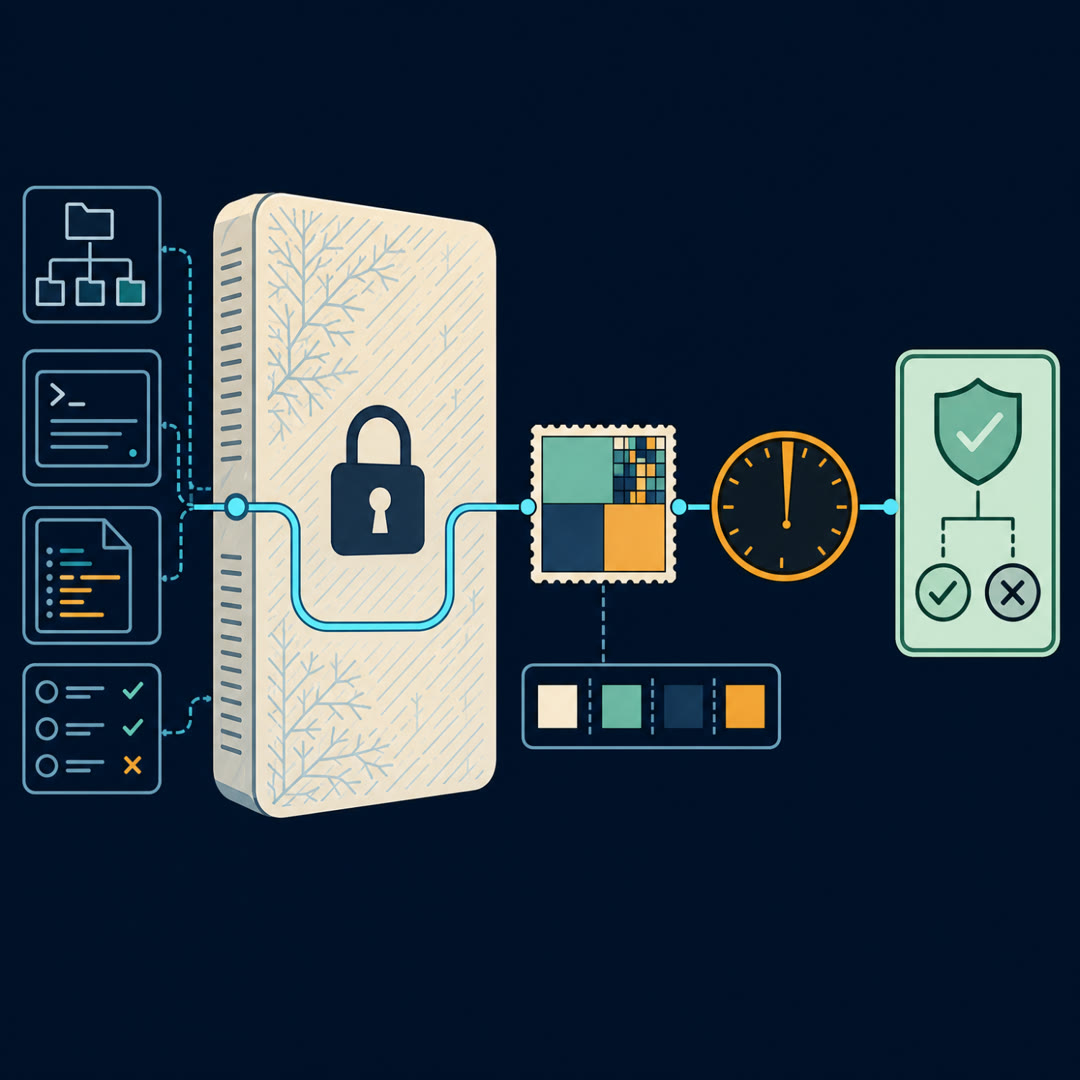
The paper that asks how few bits an adapter can survive on. Maya opens with a mosaic master firing a portrait in four tile shades, and the analogy turns out to be the method: LowRA pushes LoRA fine-tuning below two bits per parameter through three deliberate decisions — the Palette (which values the codes stand for), the Cut Lines (where bucket boundaries sit), and the Bit Budget (where bits get spent) — plus the CUDA kernels that keep the memory win from leaking back out as runtime. The reported floor: accuracy down to about 1.15 bits, with up to fifty percent memory reduction. Then the staged argument: Leo refuses to bet compliance rules on four levels per number, Maya argues that on constrained hardware the alternative to a 1.15-bit adapter is no adaptation at all, and the resolution lands on a rule — the precision budget and the testing budget move together. The hospital discharge-note summarizer returns with a whole shelf of department adapters to manage.
Transcript
MayaA mosaic workshop gets a commission that sounds like a prank: reproduce a full-color portrait, but the kiln can only fire four shades of tile. Four. And the master doesn't panic — she asks three questions. Which four shades do we fire? Where on the face does one shade hand off to the next? And where do the tiny tiles go — because the eyes get the small detailed work, and the wall behind the sitter gets big flat slabs.
LeoFour shades. For a face.
MayaDone well, from across the room it reads as a portrait. Done carelessly, it reads as a warning about kilns.
Leo[chuckle] Hold those three questions, because they are, almost literally, today's paper. LowRA — written L-o-w-R-A, pronounced exactly like LoRA, which I'm sure has confused nobody at any standup ever. Full title: Accurate and Efficient LoRA Fine-Tuning of Large Language Models under Two Bits. Under two bits per adapter parameter.
MayaFooting before we climb. Last episode, QLoRA squeezed the frozen base model down to four bits and trained LoRA adapters through it — but notice what stayed protected.
LeoThe adapters. They trained at comfortable precision the whole way through.
MayaThe compression never touched the part doing the learning.
LeoAnd today it does. QLoRA left us staring down the precision ladder; this paper climbs down it — and treats "under two bits" as an engineering target, not a dare.
MayaWhy would anyone need to? LoRA's whole pitch was that adapters are already small.
LeoSmall compared with enormous can still be large. The paper's framing is scale: even the parameter-efficient path carries a memory bill once you stop counting one adapter and start counting thousands. A platform with a customer adapter per tenant. On-device personalization where every user carries their own delta.
MayaOur hospital makes it concrete. Picture the discharge-note project eighteen months in — not one summarizer adapter anymore. Cardiology wants its own phrasing, pediatrics its own exclusions, the emergency department its own format, and every guideline revision adds a version. A shelf of adapters, and the records-office workstation has to hold the working set in memory.
LeoSo the bill LoRA shrank grows back sideways. Not one big model — many small deltas, multiplying.
MayaNow the mechanism, and we need plain footing on what two bits even buys you.
LeoSixteen bits gives each weight tens of thousands of gradations. Four bits gives sixteen levels. Two bits — four levels. And under two bits, you're averaging fewer than four levels per number. That's not a smaller vocabulary. That's pointing and grunting.
MayaHmm — and here's why that's scarier for adapters than it was for the base. The adapter isn't a warehouse of stored knowledge. It's the steering input — the difference between the hospital's format and generic prose. Make the steering coarse enough and the model stops receiving a precise behavior update at all.
LeoThe naive version is tuning a piano with a hammer.
MayaWhich is why LowRA's contribution isn't "we used fewer bits." It's three deliberate decisions — the master's three questions. Call them the Palette, the Cut Lines, and the Bit Budget.
LeoPalette first.
MayaThe Palette is mapping. With only a handful of codes available, which actual values do those codes stand for? Compressing isn't grabbing "small, medium, large" off a default menu — you choose what each code means, so the few values you can represent sit where this adapter's weights actually need them.
LeoThe four tile shades, fired to match this face. Not faces in general.
MayaThe Cut Lines are threshold selection — where one code's territory ends and the next begins. Every weight gets pushed into some bucket. Put a boundary in the wrong place and a mass of values that mattered lands in the wrong bucket, and the steering goes mushy.
LeoThe shade hand-off across the cheekbone.
MayaAnd the Bit Budget is precision assignment. Not every part of the adapter contributes equally to final behavior, so you don't spend uniformly. More bits where behavior is sensitive, fewer where it's flat. Eyes get small tiles; the wall gets slabs.
LeoSelective, not uniform. Which has to be the trick behind the headline, because "under two bits" sounds like nonsense if every weight gets the same allowance—
Maya—it's an average, right. Some places spend more, most spend less, and the budget can land below two while the behavior holds.
LeoAnd the number it lands on: the paper reports staying accurate down to about one point one five bits per parameter, with memory reductions up to fifty percent in their evaluations. Above two bits they report a strong precision-performance trade-off; the surprise is how far below two it stretches.
MayaOne point one five. Say it slowly and it stops sounding like compression and starts sounding like a magic trick.
LeoIn their evaluations. We're coming back to that clause.
Maya[chuckle] You always do. But first, the part of the paper that's pure Topic 3 energy: the kernels.
LeoBecause this kind of bookkeeping — custom palettes, threshold lookups, mixed budgets across the adapter — is exactly the stuff that's cheap on a whiteboard and expensive on a GPU.
MayaSo LowRA ships efficient CUDA kernels — CUDA being the GPU's native programming layer.
LeoMm.
MayaWithout them, the clever quantization saves memory and then hands the win back in runtime. The adaptation method and the hardware execution path have to agree.
LeoDistributed training spent a whole topic teaching us that the wall is memory movement and kernels, not arithmetic. Same lesson, much smaller patient.
MayaOne distinction that's easy to slide past, and it matters: this is not "train normally, compress the file afterward." LowRA is about fine-tuning accurately under the tight budget — the constraint is there during learning.
LeoWhich costs something. Ultra-low precision makes optimization noisier — the training signal is squeezing through those few levels the whole way. That's part of why the Palette and the Cut Lines have to be this careful. Sloppy buckets don't just damage the stored result; they destabilize the run itself.
MayaSet it against QLoRA so the stack stays clean in your head. QLoRA compresses the frozen base — the read-only part — and protects the adapters. LowRA compresses the adaptation itself. Same instinct, opposite end of the stack.
LeoSo the lineage in one breath: LoRA made adaptation low-rank. QLoRA made the frozen base low-memory. LowRA makes the adapter's own precision budget almost nothing. Each paper keeps the specialization idea and moves the pressure to a fresh bottleneck.
MayaWhich is the tidy version. Now the uncomfortable question.
LeoMine to ask, then. How much should anyone trust a sub-two-bit adapter? And I'll argue the cautious camp properly, because their case is strong. The lower the precision, the more fragile the learned behavior can get — and benchmarks may not reveal where.
MayaGo on.
LeoA small average loss can be invisible in the score and decisive in exactly the wrong place. Some domains need predictable edge-case behavior. Our hospital's never-invent rules live inside that adapter. I'm not betting a compliance requirement on four levels per number.
MayaThen hear the pro-compression camp at full strength: memory is not a preference, it's a wall. If quality genuinely holds — and they report it holding — then halving the footprint unlocks teams, devices, and use cases that otherwise get nothing. The honest alternative to a one point one five bit adapter on constrained hardware isn't a sixteen-bit adapter. It's no adaptation at all.
LeoIt unlocks them right up until the first quiet failure. "Accurate in their evaluations" is carrying a lot of weight in that sentence—
Maya—it is, and I'll give you the shape of it: an evaluation suite is a sample, not a guarantee, and the thinner the precision, the less I'd trust the gap between the two. Now give me mine. Your caution prices the failure and ignores the access. A casual personalization feature and a compliance tool do not deserve the same paranoia.
LeoFair — and that's the resolution, because there is one. The precision budget and the testing budget move together. Fewer bits kept means more evaluation owed: task accuracy, refusal behavior, hallucination patterns, formatting, regression against the base model's general abilities. Ship the drafting helper at one point one five bits with ordinary testing. Ship the compliance tool there only with a suite you'd stake an audit on.
MayaAnd the hospital would run both postures at once — a featherweight adapter for the low-stakes helper, a heavily certified one wherever the never-invent rules bind. Same paper, two risk levels.
LeoThere's a second argument hiding behind that one, though. Why compress adapters at all? Train fewer of them. Put the changing material in prompts and retrieval, where you can inspect it and update it tomorrow morning.
MayaA real camp, and the split has a clean grain. Learned behavior is faster and more reliable for repeated, format-heavy work; external context is easier to update, inspect, and control when the facts move.
LeoDecision rule, then. Behavior stable — adapter. Knowledge shifting — retrieve.
MayaAnd policy-heavy — you want the harness and the evaluation either way.
LeoSo LowRA doesn't win that argument. It widens it — whenever the answer is "adapter," it asks how light the adapter can get.
MayaAnd the moment adapters get that light, they stop being research artifacts and become system components. Tiny adapters move — loaded, swapped, cached, pushed to devices.
LeoHuh.
MayaCache misses hurt less. More of them fit in memory at once. The serving layer starts treating adaptation like inventory.
LeoWhich purchases a brand-new failure mode: adapter selection. Apply the wrong tiny adapter — or one trained against the wrong assumptions — and the model behaves confidently in the wrong direction. Nothing about being small makes it correct.
MayaSo compression doesn't shrink governance. Every adapter still needs its papers — what data trained it, what task it targets, which base model it expects, which evaluation it passed, when it should retire.
LeoAn adapter marketplace, basically. And marketplaces run on labels, tests, versioning, and trust. Easier distribution means more tracking, not less.
MayaPull back for the through-line, then. Topic 4 keeps asking one question in different costumes: how much do you actually need to change, and what does changing it cost? LowRA's answer is the most extreme so far — the delta between general and specialized can be almost nothing, measured in bits.
LeoPractitioner's cut: if you're training a handful of adapters on a server with room to spare, standard LoRA or QLoRA is simpler — use it. Huge adapter counts, tight storage, constrained hardware, on-device personalization — that's when this becomes your frontier tool.
MayaAnd it previews where the field is drifting — not only bigger models, but cheaper, smaller, more personal deltas. Which walks us straight into this topic's last problem. We've made adaptation small. We haven't made it repeatable. What happens when the model has to keep learning, month after month — when the medical guidelines change, and change again?
LeoLearning new things erases old things. That fight is next episode: continual learning.
MayaSo sit with this one until then. In your own system, where would the next dollar honestly go — more adapter precision, better data, more evaluation, or more retrieval outside the model?
Back to Mastering Language Models: From Architecture to Optimization