Subscribe
Show notes
The paper that made fine-tuning feel modular. Maya and Leo open up LoRA's central trick — freeze the pretrained weights and learn the update as the product of two thin matrices, around sixty-five thousand trainable numbers standing in for sixteen million — then follow it through the merge fork (flatten for zero-overhead serving, or keep adapters swappable on one frozen base), the rank and alpha dials, and why low intrinsic dimension makes the whole bet plausible. Two real practitioner arguments get staged on air: attention-only versus broad target modules, and whether LoRA's cheapness has made fine-tuning the default move when it shouldn't be. The hospital discharge-note summarizer returns to show why frozen storage is not frozen behavior.
Transcript
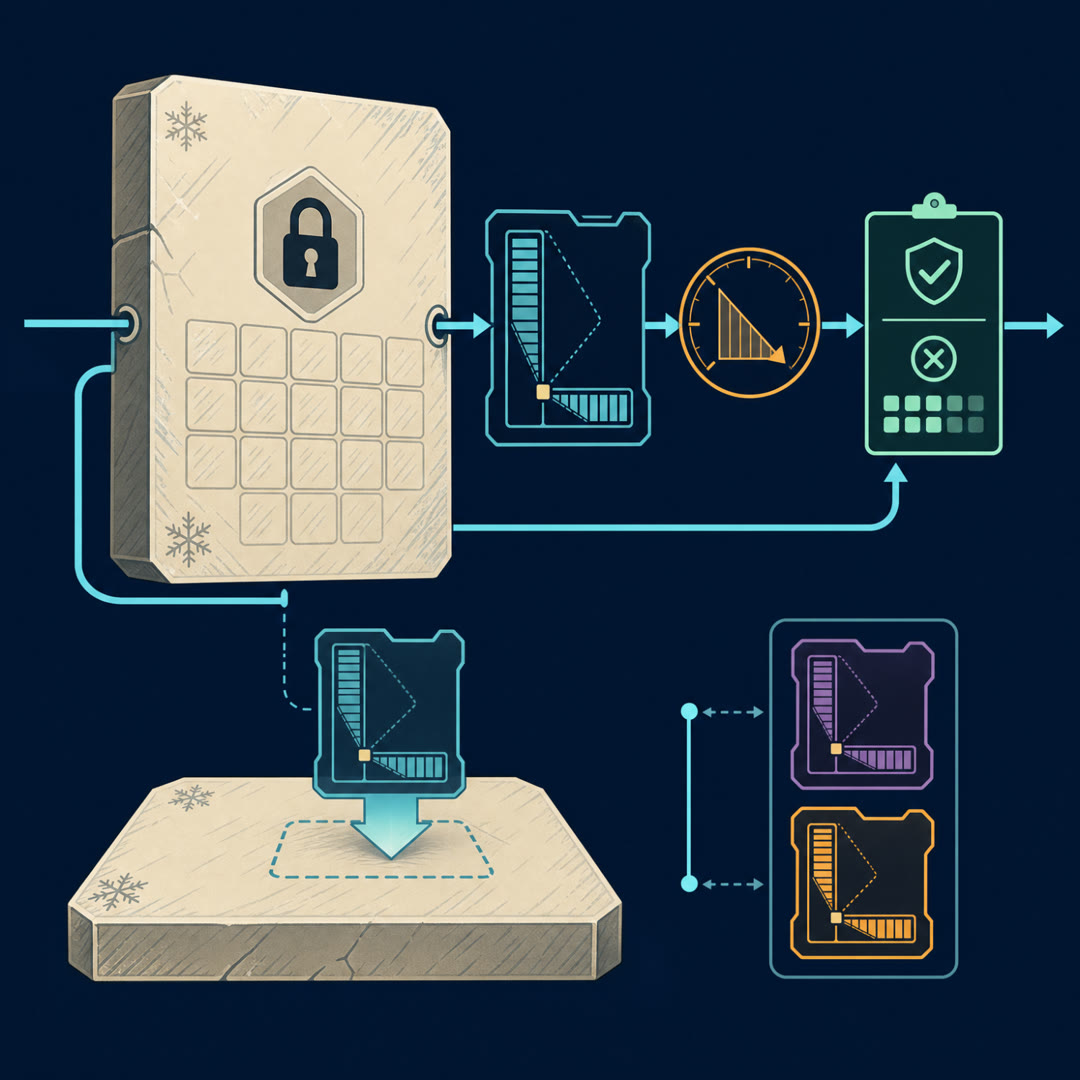
MayaA photo editor gets a commission: take a finished photograph and change its mood — warmer, moodier, more clinical, whatever the client wants. She doesn't repaint sixteen million pixels. She adds an adjustment layer: a thin sheet of instructions that sits over the untouched image and recolors everything on its way out.
LeoMm — and the original file never changes.
MayaNever. The layer is tiny next to the photo. She can keep a different layer for every client. And when she's done — this is the part to hold onto — she can flatten the layer into the image and hand over one ordinary file, no trace of the trick left inside.
LeoThat flatten step is doing a lot of foreshadowing.
MayaIt's the whole episode. The photograph is a pretrained language model. The adjustment layer is LoRA.
LeoQuick footing from last time: we mapped Topic Four — specialization as a budget problem, fine-tuning shifting behavior more than knowledge, and the bet that the change a task needs is small compared to the model carrying it. Today is the paper that turned that bet into a working method: LoRA — Low-Rank Adaptation of Large Language Models.
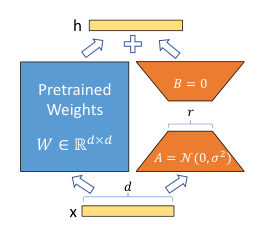
MayaSo, the mechanism. Inside a Transformer, a linear layer is a big weight matrix — call it W. Full fine-tuning moves W itself. LoRA's first move is a refusal: W stays frozen, every entry exactly where pretraining left it. All the learning goes into an update that rides alongside — delta-W, the change.
LeoExcept an unconstrained delta-W is exactly as big as W. You haven't shrunk anything, you've renamed it.
MayaIf you learned it directly, sure. So you don't. {pause=0.8} You force the update to be the product of two thin matrices — the paper calls them B and A. The layer now computes W times the input, plus B times A times the input. A squeezes the input down into a narrow bottleneck — that width is the rank — and B expands it back out.
LeoHow thin is thin? Put a number on it.
MayaTake a square matrix four thousand ninety-six on each side. The full grid of changes is over sixteen million numbers. A rank-eight LoRA replaces it with one strip going from four thousand ninety-six down to eight, and a second strip from eight back up. Around sixty-five thousand trainable numbers.
LeoSixty-five thousand standing in for sixteen million. That's not an optimization, that's a different category of object.
MayaAnd the saving repeats at every matrix you attach it to. The paper reports dramatic cuts in trainable parameters and training memory — while matching, sometimes beating, full fine-tuning across their experiments.
LeoThere's also a volume control in there, right? The update gets scaled by alpha over the rank.
MayaSo you end up with two dials. Rank is capacity — how much room the change has. Alpha is volume — how loudly the adapter plays against the frozen base.
LeoWhere do the strips actually go, though? "Every matrix" sounds like a memory bill of its own.
MayaIt would be. In practice you attach them selectively — most often to attention projections, the matrices that build queries and values. Every attachment costs training memory and storage, so the craft is choosing the spots where a small change buys the biggest behavioral shift.
LeoAnd practitioners genuinely split on this, so let's have it out. I'll hold the lean side: query and value projections are enough. That's the configuration the paper itself leaned on, the scores came back level with full fine-tuning, and every extra module you wire up is memory you pay on every single experiment.
MayaThen I'm taking coverage. The moment the job is more than restyling — instruction-following, domain reasoning, behavior that has to change deep in the stack — a thin patch in two places can be too weak. More modules means more places the update can act.
LeoShow me the failure first. If attention-only holds the score on your task, the broader wiring is superstition with a storage bill.
MayaWhen the lean setup passes, take the lean setup — I'll concede the default. But when it plateaus, the fix is usually more coverage or more rank before it's more data. The real disagreement is about where your task sits on that curve.
LeoStart lean, escalate on evidence. I can sign that.
MayaNow the flatten step, because it's the one that separated LoRA from the adapter methods that came before it.
LeoGo on.
MayaAfter training, the update is just an additive matrix. W plus B-times-A is — one matrix. Do that addition once, and you deploy a single ordinary model. No adapter machinery at inference, no extra computation on the serving path.
LeoWhich is the quiet dig at earlier adapter designs — bolt-on layers that ride along at serving time and charge latency on every call. LoRA's runtime overhead can be merged down to zero.
MayaOr you don't merge — and that's a genuine fork, not a footnote. Keep the adapter separate, and one frozen base can serve many specializations: load this team's strip, swap in that customer's, route between them on the same shared weights.
LeoThe hospital from the overview makes this concrete. The discharge-note summarizer — the base model already knows the medicine; what it needs is this hospital's format, its exclusions, its rule that a missing dose stays missing instead of getting guessed. Train that as one adapter, and cardiology can carry a different one from pediatrics, all on a single base model in a single set of memory.
MayaAnd if the hospital only ever needs the one specialization, merge it and run the simplest possible artifact. The method doesn't force the choice — the serving constraints do.
LeoStep back to the suspicious part, though. Why should sixteen million numbers of change compress into sixty-five thousand without losing the part that mattered?
MayaThe paper leans on a real observation: adaptation seems to have low intrinsic dimension. Plain version — the model already contains most of what the task needs, so the worthwhile change lies along a few directions, not all of them.
LeoHm. Okay.
MayaAn experienced chef joining a new restaurant doesn't relearn knife work. They learn the house menu, the plating, the kitchen's rules. Days, not years — because the skill was already there.
LeoIt's still an empirical bet, not a theorem. But the evidence is the results table: tiny trainable footprint, full-tune-level scores, across model sizes up to the very large ones.
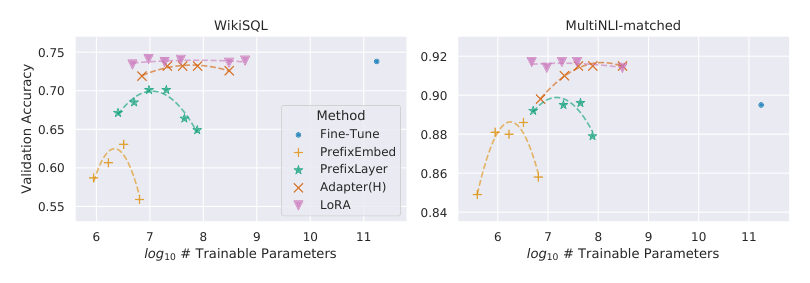
MayaMatching was the headline. Occasionally beating — that was the eyebrow-raiser.
LeoWhich brings me to the part I actually care about: where does it break?
MayaStart with what it eats. LoRA trains on whatever you feed it — noisy, contradictory, narrow examples produce a noisy, contradictory, narrow adapter. Efficiently.
Leo[chuckle] A faster way to learn the wrong thing. And that capacity dial we set up earlier — rank has to cut both ways too, right? Too thin and the change can't fit?
MayaIt underfits, yes. And too wide hands back the efficiency you came for, and possibly starts overfitting. There's no universal right answer; it's tuned per task.
LeoThen there's the one I'd put on a poster — frozen storage is not frozen behavior.
MayaThat distinction matters enough to slow down for. The base file on disk never changed. But the thing answering questions is base-plus-adapter, and that combination can get worse at things the base did perfectly well.
LeoSo the hospital runs its regression checks against the combined model, not the base. The adapter that nails discharge formatting can be the same adapter that quietly nudges refusal behavior or factuality somewhere nobody was watching. Freezing W is a rollback guarantee, not a safety guarantee.
MayaAnd the pitfall teams find the hard way once they're past all of that: stacking. One adapter for domain, one for tone, one for safety, one per customer — composing them is tempting, and the interactions get messy.
LeoFour steering wheels, one car.
MayaSometimes it drives fine. Sometimes the signals fight. There are composition methods, but none of them excuse you from evaluating the combination you actually ship.
LeoOkay — the argument I promised myself we'd have. LoRA made customization cheap, modular, reversible. And cheap invites a reflex: see a quality gap, train an adapter. I think that reflex is doing damage.
MayaThat's a strong swing at the method we've spent the whole episode taking apart admiringly. Make the case.
LeoBecause most quality gaps I get called about are not adaptation gaps. They're a prompt nobody iterated, retrieval serving stale documents, a training set full of contradictions, an evaluation that doesn't exist. Fine-tune on top of that and you don't fix the system — you bake the mess into weights and hide it behind a metric that went up.
MayaThe same cheapness is the defense, though. An adapter is the cheapest experiment in the building — an afternoon and a rollback. And when full fine-tuning was the only road, only well-funded teams could specialize at all. LoRA lowered the barrier—
Leo—and the barrier was load-bearing! When adapting cost real money, somebody senior asked whether the data was clean before anyone pressed train.
Maya[chuckle] The invoice as a quality gate. Fine — the misuse is real, I'll give you that. LoRA is easy enough to misuse, and "we fine-tuned it" has become a way to sound rigorous without being rigorous. But that verdict lands on the team, not the tool.
LeoAgreed on where it lands. So here's the resolution I can sign: LoRA as the default tool, not the default first move. Clean data, working retrieval, an evaluation you trust — then the adapter is exactly the right cheap experiment, and you should run a lot of them.
MayaAnd "run a lot of them" is its own revolution — it gets lost under the cost story. With full fine-tuning, every run feels like a commitment.
LeoRight.
MayaWith adapters, you try four ranks, three data mixes, two target-module sets, and throw away what loses. The base model stays the shared reference point underneath all of it.
LeoIt turned specialization into something like software practice. Small artifacts, diffs against a base, cheap rollback. People publish adapters instead of whole models; two teammates tune two different tasks without ever colliding on the same giant copy.
MayaVersion control for behavior. That cultural shift is a big reason the paper's influence outran its benchmarks.
LeoBefore we close the loop — when would you not reach for it, even with clean data and a real eval?
MayaWhen the shift is bigger than a steer. A genuinely new language, a deep domain leap, tokenizer behavior that has to change, a large mass of new knowledge to absorb — that's continued pretraining or full fine-tuning territory. And if the gap is fresh facts, don't move weights at all. Retrieve. Adapters teach a model how to behave; they're a poor mechanism for keeping it informed.
LeoAnd there's the cost LoRA never touched: the frozen base itself. Sixty-five thousand trainable numbers is lovely, but the whole model still has to sit in memory underneath them. That bill didn't move an inch.
MayaWhich is exactly the bill the next episode takes on. It's called QLoRA, and we'll let it make its own case then.
LeoLoRA said train fewer weights. Next time, the question turns to the weights you're not training.
MayaSo carry this one out the door: for the task you'd most want a model adapted to, how much of the change is genuinely new capability — and how much is just steering something the model already knows?
Back to Mastering Language Models: From Architecture to Optimization