Subscribe
Show notes
Topic 4 opens with the move that defines modern model specialization: freeze the giant base model and train a tiny low-rank update beside it. Maya and Leo map the topic's landmarks — the Rank Knob, the Precision Floor, the What-Got-Worse Test, and the Long Haul — and stage the field's real arguments: PEFT-everywhere versus full fine-tuning's capacity case, and how many bits the frozen base can lose before quality quietly collapses. A hospital discharge-note summarizer anchors the whole topic, setting up deep dives on LoRA, QLoRA, LowRA, and continual learning.
Transcript
MayaTwo teams, same week, same assignment: take the same giant open model and teach it to speak their company's language. Team one rents a cluster and retrains the whole thing — every weight in the network moves.
LeoI've seen that invoice. [chuckle] It has a lot of digits.
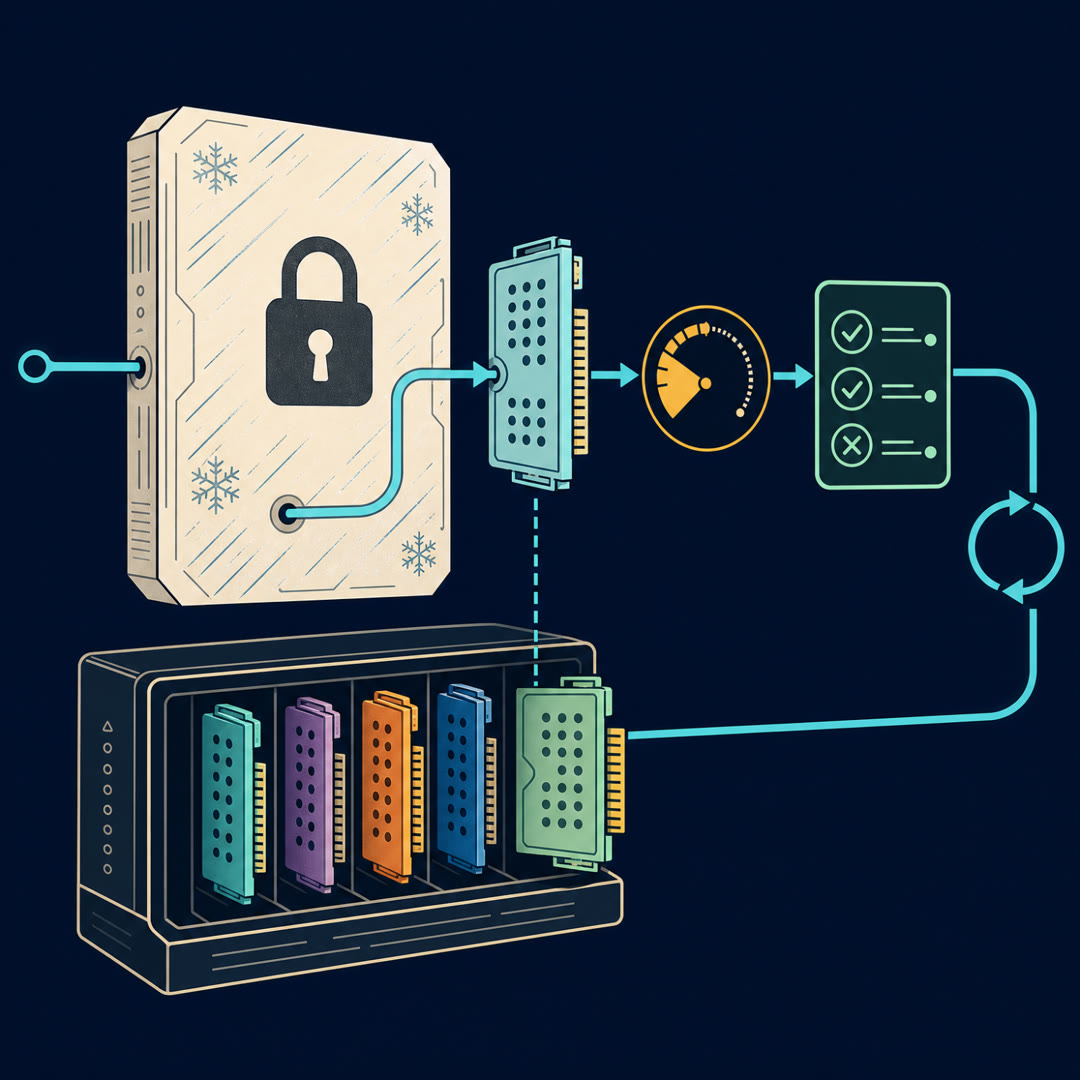
MayaTeam two freezes the model solid. Not one original weight changes. They train two skinny matrices that ride alongside the frozen weights — and when they're done, the entire customization fits in a file you could carry on a thumb drive.
LeoAnd the part that makes this topic exist: on a long list of tasks, the thumb-drive team does just as well.
MayaFreeze the giant, train a sliver. That move is Topic 4.
LeoBearings first, though. Topic 3 was the construction site — pipelines, sharded optimizer state, kernels that stop hauling data across the chip — all in service of getting a huge model trained at all.
MayaAnd this topic is the morning after. The model exists. Someone already paid that bill. Now a company walks in asking — can it handle our support tickets, our legal forms, our medical vocabulary, our tone?
LeoThe old answer was "sure, retrain a copy." Which sounds fine until every customer becomes a separate warehouse full of weights.
MayaSo the question changes shape: how do we make this model good at this job, under this budget, without paying the original bill twice?
LeoOkay. Before any methods — what is fine-tuning actually doing? The casual version is "teaching the model new facts," and I don't think that survives contact.
MayaIt mostly doesn't. The mental model this topic opens with: fine-tuning changes behavior more than knowledge. Format. Tone. Whether the output lands in your schema or wanders off.
LeoBehavior, not trivia.
MayaHere's the example we'll carry through every episode this topic. A hospital wants a model that summarizes discharge notes. The base model already knows the medicine — it read more medical text in pretraining than any resident ever will. What it doesn't know is this hospital's format. This team's tone. What to leave out. What must never be invented.
LeoSo the gap isn't a knowledge gap. It's a habits gap.
MayaWhich sets up the idea the whole topic stands on. {pause=0.8} The change you need can be tiny compared to the model.
LeoThat's where I push, because it sounds suspiciously convenient. Billions of weights, and the useful update is... small?
MayaSmall in a specific sense — it moves the model along a few directions, not all of them. You're not rewriting the grammar, reasoning patterns, and world knowledge the base already carries. You're steering it. And a steer is a low-dimensional thing.
LeoGive me the mechanism, not the poetry.
MayaThe full update to one weight matrix would itself be a giant matrix — the same enormous size. LoRA — Low-Rank Adaptation — says: don't learn that giant grid of changes. Learn two thin matrices whose product stands in for it. The original weights stay frozen; the thin pair carries the entire change.
LeoAnd "rank" is the thinness. Low rank, few trainable numbers, light memory. Higher rank, more room for the task to express itself.
MayaThat dial is our first landmark — the Rank Knob. And the family of methods built this way has a name: parameter-efficient fine-tuning. PEFT, said like a word.
LeoWhich brings us to the field's first real argument, and I want my side on the record: use PEFT whenever you possibly can. One base model, fifty customers — fifty small adapter files instead of fifty full copies. Roll a bad adapter back without touching the foundation. Operationally, it is not even close.
MayaThen I'll take the other camp — their point is capacity. Freeze the base and you have bounded what can move. If the behavior you need sits far from the base model's distribution — a new language, deep domain behavior, safety-critical decision rules — a thin adapter may simply not have the room.
LeoMay not. On a huge range of practical tasks, the low-rank path matches full fine-tuning. That's the published result, not the brochure.
MayaNear the base distribution — agreed, and I'll concede the operational story. The adapter shelf beats the warehouse district. But push the model somewhere genuinely new, and the frozen base becomes the bottleneck. Steering doesn't help when the road you need doesn't exist yet.
LeoFine — the capacity point survives. When the required change is broad, freezing the base can strangle it. So the honest version of this debate isn't "LoRA good, full fine-tuning bad."
MayaIt's: how much of the model needs to move? A small behavioral steer — adapter. A wholesale shift — more of the model moves, and you pay for it.
LeoResolved, and cheaply for once. [chuckle]
MayaNext landmark, then — the Precision Floor. Because LoRA shrank the trainable part, but the frozen base still has to sit in memory, in full, just to be steered.
LeoWhich is the bill QLoRA goes after. Store the frozen base in four-bit quantized form — numbers squeezed down to low precision — train LoRA adapters straight through it, and the memory bill drops dramatically.
MayaThere's real craft inside — a four-bit format called NormalFloat, double quantization, paged optimizers — and we'll unpack those in the QLoRA episode. The headline: fine-tuning very large models suddenly fits on hardware a small team can actually have.
LeoOur hospital again. Maybe they don't own a cluster. QLoRA is how they fine-tune a bigger base model than they had any right to, on the machines they've already got.
MayaAnd then a paper called LowRA asks the floor question: if four bits worked, can LoRA-style fine-tuning survive under two?
Leo[chuckle] One letter from LoRA, by the way. This field names things maliciously.
MayaWait until Topic 5's acronyms. But under two bits, this stops being "round the numbers harder." You need careful mapping, threshold choices, deciding which parts of the model deserve the few high-precision slots, and fast kernels — or the math gets cheap while the model quietly collapses.
LeoHere's the other split worth staging, then — how hard to squeeze. I'll take the wary side this time: precision is not free. Compression introduces subtle errors, and a benchmark average can hide failures piling up in the long tail. If the domain is high-stakes, a two-bit setup is the wrong place to save money.
MayaAnd I'll argue the squeeze, because memory is the gate everyone actually hits. Every bit you shave moves fine-tuning from the data center onto smaller devices and smaller budgets. That's not a convenience — that's who gets to participate.
LeoParticipate in what, though? A clinic that fine-tunes on a cheap box and ships subtle long-tail errors into discharge summaries didn't get included — it got exposed.
MayaThen the floor isn't a constant — that's the concession that matters. It depends on the evaluation. Squeeze hard for a brainstorming assistant; hold precision where the stakes are high.
LeoWhich lands on the rule I'd frame on the wall: the question is never "what's the smallest adapter." It's "what's the smallest setup that still passes the evaluation that matters."
MayaFramed and hung.
LeoUnderneath both arguments sits a quieter accounting — maybe the topic's real spine. Specialization is a budgeted intervention. Every choice trades quality, memory, training cost, inference cost, deployment complexity —
Maya— and the risk of forgetting. The line item nobody prices until it bites.
LeoWhich is why the rule needs its test. Call this landmark the What-Got-Worse Test. Fine-tuning is easy to celebrate when the target metric climbs. The underrated measurement is everything else.
MayaBecause a fine-tuned model can get charmingly good at the demo and quietly worse everywhere around it. Format reliability, safety behavior, refusals, factuality, the domain's own edge cases.
LeoThe serious teams keep a regression suite, not just a target-task score. The score tells you what you bought. The suite tells you what you sold.
MayaAnd the deepest version of "what got worse" has a name: catastrophic forgetting — training on the new domain pulls the model away from things it used to do well. It's an old problem in machine learning, but with language models it turns strange, because "old knowledge" isn't a checklist you can inventory.
LeoMeaning it doesn't fail like a hard drive losing files. It fails like... what?
MayaIt fails like— okay, here's the better frame: a personality shift. The model might keep its grammar and lose its calibration. Keep broad chat ability but turn narrow and rigid. Learn new policies that interfere with old tasks in ways nobody listed in advance.
LeoThat's unsettling.
MayaIt's why the topic ends on the Long Haul — continual learning. Not one adaptation, but a life of adaptations. Can a model keep absorbing a changing world without erasing the useful past? The survey we close with maps that landscape — continual pretraining, domain-adaptive pretraining, continual fine-tuning.
LeoThe hospital, one more time. Medical guidelines change; next year's discharge standards aren't this year's. A one-shot fine-tune ages; the question becomes whether you can update again and again without breaking what worked.
MayaNotice what the example keeps whispering, too: maybe not everything belongs in the weights at all. If the summarizer needs the hospital's current policy, that's a retrieval problem — retrieval-augmented generation, RAG — not a fine-tuning problem.
LeoWhich opens the last split — and this time I'm standing inside it. I'd run a specialist per task. That summarizer — stable job, high volume, same format every discharge — a tuned model is more reliable there, and cheaper at inference. My whole case.
MayaThen I'll take the generalist desk: one model, retrieval, tools. No zoo of adapters to maintain, and when the knowledge changes you swap a document, not a training run. You said it yourself — next year's discharge standards aren't this year's —
Leo— and your generalist just re-reads the new policy. Fine, that point's yours: knowledge that changes daily belongs outside the weights. But format, tone, the never-invent discipline — stable behavior at volume — there the adapter stays more reliable and cheaper per call. Retrieval doesn't buy you that.
MayaGranted — for stable behavior, your specialist holds. So the resolution is an inventory, not a winner. Stable, high-volume task — a tuned adapter is excellent. Knowledge that changes daily — retrieval. Privacy that demands local deployment — quantized PEFT gets very attractive. High safety risk — conservative training and heavier evaluation.
LeoSo Topic 4 isn't a method catalog. It's a decision framework wearing one.
MayaWorking vocabulary before the map — short and plain. Fine-tuning means continuing to train a pretrained model on task-specific data so its behavior shifts toward the job.
LeoParameter-efficient fine-tuning means freezing most or all of the base model and training only a small added set of parameters.
MayaLoRA means representing the weight update as the product of two thin matrices instead of one giant one.
LeoRank means how thin those matrices are — fewer dimensions, fewer trainable numbers, less expressive room.
MayaQuantization means storing numbers at lower precision — fewer bits each — trading exactness for memory.
LeoCatastrophic forgetting means losing previously learned ability while training on something new.
MayaAnd continual learning means updating a model repeatedly over time while protecting what it already does well.
LeoSo, the map. LoRA first — the clean idea that a low-rank update can steer a giant frozen model. Then QLoRA, which compresses the frozen base to four bits and trains through it. Then LowRA, pushing the precision floor toward two. And finally the continual-learning survey.
MayaMy one-liner for the walk home: pretraining builds the general machine. Fine-tuning decides what job that machine is ready to do tomorrow morning.
LeoThen here's the question to carry out. In your own system — what deserves to be burned into the weights, what should live in a removable adapter, and what should stay outside the model entirely?
Back to Mastering Language Models: From Architecture to Optimization