Subscribe
Show notes
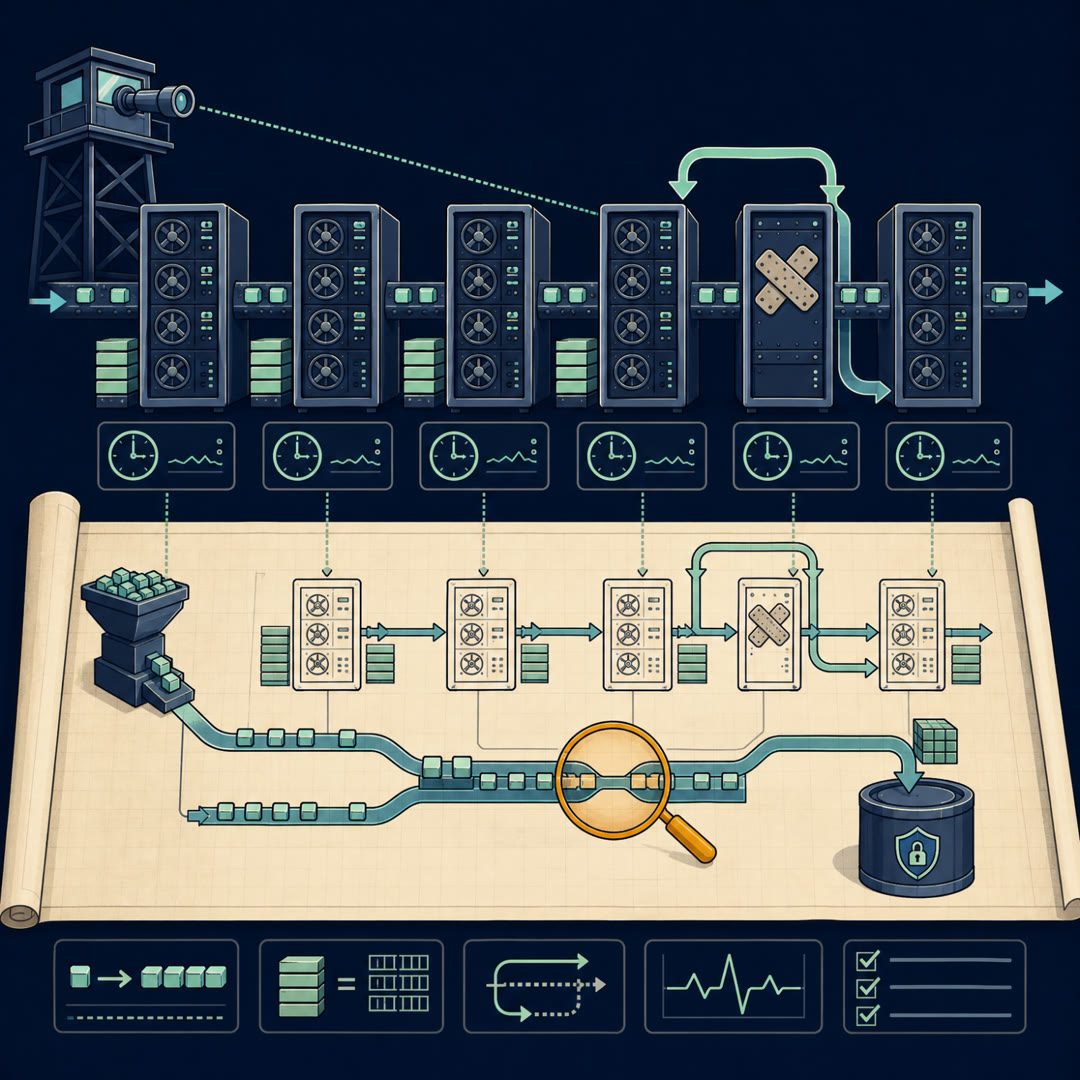
Episode five of Topic 3 steps back from single techniques to the whole system. Maya and Leo open at a container port at dawn — the cranes are the postcard, but the slowest gate decides when the ship leaves — and use a 2025 ACM survey to define a training architecture as a distributed system with machine-learning math inside it. They walk six harbor-named stops where real runs get caught: the Channels (topology), the Berth Plan (scheduling and placement), the Feeder Road (data supply), the Logbook Window (checkpointing), the Watchtower (monitoring), and the Recovery Drill (fault tolerance). A staged argument over model-first versus cluster-first design resolves into an ordering rather than a winner, and the close lands on the diagnostic habit: averages hide too much — the shape of the stalls tells you what the system is really doing.
Transcript
MayaStand at a container port at six in the morning and watch the cranes. Enormous, fast, the whole postcard. And almost never the reason a ship leaves late.
LeoThen what is?
MayaA truck lane that backed up overnight. A yard with no stacking space left. A berth schedule that parked two giant vessels side by side. Customs holding one manifest. The cranes hang there, world-class, waiting. A port doesn't move at the speed of its cranes — it moves at the speed of its slowest gate.
LeoAnd for five episodes straight, this topic has been upgrading cranes.
MayaFaster cranes, cleverer cranes, cranes that share one lift across four arms. Today we finally talk about the port.
LeoWhich is the honest next step, because last time we watched sharding become ordinary — F-S-D-P turned ZeRO's idea into a tool a team switches on before lunch, and the real work moved into tuning its boundaries. Today's source backs away from any single tool. It's a twenty-twenty-five survey published through the A-C-M — the Association for Computing Machinery — on distributed training architecture for large-scale models in natural language processing.
MayaAnd "architecture" is the load-bearing word in that title. A single scaling technique is a good engine part. An architecture is the whole race car, plus the pit crew, plus the track conditions.
LeoSo define it before we admire it. When this survey says training architecture, what's actually inside the box?
MayaHere's the sentence I want stapled to the whole episode. A large-model training run is a distributed system with machine-learning math inside it. Compute, memory, network, storage, failures, monitoring, scheduling — all entangled, and every one of them capable of being the slow part.
LeoWhich quietly rewrites the question. It's no longer just "can we compute this?" It's "can we store it, move it, and synchronize it before the GPUs go idle?"
MayaAnd the paper is blunt about the stakes. At the scale of modern language models, efficient distributed learning isn't a nice optimization anymore — it's the entry fee.
LeoFits versus doesn't fit.
MayaFits versus doesn't fit, stalls versus keeps flowing, paper speed versus wall-clock speed. Those are the boundaries an architecture has to carry a run across.
LeoFine, but we've already done pipeline cuts, tensor cuts, sharded states. What does zooming out actually add — beyond a tidier diagram with more boxes?
MayaThe composition problem. The survey's sharpest claim is that the hard part is not choosing the one best parallelism method. It's composing methods — data parallelism here, model parallelism there, communication patterns, hardware topology, checkpointing, data loading, fault recovery — so the slowest bottleneck doesn't run the entire show.
LeoThe port again. One slow gate prices the whole harbor.
MayaAnd most of those gates never appear on the whiteboard.
LeoThen let's go find them. Bring back the team we've followed all topic — hundred-billion-parameter model, sixty-four GPUs, a budget that bleeds with every idle second. They've applied everything the last four episodes taught them. Where does the architecture view catch them off guard?
MayaMore places than they'd guess. Walk the docks with me — I'll give each gate a harbor name so it sticks. Start at the water itself: the Channels. The wiring. GPUs inside one node talk over very fast links; GPUs across racks talk slower. A good layout keeps the chattiest communication inside the fastest neighborhood and sends only the patient traffic across the slow water.
LeoWhich is why two clusters with the same GPU count can behave like different machines. The count is the headline. The interconnect is the story underneath.
MayaThe topology shapes the algorithm — not the other way around. And even perfect wiring doesn't decide who docks where. Somebody assigns jobs to hardware — that's the Berth Plan. A tightly synchronized job needs placement guarantees — parallel groups landing on neighboring machines. If the scheduler scatters it across the port—
Leo—the algorithm pays the scatter fee on every step. Forever.
MayaAnd say the placement lands perfectly — the cranes still need something to lift. That's the Feeder Road: tokenization, streaming, shuffling, preprocessing. If the data pipeline can't feed the accelerators fast enough, the most sophisticated parallelism strategy ever built just idles, waiting on input.
LeoStarving, politely.
MayaThen there's the sneaky one — the Logbook Window. Checkpointing. Saving model state is non-negotiable, but writing a checkpoint for a model this size is a serious storage event. A run that looks compute-bound during normal steps can turn storage-bound every time it saves.
LeoHuh. So the job has a heartbeat. Smooth, smooth, smooth — then a stall, on schedule, at every save.
MayaAnd you'd only catch that heartbeat if someone's actually watching — which is the Watchtower. Monitoring. Without traces, a team sees one number: final throughput. With traces, they can tell network contention from memory spikes from stragglers from slow checkpoint windows from input starvation.
LeoAnd when the watchtower spots a node that's just... gone?
MayaThat's the last gate — the Recovery Drill. At small scale, a crash is an interruption — you groan, you restart. On a run that lasts weeks, failures stop being accidents and become scheduled guests. The architecture needs recovery paths, degraded-node plans, restart logic. Not just a happy-path training loop.
Leo[sigh] That one I've lived. So distributed training is secretly a reliability discipline wearing a machine-learning costume.
MayaThat's most of the survey's argument in one sentence.
LeoHere's where I push, because the survey hands us the parts list but won't make this call for us. When you design one of these systems, do you start from the model, or from the cluster? My instinct says cluster-first, every time. The interconnect, the failure rate, the memory per device, the scheduler's moods: those decide what's actually efficient. Design for an idealized model and the cluster will re-educate you.
MayaThen let me steelman the other instinct, because it isn't naive. Model-first design gives you cleaner algorithms. You reason from the mathematics — the dependencies, the natural cut points — and what you get is general, analyzable, portable. Start from one cluster's quirks and you've built a beautiful machine that only runs in one building.
LeoPortable to where? The cluster you actually have is the only one that bills you! A clean algorithm that ignores its own wiring is clean on paper and idle in production.
MayaFine — the cluster holds veto power. I concede that completely. But notice the concession doesn't run the other way. The cluster cannot tell you where the model's seams are. Cluster-first with no model thinking gives you hardware-shaped mush.
LeoSo the honest resolution isn't a winner — it's an ordering. Reason from the model to generate your options. Let the cluster eliminate most of them. And keep the survey's own caveat attached: the balance shifts with model shape, sequence length, topology, the training objective, and how much engineering time the team actually has.
MayaWhich is a real resolution, not a shrug. You and I disagree about where design *starts*. We agree completely about where it gets *tested*.
LeoThen let me spend my remaining skepticism on the survey itself. These taxonomies — the tidy boxes, data parallel, model parallel, hybrid — they're drawn in still air. Real systems have jitter, stragglers, dataloader stalls, checkpoint delays, kernel launch overhead, nodes that die at two in the morning. Does the clean picture survive contact?
MayaNot unchanged — and the survey half-admits that, because it keeps fault recovery and monitoring *inside* the definition of architecture instead of exiling them to footnotes. The boxes tell you what's possible. The mess tells you what it costs.
LeoA menu, then. Not a promise.
MayaAnd the mess is measurable — that's the redeeming part. Run the practical version: our sixty-four-GPU team's throughput drops ten percent on a Wednesday. What do you pull up first?
LeoUtilization over time — never the average. Communication traces. Dataloader stalls. Memory peaks. Checkpoint timing. Averages hide too much; the *shape* of the stalls tells you what the system is really doing.
MayaA flat dip every fifteen minutes is a very different suspect than a ragged sawtooth on one node.
LeoCompletely different arrest.
MayaAnd that's the diagnostic habit this whole topic keeps preaching, one more time: don't memorize the technique first. Find the bottleneck first.
LeoOne layer we haven't said out loud, though — the survey folds it in, and most diagrams skip it.
MayaThe people. Researchers need experiment tracking. Infrastructure teams need alerts. Data teams need lineage. Security may need access controls. Past a certain scale, the training run stops being a script someone launches and becomes an organizational system.
LeoBecause someone has to know whether a throughput drop is a model change, a network issue, a data issue, or a dying node — and "someone" means dashboards, on-call rotations, ownership. Production-scale training is operations.
MayaWhich is also why reproducibility gets hard in a way that surprises people. Re-run the same recipe months later and you may be on new drivers, new kernels, different node placement, a changed dataset, a different pattern of failures—
Leo—so "the same experiment" quietly isn't. [chuckle] The recipe survived; the kitchen got remodeled.
MayaSo part of what a mature architecture buys is fewer surprises — stable ways to launch, observe, recover, and compare runs across months.
LeoTwo reviewer's habits before we close, then. If a team brings you a distributed architecture, don't ask whether the method sounds modern — ask whether the measurements show the right problem being solved. And compare against the simplest tuned baseline. If the sophisticated method beats a weak baseline but loses to a well-tuned simple setup, the story isn't finished.
MayaAnd my favorite stress test of the whole stack: can the team explain a slowdown from traces instead of guessing? That single question separates an architecture from a pile of techniques.
LeoIt also says why any of this matters beyond bragging rights. Some methods train one model faster. An architecture changes which experiments a team can afford to run at all — and those experiments shape the models everyone else inherits.
MayaThe survey is linked in the episode notes. It's the kind of source where the diagrams and implementation notes pay off on a second read.
LeoNext time, we swing the telescope the other way. From the whole port down into a single crane's gearbox — inside one GPU, where attention reads and writes memory, and a paper called FlashAttention argues the real cost was never the math.
MayaSo here's what to carry off the docks. The model is the headline; the system underneath sets the speed. The next time someone hands you a training-speed claim, which hidden part of the system — the wiring, the scheduler, the data feed, the checkpoint path, or the recovery plan — would you inspect first before you believed it?
Back to Mastering Language Models: From Architecture to Optimization