Subscribe
Transcript
MayaLast episode looked at Aider's edit-and-repair lens: make the change, read feedback, and improve the attempt.
LeoToday GitHub Copilot's cloud-agent documentation turns that loop into a product workflow, from assigned task to reviewable work.
MayaA developer assigns a task to a cloud agent, goes back to other work, and later receives a branch, logs, a diff, and a pull request ready for review.
LeoThat feels less like autocomplete and more like a workflow.
MayaExactly. This is the product version of the agentic loop.
LeoPlain language: a cloud coding agent turns a software task into an observable work session that can hand back changes through normal development channels.
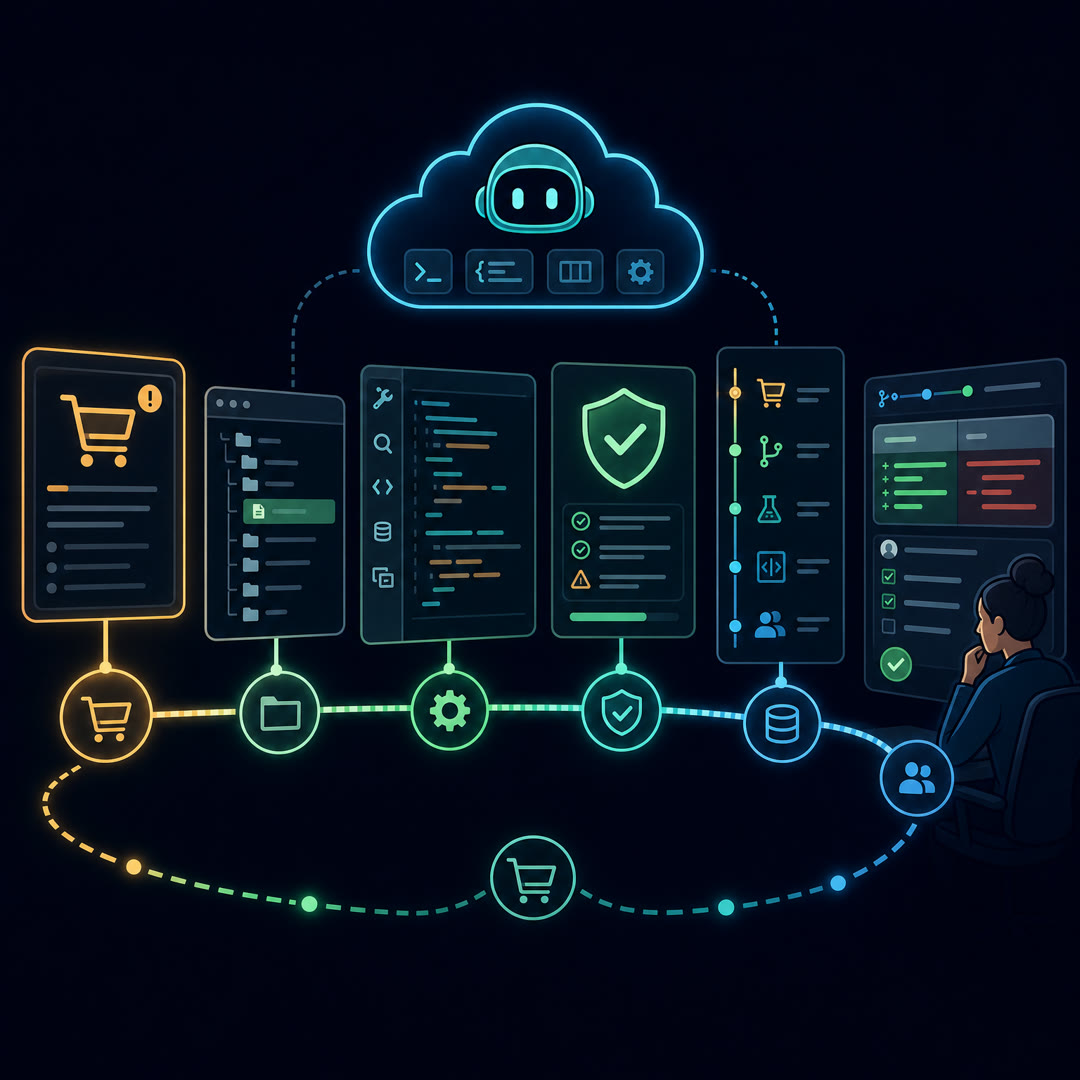
MayaRight. The first landmark is the Assignment Gate.
LeoThat is how the task enters the system?
MayaYes. A task might come from an issue, a pull request discussion, or a direct instruction. The agent needs enough intent to start, but the task still may be ambiguous. In the express-checkout bug, the assignment might describe the symptom and expected behavior, not the implementation location.
LeoThe gate matters because a vague task creates a vague run.
MayaExactly. The second landmark is the Branch Workspace. Product-style agents typically need an isolated place to work. They should not mutate the main branch directly. They create or use a workspace, inspect code, make changes, and prepare a branch.
LeoThat gives humans a familiar artifact: a diff.
MayaYes. It also gives the system boundaries. A branch can be reviewed, tested, accepted, rejected, or revised.
LeoThe third landmark is the Log Trail.
MayaGitHub's documentation describes managing and tracking cloud-agent sessions. The important concept for this series is observability. A useful session leaves evidence: what task was assigned, what the agent did, what checks ran, and what state the work reached.
LeoSo a product workflow can generate trajectory-like data even if its first purpose is user trust and control.
MayaExactly. Product logs are not automatically training data, and they may include sensitive code or user context. But they show the kind of trace a real agent workflow can expose.
LeoThe fourth landmark is the Review Handoff.
MayaThis is where agent work re-enters human software practice. The agent's output should be reviewable: a pull request, a summary, test evidence, and enough context for a developer to decide what to do.
LeoIn other words, the end state is not "the agent says it is fixed." The end state is "a human can evaluate the work."
MayaExactly. That is why this episode belongs in Topic 1 even though GitHub Copilot appears again in later agent-systems topics. Here, it shows that agentic coding is a workflow with artifacts.
LeoWhat are the artifacts for the checkout bug?
MayaA task description, searched files, changed validator or schema, tests run, any failures and retries, final branch, pull request diff, and a summary explaining that express checkout now shares the same address validation path as standard checkout.
LeoSo the express-checkout task becomes not only a fix, but a session someone can inspect.
LeoAnd maybe reviewer comments if the human finds an issue.
MayaYes. Those comments become valuable labels if governance allows them to be used.
LeoWhere do experts disagree about cloud-agent workflows?
MayaOne side says asynchronous agents are the natural shape of software work. Their strongest argument is parallelism and handoff: agents can take bounded tasks, work in the background, and return reviewable artifacts.
LeoAnd the other side?
MayaThe cautious side says asynchronous autonomy can hide mistakes until they become diffs someone has to audit. Their strongest argument is accountability: the more independent the agent is, the more important logs, permissions, test evidence, and human review become.
LeoSo cloud agents increase leverage and increase the need for observability.
MayaExactly. They make the trace ledger a product feature, not only a research artifact.
LeoWhat should teams avoid when treating product logs as data?
MayaThey should avoid assuming that every useful trace is safe to train on. Product logs can contain private code, secrets, customer references, proprietary implementation details, and benchmark-like tasks that should remain eval-only. Governance is not a paperwork add-on; it is part of the data product.
LeoThat tees up later topics on data products and reliability.
MayaYes. But for Topic 1, the core lesson is simpler: agentic coding produces reviewable work through an observable session. The task, branch, logs, tests, diff, and review outcome are all part of the capability story.
LeoCompared with the first episode, we have moved from a prompt and code answer to a whole software process.
MayaExactly. The series starts here because every later evaluation or training question depends on seeing that process clearly.
LeoWhat should listeners remember before moving to Topic 2?
MayaA coding agent is not only judged by whether it can write a patch. It is judged by whether it can turn a task into trustworthy, inspectable, reviewable software work.
LeoAnd the best workflows preserve enough evidence for humans and future systems to learn from.
MayaOne final practical test is the reviewer burden test. Did the agent reduce the reviewer's work, or did it move uncertainty into a pull request?
LeoA diff can be technically reviewable and still be exhausting.
MayaExactly. A useful cloud-agent session should make the reviewer faster and more confident. It should explain the task, summarize changed files, report tests honestly, disclose unresolved uncertainty, and keep the patch scoped.
LeoIf the session trail is vague, the reviewer has to reconstruct the whole run.
MayaRight. That is not leverage. That is hidden work. The best product workflows treat human review as part of the system, not as a rubber stamp after the agent is done.
LeoThat also changes the training signal.
MayaYes. A reviewer acceptance, a requested change, an inline comment, or a rejected PR can become a label if handled with proper governance. Review is not only a safety net. It is feedback about whether the agent produced work humans could trust.
LeoSo Topic 1 ends by connecting the work loop to human judgment.
MayaExactly. The agent inspects, edits, tests, and hands off. The human reviews, accepts, modifies, or rejects. The system logs enough to learn. That is agentic coding as a capability pipeline.
LeoAnd Topic 2 asks how to evaluate that pipeline.
MayaRight. We will move from "what is the work?" to "how do we know the work is good?"
LeoThat is the natural next step.
MayaAnd it is worth noticing what changed from the start of Topic 1. We began with a model writing code. We end with a system that accepts assignments, works in a branch, records a session, produces a diff, and asks a human to judge it.
LeoThe unit of capability got larger.
MayaExactly. It now includes task framing, workspace isolation, tool use, verification, audit trail, review, and governance. That is why the final curriculum keeps returning to replayable software work.
LeoThe magic is less important than the record of the work.
MayaRight. Without the record, the team cannot evaluate, improve, or safely reuse what happened. With the record, every agent session can become a lesson, a review object, or a carefully governed data point.
MayaIf a cloud coding agent handed you a pull request tomorrow, what would you need to see in its session trail before you would trust the change enough to merge it?
Source material
← Back to Agentic Coding Capability: From Coding Models to Coding Agents