Subscribe
Transcript
MayaPicture a build meeting at the healthcare scheduling company we've carried through this topic. The alignment team has the whole preference pipeline up on the whiteboard. Reviewers picking between answer cards on the left. A big box in the middle labeled "judge" — the scoring network they're about to spend a month training. And on the right, the reinforcement-learning rig that will chase the judge's scores.
LeoStandard architecture. We've toured it five episodes running.
MayaAnd a new hire walks up with a napkin and says: I did the algebra. The middle box is already inside your model. You can unplug it.
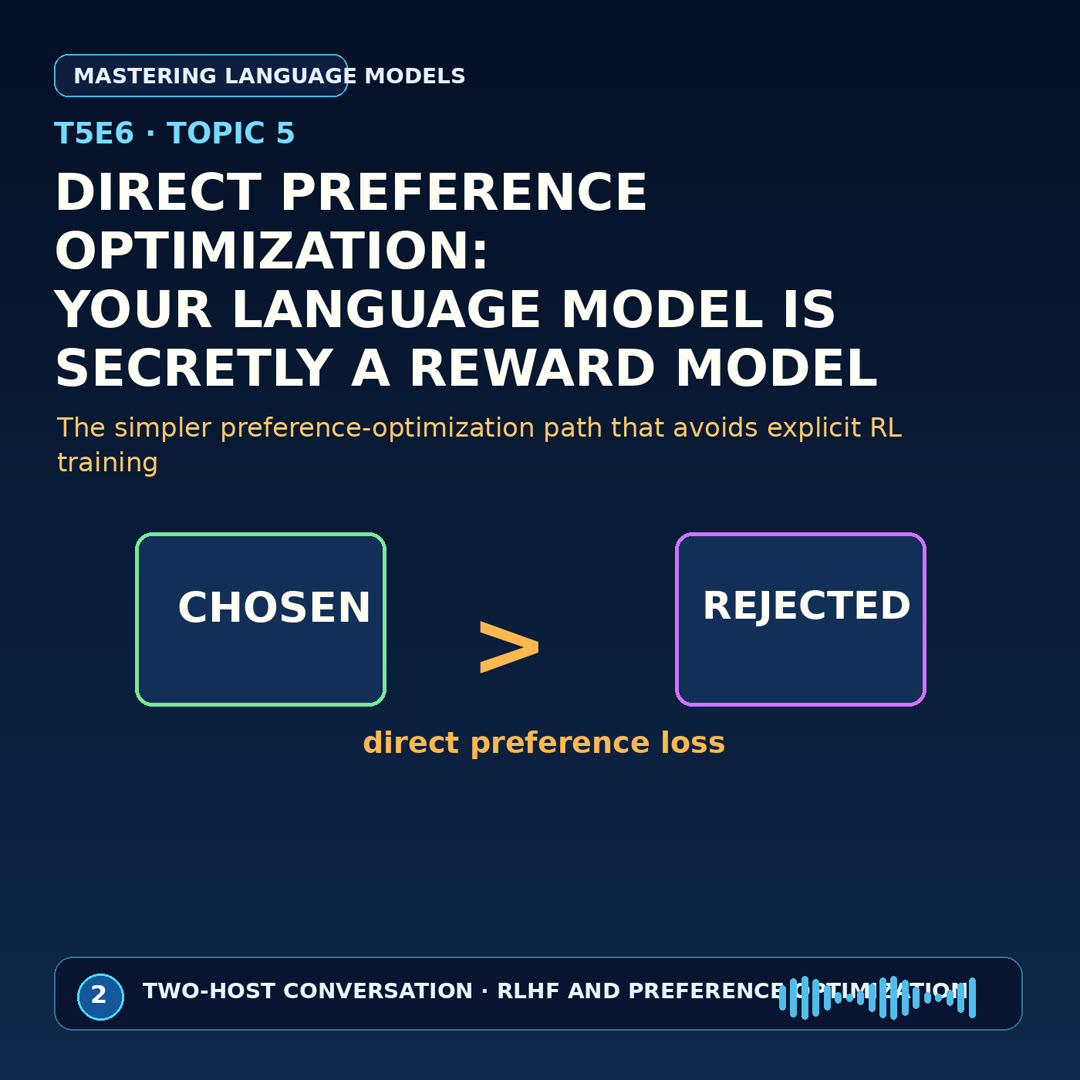
LeoThat napkin is today's paper. Direct Preference Optimization: Your Language Model is Secretly a Reward Model — twenty twenty-three. And the title isn't marketing. It's the literal technical claim.
MayaLast episode, Constitutional AI swapped the human labeler for a written page and an AI judge — but look at what it kept. A learned preference model. A full reinforcement-learning run against it. Same heavy engine, different fuel.
LeoAnd it left us with the impolite question: do you need the engine at all? This paper's answer is no — for a specific slice of the problem — and it shows the math instead of waving at it.
MayaSo before the trick, the weight. The trick only lands if you feel what's being demolished, so the first landmark is the Long Way Around. Classic reinforcement learning from human feedback — R-L-H-F — earns that name honestly. It starts by taking all those reviewer picks and training a separate network, the reward model, to score any answer.
LeoThat's the judge box.
MayaThen it runs reinforcement learning — usually P-P-O, the algorithm from the top of this topic — to push the assistant toward answers the judge scores highly, while a drift penalty keeps it from wandering too far from the supervised model it started as.
LeoWhich is a lot of moving parts when you list them honestly. A second network to train and host. Fresh samples generated all through training. A value function, advantage estimates, clipping — the whole stability toolkit we spent an episode on.
MayaMm-hm.
LeoTeams burned real months getting that loop to converge. So the prize for removing it isn't elegance points. It's weeks of engineering, and a training run that doesn't fall over on a Tuesday.
MayaNow the move itself — and let's ground it first. A patient writes: can I move my Thursday appointment, and should I stop my medication before the procedure? Two candidate replies come back. One reschedules and routes the medication question to a clinician. The other reschedules and casually plays doctor.
LeoA reviewer marks the safer one as better. Same two cards as the whole topic. No grade, no score — just, this one beats that one.
MayaAnd the standard story for what that click means comes from an old statistical recipe — the Bradley-Terry model — which turns head-to-head choices into hidden scores. The bigger one answer's hidden score advantage, the more often it should win the matchup.
LeoSo the judge in RLHF is literally a network fitted to recover those hidden scores from the win-loss record.
MayaThat's the setup. Here's the landmark — the Substitution. The paper asks a question that sounds almost too innocent: what does the finish line of that reinforcement-learning chase look like? And it turns out the best possible policy, for a given reward and a given drift penalty, has a clean closed form — it's the reference model, re-weighted toward high-reward answers.
LeoOkay. A formula for where the chase ends.
MayaNow run it backwards. If every reward has a matching optimal policy, then every policy is the optimal answer for *some* reward. The model learns— okay, here's the cleaner way in. The relationship is a two-way street. You can write the reward purely in terms of the policy and the reference model.
LeoHuh.
MayaSo substitute. Take the Bradley-Terry recipe for fitting a judge to the clicks, and everywhere the reward appears, replace it with its policy expression. The reward variable cancels out of the problem entirely. What's left is a loss on the language model itself: make the chosen answer more likely and the rejected one less likely — measured relative to the reference model — until the margin matches what the preferences imply.
LeoAnd that loss looks like what, in practice?
MayaA classification problem. Every training example asks the model: can you tell which of these two answers won? Gradient descent on that, straight through.
LeoNo sampling loop. No value function. No reinforcement-learning machinery at all.

MayaFrom the outside it looks like ordinary supervised fine-tuning on pairs.
LeoThat's the whole pipeline?
MayaThat's the whole pipeline.
LeoLet me say the part that made me re-read the derivation. Nothing got approximated away. It's the same objective the PPO pipeline was chasing — same preference assumption, same drift penalty. The algebra just walks around the scaffolding instead of through it.
MayaWhich is why the title earns itself, and it's our next landmark — the Secret Scorekeeper. After training, the gap between the tuned model and the reference model *is* a reward model.
LeoThere it is.
MayaRead off how much more likely the tuned model finds an answer than the reference did, and you're reading a score. The judge was never a separate machine. It's a way of reading the model you already have.
LeoRun that on the scheduler. If the reference model already strongly favored the safe reply, the margin barely needs to move — the click carries no news, so the update is small.
MayaAnd if the reference treated safe and risky as a coin flip, the click carries real information, and the update is bigger. The update is sized by surprise, not by repetition. It's not memorizing the winning card — it's adjusting a margin.
LeoThere's one piece of old machinery still standing, though, and I want it named before anyone thinks the demolition was total. The reference model didn't get unplugged.
MayaIt can't be. That's the last landmark — the Mooring. Preference data is narrow. A few thousand clicks about medication boundaries say nothing about the ten thousand other things the model must keep doing.
LeoRight.
MayaSo every move the preferences ask for is priced against where the reference model stood, and one dial sets how stiff that mooring line is.
LeoToo loose?
MayaA handful of comparisons can warp the model into a preference-pleasing caricature. Too stiff, and training barely moves it.
LeoAnd the mooring inherits the reference's flaws. Anchor to a sloppy supervised model and you've preserved sloppy habits with mathematical precision.
Maya[chuckle] Precisely moored to the wrong dock.
LeoNow, results — because a beautiful derivation that loses to PPO would be a footnote. The paper runs three settings: controlled sentiment generation, summarization, and single-turn dialogue. DPO matches or beats the PPO-style baselines across them, while being radically simpler to implement and noticeably more stable to train.

MayaAnd that combination hit a nerve. DPO-style training quickly became a popular default for open-model preference tuning — pairs in, gradient descent out, no reinforcement-learning rig.
LeoAnd this is where I get off the train. Because "matches PPO on those benchmarks" is doing a lot of quiet work in that sentence. The evaluations are single-turn and offline — fixed pairs, generated earlier, judged once.
MayaGo on.
LeoThe reinforcement-learning camp has a real case, and I'll make it. Online sampling grades the model on what *it* actually generates as it improves, not on stale pairs from some earlier model. An explicit reward model is an artifact — you can probe it, audit it, test it for shortcuts before it ever touches your policy. And anything long-horizon — tool use, multi-step consequences — does not arrive in life as tidy pairwise picks.
MayaProbe your explicit judge all you want — and then watch the policy learn to please it anyway. The judge isn't just inspectable, Leo, it's *exploitable*. It's a second learned network whose errors become exactly the target your optimizer aims at. DPO deletes the most game-able component in the pipeline. And "offline pairs" isn't a corner case — it's what most teams actually have. The clicks are sitting in a table. For them the real comparison isn't DPO versus some glorious online loop. It's DPO versus a PPO run their team may never stabilize.
LeoThe stability claim survives — I'll sign that, and the operational claim with it. What I won't sign is "the reward was secretly there all along, so nothing was lost." Something was lost: the ability to look your judge in the eye before you optimize against it. The scorekeeper being secret is the bug, not just the poetry.
MayaThat concession I'll make. There's no standalone reward artifact anymore. You can evaluate the tuned model directly — win rates, behavior probes — but you can't unit-test the judge on its own, because the judge and the policy are now the same weights.
LeoSo here's where the evidence actually lands for me. DPO won the default for the setting it was built for — offline pairs, single responses, a decent reference model. Style, tone, refusal boundaries, helpfulness on our scheduler: strong choice, fewer ways to fail. What it did not win is the argument that explicit rewards and online optimization are obsolete.
MayaThe field agrees with you about it being unsettled, for what it's worth. The method war this paper started runs right through the rest of the topic — the critical-analysis paper two episodes from now re-litigates exactly this ground.
LeoA war with scheduled sequels. [chuckle] Job security.
MayaOne caution before we close the loop, because the simplicity is genuinely seductive. DPO did not simplify the part that decides what your model becomes.
LeoMeaning the data.
MayaIt optimizes preferences — not truth, not medical safety, not policy compliance. If reviewers reliably prefer confident-sounding answers, DPO will manufacture confidence with the same efficiency it manufactures caution.
LeoCleaner pipe, same water.
MayaSo the evaluation duty doesn't shrink an inch. Scenario tests where the right answer is not the likeable answer. Audits for over-refusal. Adversarial prompts hunting for the reviewer shortcuts the margin quietly absorbed.
LeoFor the scheduler, my test suite stays exactly what it was under PPO: medication questions, emergency symptoms, conflicting policies, users pressuring the bot to bend rules. The training got simpler. The verification didn't.
MayaSo, the map once more, walking pace. The Long Way Around — clicks train a judge, then reinforcement learning chases its score. The Substitution — write the judge in terms of the policy, and the middle box cancels. The Secret Scorekeeper — the tuned model's margin over the reference is the reward, readable any time you want it. And the Mooring — a reference model and one stiffness dial, still quietly deciding how far the preferences can pull—
Leo—which means the engineering got lighter and the judgment didn't. Somebody still chooses the data, the reference, and the dial. The napkin didn't fire anyone; it just changed what they're responsible for.
MayaSo here's the question to carry out of this one. The next time a clean trick collapses your messiest pipeline into a single step — where do the old failure modes go to hide, and who on your team is still looking for them there?
Source material
← Back to Mastering Language Models: From Architecture to Optimization