Transcript
Generated: 2026-05-09 02:19 UTC
---
MayaBefore we jump in, here's a quick setup for this episode on t4e4_continual_learning llms. You'll hear Maya and Leo work through the topic together.
MayaA model trained once is a photograph. A model used in the real world needs something closer to a memory.
LeoAnd memory is messy. If you keep learning new things, you risk overwriting old things.
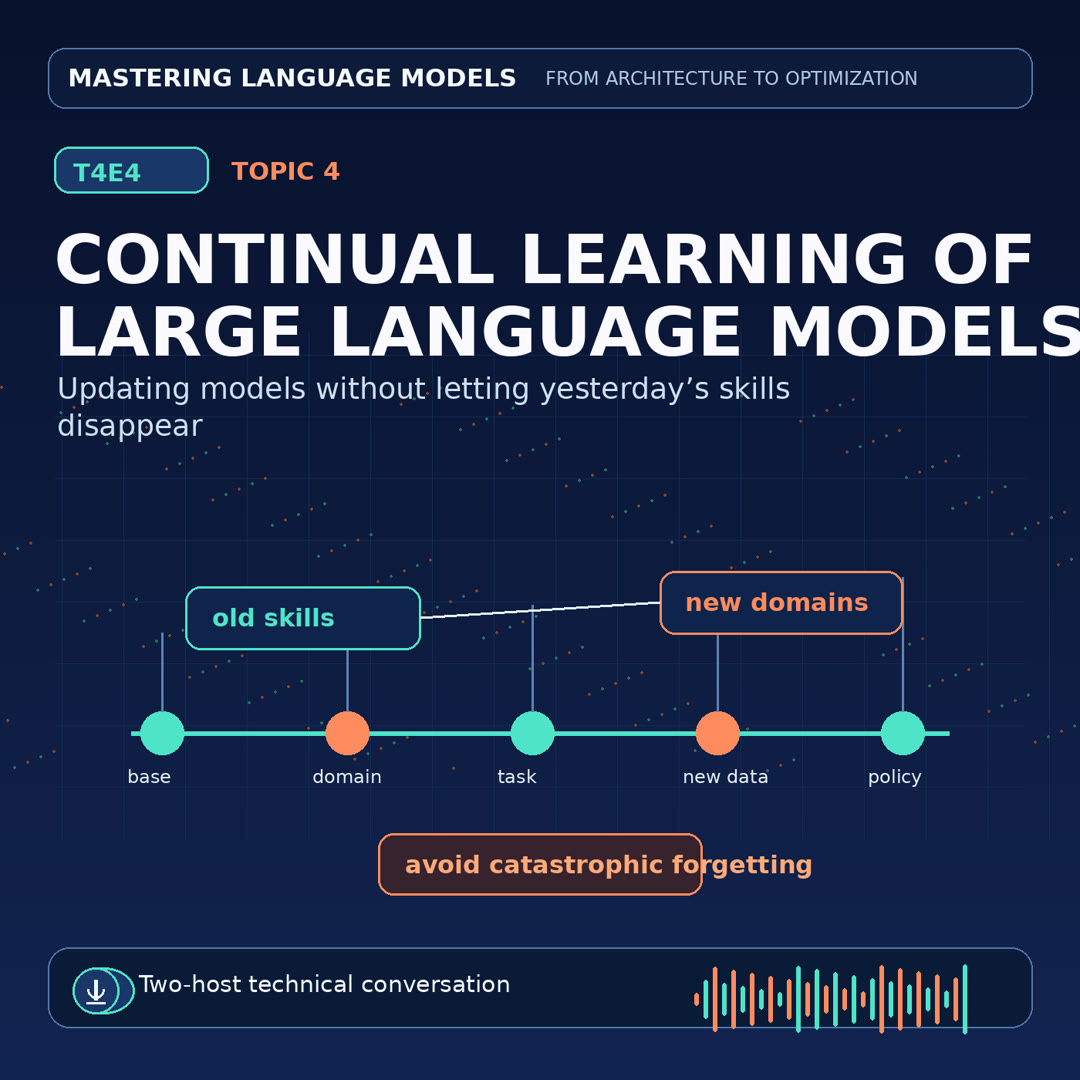
MayaThat is the heart of continual learning for large language models. The survey we are discussing looks at how pretrained Large Language Models can adapt to changing data, tasks, and user preferences without severe performance degradation in previous domains.
LeoThe phrase everyone needs is catastrophic forgetting.
MayaYes. Catastrophic forgetting means a model learns a new task or domain and loses capability on earlier ones. In small examples, it is easy to describe: train on task A, then task B, and performance on task A collapses. In Large Language Models, it is more subtle.
LeoBecause the “old task” might be everything from grammar to safety behavior to coding style to domain knowledge.
MayaExactly. A model may still sound fluent but become worse at a previous domain. Or it may preserve facts but lose formatting discipline. Or it may over-adapt to a new customer’s style and become less useful elsewhere.
LeoTopic 4 has been about specialization. LoRA, QLoRA, and LowRA all ask how to adapt efficiently. Continual learning asks: how do we adapt repeatedly?
MayaRight. The survey organizes continual learning for Large Language Models around directions and stages. One useful distinction is vertical versus horizontal continual learning.
LeoVertical sounds like going deeper.
MayaIn this context, vertical continuity is adaptation from general capabilities toward more specific capabilities. For example: general language model, then instruction-following model, then domain assistant, then task-specific helper.
LeoHorizontal continuity is adaptation across time or domains?
MayaYes. New laws, new products, new codebases, new user preferences, new slang, new scientific findings. The world shifts sideways, and the model has to keep up.
LeoThat is a great mental model. Vertical: general to specialized. Horizontal: old world to new world.
MayaThe survey also discusses stages like continual pretraining, domain-adaptive pretraining, and continual fine-tuning.
LeoLet’s make those concrete.
MayaContinual pretraining means continuing broad language-model training as new data arrives. Domain-adaptive pretraining means continuing training on domain-specific text, like legal documents or biomedical papers, before task-specific tuning. Continual fine-tuning means updating the model on sequences of tasks or instruction data.
LeoEach stage has a different risk profile. Continual pretraining can change broad representations. Domain-adaptive pretraining can improve domain language but over-specialize. Continual fine-tuning can quickly teach tasks but may forget earlier tasks.
MayaExactly. And that leads to one of the core expert mental models: continual learning is not just “train more.” It is controlled updating under memory, compute, and evaluation constraints.
LeoAnother mental model: old performance is part of the objective.
MayaYes. In ordinary fine-tuning, people sometimes optimize the new task score. In continual learning, you care about plasticity and stability. Plasticity means the model can learn new things. Stability means it does not forget old things.
LeoSo continual learning is a balance between being flexible and being reliable.
MayaExactly. Too stable, and the model cannot adapt. Too plastic, and it forgets.
LeoWhat are the main families of solutions?
MayaBroadly: rehearsal, regularization, architecture or parameter isolation, and data or curriculum strategies. Rehearsal means mixing in examples from previous tasks so the model remembers them. Regularization penalizes changes that would damage old knowledge. Parameter isolation allocates separate parameters or adapters for different tasks. Curriculum strategies control the order and mix of training data.
LeoAdapters fit naturally here. Instead of rewriting one shared model over and over, keep task-specific adapters.
MayaYes, that is why Topic 4 ends here. Parameter-Efficient Fine-Tuning methods are not only cheaper; they can help isolate updates. But isolation is not magic. If you need the model to combine knowledge across adapters or generalize to new tasks, you still face integration problems.
LeoExpert disagreement: should continual learning happen inside the model weights or outside the model in retrieval and tools?
MayaBig one. Weight-update advocates say some behaviors must be internalized. If the model needs a new style, new reasoning pattern, or new domain intuition, retrieval is not enough. The model’s behavior should change.
LeoTheir strongest argument is fluency and integration.
MayaYes. External-memory advocates say changing weights is risky and hard to audit. If the issue is new facts, policies, product docs, or user records, retrieval is fresher, more inspectable, and easier to revoke.
LeoTheir strongest argument is control.
MayaExactly. A practical system often uses both: update weights for stable behavior patterns, use retrieval for fast-changing knowledge.
LeoAnother disagreement: should we maintain one continually updated model or many specialized models?
MayaOne-model advocates want transfer. If the model learns from many domains, maybe improvements combine. Multi-model or multi-adapter advocates want containment. If one domain update goes wrong, it does not poison everything else.
LeoThis is the same shared-brain versus modular-cartridge debate from LoRA, but now stretched over time.
MayaExactly. And the best choice depends on governance. In a research lab, one evolving model might be acceptable. In an enterprise, separate adapters or retrieval indices may be easier to audit and roll back.
LeoLet’s talk evaluation, because continual learning sounds impossible to trust without it.
MayaEvaluation is absolutely central. You need new-task performance, old-task retention, transfer to related tasks, forgetting measures, and sometimes time-aware benchmarks. You also need to test behavior that is not captured by the training loss.
LeoLike safety policy consistency, instruction following, refusal boundaries, and calibration.
MayaYes. And you need to decide what counts as forgetting. If a model becomes better at legal language and slightly worse at casual jokes, maybe that is acceptable for a legal assistant. If it becomes worse at basic arithmetic, not acceptable.
LeoSo forgetting is not a single number. It is a product requirement.
MayaPrecisely. Another subtle point: continual learning can create data contamination and evaluation leakage problems. If a model sees benchmark-like data over time, you may think it is getting smarter when it is just memorizing evaluation patterns.
LeoThat connects back to scaling and training data from Topic 2. More data is not automatically better if the data stream is biased, duplicated, or leaks test cases.
MayaExactly. Continual learning is partly a data engineering problem. What do you store? What do you replay? What do you delete? What do you weight more heavily? Who decides when the model has truly learned a new policy?
LeoLet’s use a concrete example. A coding assistant is trained in 2024. By 2026, frameworks changed, APIs changed, package versions changed, and security practices changed. If you never update the model, it gives stale advice. If you update aggressively on new code, it may lose older language support or overfit to noisy examples.
MayaA sensible system might use retrieval for the latest documentation, periodic domain-adaptive training for stable ecosystem shifts, adapters for customer-specific codebases, and regression tests to catch forgetting.
LeoAnother example: customer support. Product names, refund rules, and legal language change. You probably do not want every policy update baked into weights. But you may fine-tune for tone, escalation behavior, and structured response style.
MayaGreat distinction. Continual learning is not a mandate to update weights for everything. It is a framework for deciding what should change, how, and with what safeguards.
LeoWhat is the biggest misconception?
MayaThat continual learning means the model learns live from every user interaction. In high-stakes systems, that is usually dangerous. You need curation, privacy controls, evaluation gates, and rollback plans.
LeoSo “continual” does not mean “uncontrolled.”
MayaExactly. It means the model lifecycle keeps going after initial deployment.
LeoThis episode also closes Topic 4 nicely. LoRA gave us small trainable deltas. QLoRA compressed the frozen base. LowRA compressed adaptation even further. Continual learning asks how those adaptations fit into a long-term model lifecycle.
MayaAnd it points toward later topics. Reinforcement Learning from Human Feedback will discuss preference feedback. Open models will discuss model ecosystems. Mixture of Experts will discuss sparse specialization at scale. Harness engineering will ask whether some adaptation should happen in system code rather than weights.
LeoFinal takeaway: specialization is not a one-time button. It is an ongoing negotiation between new usefulness and old reliability.
LeoThere is one more practical lesson: continual learning needs an update policy. A team should know what triggers an update. Is it a drop in evaluation? A new regulation? User feedback? A new product release? A security issue?
MayaAnd after the trigger comes the gate. You update a candidate model or adapter, run it through old and new tests, inspect failures, and decide whether to ship. Without that process, continual learning becomes continual guessing.
LeoThis is where model lifecycle starts to look like software lifecycle. You have versions, regression tests, release notes, rollback plans, and monitoring after deployment.
MayaExactly. The model is not a static artifact anymore. It is part of an evolving system, and that means specialization has to be managed, not just trained.
MayaAnd the question for listeners: when your model needs to learn something new, how will you prove it did not forget something important?
CreditsThanks for listening. The producer is William Liu. Join us for the next episode.
Source material
← Back to Mastering Language Models: From Architecture to Optimization