Transcript
Generated: 2026-05-09 02:19 UTC
---
MayaBefore we jump in, here's a quick setup for this episode on t4e3_lowra_under_two bits. You'll hear Maya and Leo work through the topic together.
MayaToday’s episode starts with a deliberately uncomfortable question: how few bits can an adapter survive on?
LeoWe already compressed a lot with QLoRA. Four-bit quantization sounded aggressive. LowRA asks whether LoRA fine-tuning can go below two bits per parameter and still remain useful.
MayaExactly. The paper frames the problem around scale. As models grow to tens or hundreds of billions of parameters, even parameter-efficient fine-tuning can still feel expensive. LoRA is small compared with full fine-tuning, but “small compared with enormous” can still be large.
LeoSo LowRA is not saying LoRA failed. It is saying: even LoRA has a memory bill, especially when there are many adapters, many users, or tight hardware limits.
MayaRight. This matters in resource-constrained environments: edge deployment, local fine-tuning, many-task serving, or organizations that want adapter libraries without huge storage costs.
LeoLet’s define the challenge. With a normal number like sixteen bits, you have many possible values. With four bits, you have sixteen levels. Below two bits, you are talking about fewer than four effective levels on average. That is a very coarse language for numbers.
MayaAnd LoRA adapters are not just stored numbers. They are the steering mechanism for the model. If the adapter values become too crude, the model may not receive a precise enough behavior update.
LeoSo naive ultra-low-bit quantization could be like trying to tune a piano with a hammer.
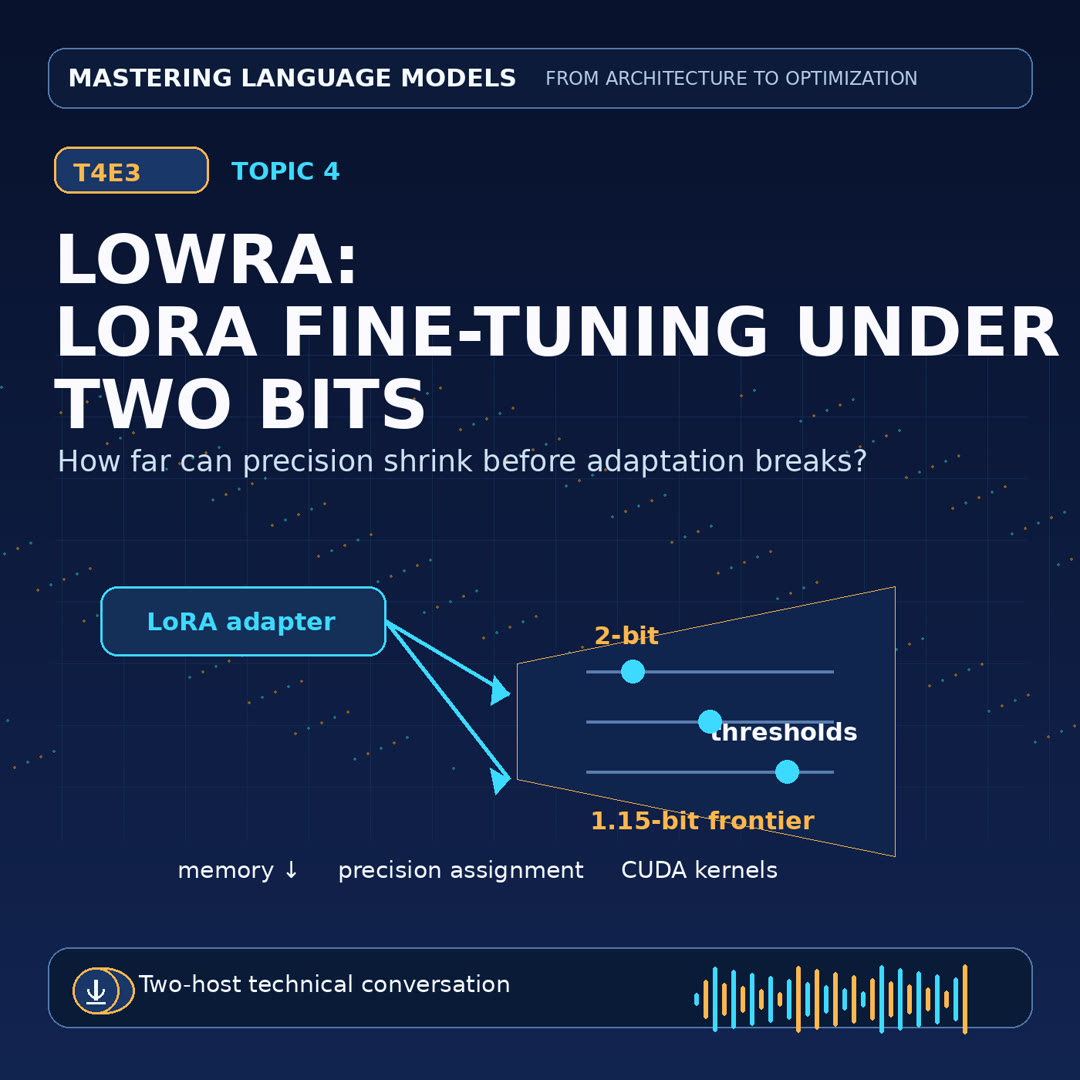
MayaThat is the danger. LowRA’s contribution is to make the hammer more like a carefully designed tool. It optimizes fine-grained quantization choices: mapping, threshold selection, and precision assignment, along with efficient C U D A kernels.
LeoMapping first. What does mapping mean here?
MayaAt a high level, mapping decides how real-valued adapter weights correspond to low-bit codes. When you compress, you do not just choose “small, medium, large.” You decide which values the codes represent and how weights get assigned to those codes.
LeoThreshold selection is where you decide the cut points between those buckets.
MayaExactly. If the thresholds are bad, many important values get pushed into the wrong bucket. Precision assignment means deciding where more or fewer bits are worth spending. Not every part of the adapter contributes equally to final behavior.
LeoThat is an important idea: compression should be selective, not blindly uniform.
MayaYes. A production analogy: if you are packing a suitcase, you do not compress your laptop and your socks equally. Some objects need protection. Some can be squeezed.
LeoThe paper reports that LowRA achieves a strong performance-precision trade-off above two bits and remains accurate down to around 1.15 bits, with memory reductions up to 50 percent in their evaluations.
MayaThat headline is striking, but the deeper lesson is about co-design. Ultra-low-bit fine-tuning is not only an algorithmic idea. It depends on hardware-aware implementation. If the C U D A kernels are inefficient, the compressed method may save memory but fail to deliver practical speed or usability.
LeoThis is very Topic 3 meeting Topic 4. Distributed training taught us that performance is often limited by memory movement and kernels, not just arithmetic. LowRA brings that same mindset into fine-tuning.
MayaExactly. The model adaptation method and the hardware execution path have to agree.
LeoLet’s compare LowRA with QLoRA carefully. QLoRA stores the frozen base model in four-bit form and trains LoRA adapters through it. LowRA focuses on making LoRA fine-tuning itself work under two bits per parameter.
MayaGood distinction. Both are about squeezing memory, but they squeeze different parts of the adaptation stack.
LeoIf QLoRA made giant base models more accessible, LowRA is about making the adapter side even lighter.
MayaRight. Think of a large company serving one base model with thousands of customer adapters. Even if each LoRA adapter is small, thousands of them become a storage and deployment problem. Ultra-low-bit LoRA makes adapter libraries easier to manage.
LeoBut here is the skeptical question: how much should we trust a sub-two-bit adapter?
MayaThat is the core expert disagreement. The pro-compression side says: memory is a hard bottleneck. If we can preserve quality while cutting precision, we unlock new use cases. More teams can fine-tune, more adapters can be stored, and deployment becomes cheaper.
LeoTheir strongest argument is practical access.
MayaYes. The cautious side says: the lower the precision, the more fragile the behavior may become. Benchmarks may not reveal all errors. Some domains need predictable edge-case behavior, and precision loss can show up in strange places.
LeoTheir strongest argument is robustness.
MayaExactly. A small average loss may be acceptable for a casual chatbot but unacceptable for a compliance tool.
LeoAnother debate: should we compress adapters, or should we just train fewer adapters and rely more on prompting or retrieval?
MayaGood. Adapter-heavy systems say learned behavior is faster and more reliable for repeated tasks. Prompt-and-retrieval systems say external context is easier to update, inspect, and control.
LeoAgain, the answer is not universal. If the behavior is stable, adapter. If the facts change, retrieve. If the task is format-heavy, maybe LoRA. If the task is policy-heavy, maybe a harness plus evaluation.
MayaLowRA is valuable because it expands the design space. It does not force every system to go ultra-low-bit. It asks: when memory is the limiting factor, how far can we push before quality gives way?
LeoLet’s use a scenario. A mobile app company wants on-device personalization. The base model might be shared or downloaded, but each user’s adaptation must be tiny. Full fine-tuning is impossible. Regular LoRA may still be too large at scale. LowRA-style ultra-low-bit adapters could make personalization more plausible.
MayaAnother scenario: a SaaS platform has industry-specific adapters: retail, insurance, education, logistics. Each customer may need a slightly different tone, schema, or terminology. Storing many higher-precision adapters costs money. Compressing adapters helps.
LeoBut they still need a validation pipeline. You cannot say “the adapter is tiny, therefore it is safe.”
MayaAbsolutely. You need tests for task accuracy, refusal behavior, hallucination patterns, formatting, latency, and regression against the base model’s general capabilities. The smaller the precision budget, the more carefully you should test.
LeoThere is also a training stability question. Ultra-low precision can make optimization noisier.
MayaYes. That is why LowRA’s quantization choices matter. The goal is not simply to store fewer bits after training; it is to fine-tune accurately under tight precision constraints.
LeoLet me try a one-sentence summary. LoRA made adaptation low-rank; QLoRA made the frozen base low-memory; LowRA makes the adapter precision budget extremely small.
MayaPerfect. And the order matters pedagogically. Each paper keeps the specialization idea but moves pressure to a different bottleneck.
LeoWhat would you tell a practitioner deciding whether to care about LowRA today?
MayaIf you are training a handful of adapters on a server with enough memory, standard LoRA or QLoRA may be simpler. If you are serving huge numbers of adapters, working under tight storage limits, or pushing adaptation onto constrained hardware, LowRA becomes much more relevant.
LeoSo LowRA is not the first tool for every fine-tuning job. It is a frontier tool for when memory and precision become the bottleneck.
MayaExactly. It is also a preview of where the field is going: not only bigger models, but more efficient personal, domain-specific, and task-specific deltas.
LeoWhich brings us to the final episode in this topic. Once you can adapt cheaply, the next problem appears: what if adaptation is not a one-time event? What if the model has to keep learning month after month?
MayaThat is continual learning. And the difficult part is that learning new things can erase old things. LowRA asks how small an adaptation can be. Continual learning asks how long adaptation can continue without breaking the model’s memory.
LeoI want to connect this to multi-tenant serving. Imagine a platform that hosts one base model and lets each customer bring an adapter. The storage problem is obvious, but there is also a bandwidth problem. Adapters may need to be loaded, swapped, cached, or moved between devices.
MayaThat is where ultra-low-bit adapters become system components, not just research artifacts. If an adapter is tiny enough, the serving layer can move it around more easily. Cache misses hurt less. More adapters fit in memory. Personalization becomes less expensive.
LeoBut now the system has a new failure mode: adapter selection. If the wrong tiny adapter is applied, or if an adapter was trained with the wrong assumptions, the model may produce confident but misplaced behavior.
MayaRight. Compression does not eliminate governance. You still need adapter metadata: what data trained it, what task it targets, which base model it expects, which evaluation suite it passed, and when it should be retired.
LeoSo LowRA pushes us toward an adapter marketplace mental model, but marketplaces need labels, tests, versioning, and trust.
MayaExactly. Tiny adapters are easier to distribute, but easier distribution means more responsibility to track what each adapter actually does.
LeoListener question: where would you rather spend your budget — more adapter precision, more data quality, more evaluation, or more retrieval outside the model?
CreditsThanks for listening. The producer is William Liu. Join us for the next episode.
Source material
← Back to Mastering Language Models: From Architecture to Optimization