Transcript
Generated: 2026-05-09 02:18 UTC
---
MayaBefore we jump in, here's a quick setup for this episode on t4e2_qlora_quantized finetuning. You'll hear Maya and Leo work through the topic together.
MayaLoRA made fine-tuning smaller. But it did not make the base model itself small.
LeoRight. Even if you train only a tiny adapter, you still have to load the giant frozen model into memory. That can be the wall.
MayaQLoRA is the episode where the wall gets lower. The paper asks a very practical question: can we fine-tune a large language model by keeping the base model in four-bit form, while still learning high-quality LoRA adapters?
LeoThe headline result is famous: QLoRA reduces memory enough to fine-tune a 65-billion-parameter model on a single 48GB G P U while preserving full sixteen-bit fine-tuning performance in their setup.
MayaAnd that changed the feel of the field. Suddenly, fine-tuning very large open models was not only a lab-cluster activity. It became something a much smaller team could at least attempt.
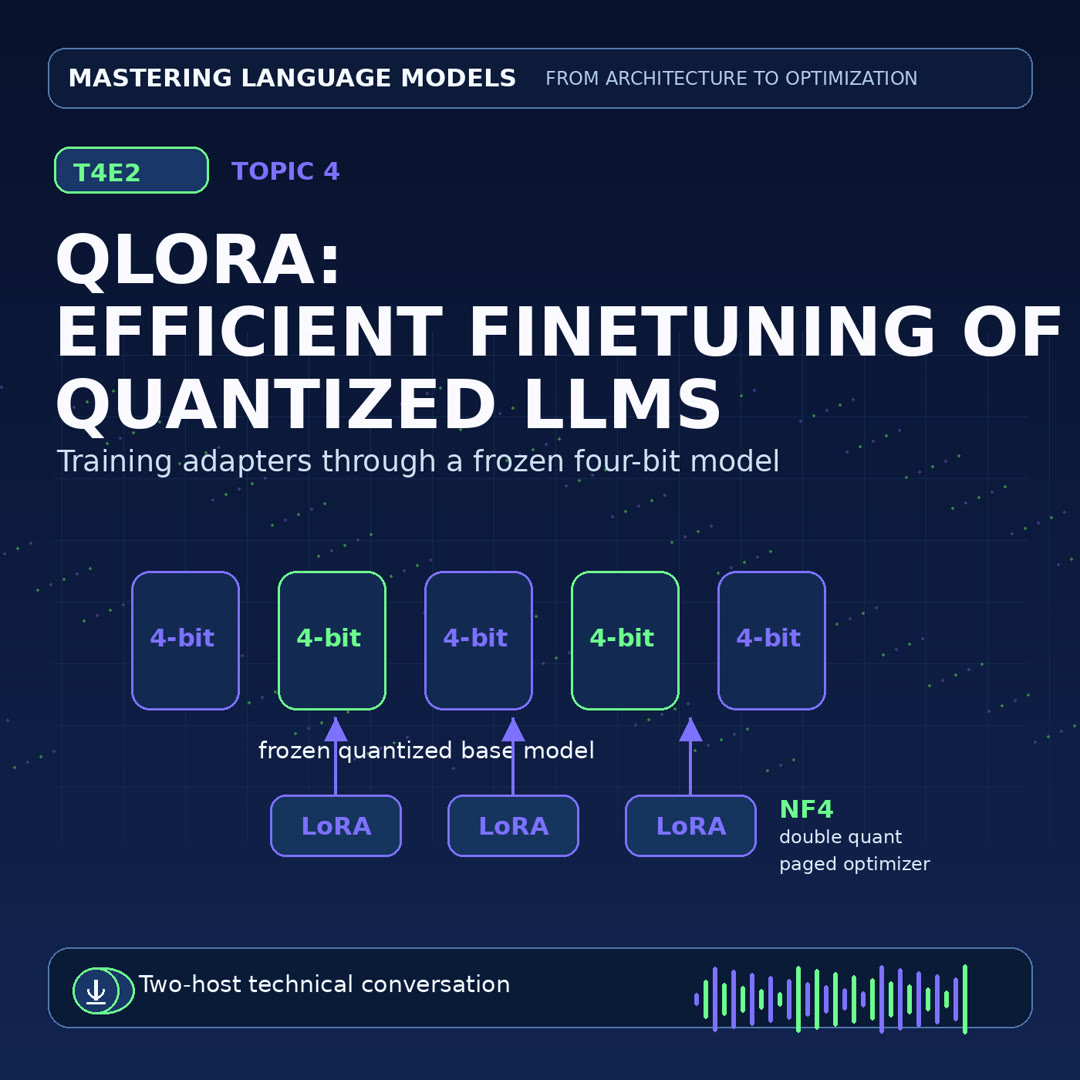
LeoLet’s anchor the mechanics. LoRA freezes the base weights and trains low-rank adapter matrices. QLoRA keeps that adapter idea, but the frozen base model is quantized to four bits.
MayaQuantization means representing numbers with fewer bits. Instead of storing a model weight as a sixteen-bit or thirty-two-bit number, store it using a small code. Fewer bits means less memory.
LeoBut a listener might ask: if the base is quantized, how can training work? Don’t gradients need precision?
MayaGreat question. QLoRA backpropagates through the frozen quantized model into the LoRA adapters. The base weights are not being updated. They are compressed, used in computation, and the trainable path is the LoRA adapter.
LeoSo the frozen model is like a compressed reference library. You consult it during training, but you write notes only in the adapter notebook.
MayaExactly. The paper introduces three memory-saving techniques that people still talk about: NF4, double quantization, and paged optimizers.
LeoNF4 first. What is it?
MayaNF4 stands for Normal Float four-bit. It is a four-bit data type designed for weights that are roughly normally distributed. Instead of spacing representable numbers evenly, it places values where normally distributed weights are more likely to be.
LeoSo it is not just “round to sixteen buckets.” It chooses buckets that fit the shape of the weight distribution.
MayaRight. That matters because if your buckets match the data better, you lose less useful information when compressing.
LeoDouble quantization next. That sounds like quantizing the quantization.
MayaThat is pretty close. Quantized weights need scaling constants. Those constants also take memory. QLoRA reduces memory further by quantizing the quantization constants themselves.
LeoLike compressing the legend on the map, not just the map.
MayaExactly. Then paged optimizers address memory spikes. During training, optimizer states and long sequences can create sudden memory peaks. Paged optimizers use unified memory behavior to handle spikes more gracefully.
LeoThis is one of those episodes where “efficient fine-tuning” is not one trick. It is a stack of tricks that cooperate.
MayaYes. LoRA reduces trainable parameters. Four-bit quantization shrinks the frozen base. NF4 reduces accuracy loss from quantization. Double quantization shaves more memory. Paged optimizers manage training spikes.
LeoAnd the paper also trained a lot of models.
MayaMore than a thousand fine-tuned models across datasets, model types, and scales. The authors used that to study instruction following and chatbot performance. Their best family, Guanaco, performed very strongly on the Vicuna benchmark in their evaluation.
LeoBut there is a caution in the paper too: chatbot benchmarks are not always trustworthy.
MayaYes, and that is important. QLoRA was not only a memory paper. It also entered the debate about evaluating instruction-tuned chatbots. If you use automated ratings or narrow benchmarks, you may overestimate real user value.
LeoLet’s make QLoRA practical. Suppose a small A I team wants to tune a 33B or 65B model for internal developer support. Full fine-tuning is too expensive. LoRA helps, but loading the base model is still heavy. QLoRA says: compress the frozen model, train adapters, and keep quality close enough to make the experiment viable.
MayaThat opens the door, but it does not remove all constraints. Activations still take memory. Sequence length matters. Batch size matters. Kernels matter. Dataset quality matters. And four-bit training can be slower or trickier depending on hardware and implementation.
LeoI like that distinction. QLoRA makes something possible; it does not make it free.
MayaExactly. There is also a subtle conceptual point: QLoRA is not the same as training a four-bit model from scratch. The base model was pretrained at higher precision. QLoRA compresses it for adaptation and routes learning into adapters.
LeoSo the knowledge was learned before compression. The adaptation happens through a small trainable side path.
MayaRight. And that is why QLoRA fits so nicely after LoRA. It keeps the specialization philosophy but attacks a different cost center.
LeoExpert disagreement time. One side says quantized fine-tuning is the default future. Most teams cannot afford full precision, and if benchmarks show little loss, use the cheaper method.
MayaTheir strongest argument is access. Efficient fine-tuning democratizes experimentation. If only giant labs can adapt giant models, the ecosystem is narrower.
LeoThe other side says quantization errors are easy to hide. Average benchmark scores may look fine, but rare cases, safety behavior, or domain-specific edge cases may degrade.
MayaTheir strongest argument is reliability. A production system should care about tails, not only averages. If a medical or legal assistant fails on the rare hard case, the fact that memory usage was elegant does not help.
LeoAnother disagreement: should teams fine-tune a bigger quantized model or a smaller full-precision model?
MayaGreat one. Bigger quantized model advocates say model scale often buys capability, and QLoRA lets you access that scale. Smaller full-precision advocates say simpler training, faster inference, and fewer quantization surprises can be better in production.
LeoThat decision depends on the task. If the task needs broad reasoning or language coverage, bigger may help. If it needs a narrow deterministic classifier, smaller and simpler may win.
MayaEvaluation again becomes the deciding layer. You test the configuration you actually plan to deploy: model, adapter, precision, prompt, retrieval, context length, latency budget.
LeoLet’s also explain why QLoRA did not make LoRA obsolete. It uses LoRA.
MayaExactly. QLoRA is not a replacement for low-rank adaptation. It is a memory-efficient wrapper around the same general idea: freeze the base, train the adapter.
LeoAnd then LowRA, the next episode, pushes precision even more aggressively.
MayaYes. QLoRA says four-bit base model plus LoRA can work surprisingly well. LowRA asks a sharper question: can LoRA-style fine-tuning itself operate accurately below two bits per parameter?
LeoThat sounds almost too compressed.
MayaIt is an engineering frontier. Below two bits, you cannot rely on naive rounding. You need careful quantization design, thresholds, precision assignment, and kernels. Otherwise, the adapter becomes too noisy to steer the model.
LeoSo the arc is: LoRA reduces trainable size. QLoRA reduces base memory. LowRA tests the lower limit of adaptation precision.
LeoWe should also mention the hidden cost people forget: optimizer state. During training, it is not enough to store model weights. Optimizers like Adam keep extra statistics, and those statistics can dominate memory.
MayaExactly. Fine-tuning memory is a stack: base weights, trainable parameters, gradients, optimizer states, activations, temporary buffers, and sometimes key-value cache-like structures depending on the training setup. QLoRA attacks several layers of that stack.
LeoSo when someone says, “a 65B model has this many parameters, and four bits means this much memory,” that is only the starting estimate.
MayaRight. Training is not inference. During inference, you mostly worry about weights, activations, and generation cache. During training, backpropagation requires more bookkeeping. That is why paged optimizers are not just a footnote; they help deal with the messy memory spikes that show up during real training.
LeoThere is also a deployment lesson. A QLoRA-tuned model is not automatically a single neat artifact. You may have a quantized base, adapter weights, tokenizer files, quantization configuration, and serving code that knows how to combine them.
MayaYes. The model card may say “QLoRA,” but the production question is: can your serving stack reproduce the exact behavior? Can it load the quantized model correctly? Can it apply the adapter? Can it run at the latency you need?
LeoAnd if you are comparing two tuning runs, you need to control those details. Otherwise, you might think dataset A beat dataset B when actually kernel configuration or sequence length changed.
MayaThis is why efficient fine-tuning is both a modeling topic and an engineering discipline. The paper gives a method, but the production system still needs measurement discipline.
LeoAnother listener-friendly way to say it: QLoRA gives you a smaller backpack, but you still have to pack it carefully.
MayaPerfect. And that packing includes data selection. The QLoRA paper’s results helped popularize the idea that small, high-quality instruction data can matter more than huge, noisy instruction data. That has become a recurring theme in model specialization.
MayaExactly. And here is the listener question: if you had one G P U and one week, would you choose a smaller model with more precise fine-tuning, or a larger model with QLoRA-style compressed adaptation?
CreditsThanks for listening. The producer is William Liu. Join us for the next episode.
Source material
← Back to Mastering Language Models: From Architecture to Optimization