Transcript
Generated: 2026-05-09 02:17 UTC
---
MayaBefore we jump in, here's a quick setup for this episode on t4e1_lora_low_rank adaptation. You'll hear Maya and Leo work through the topic together.
MayaPicture a giant Transformer weight matrix as a heavy steel door. Full fine-tuning says: reshape the whole door. LoRA says: keep the door, attach a small hinge mechanism, and let that hinge change how it swings.
LeoThat is a very physical way to explain a matrix update.
MayaGood, because LoRA can sound abstract until you see the trick. The paper’s central move is to freeze the pretrained model weights and learn a small low-rank update alongside them.
LeoQuick recap from the Topic 4 overview: a pretrained model already contains a lot of useful structure. So when we adapt it to a task, maybe we do not need to move every weight. Maybe the important change lives in a smaller subspace.
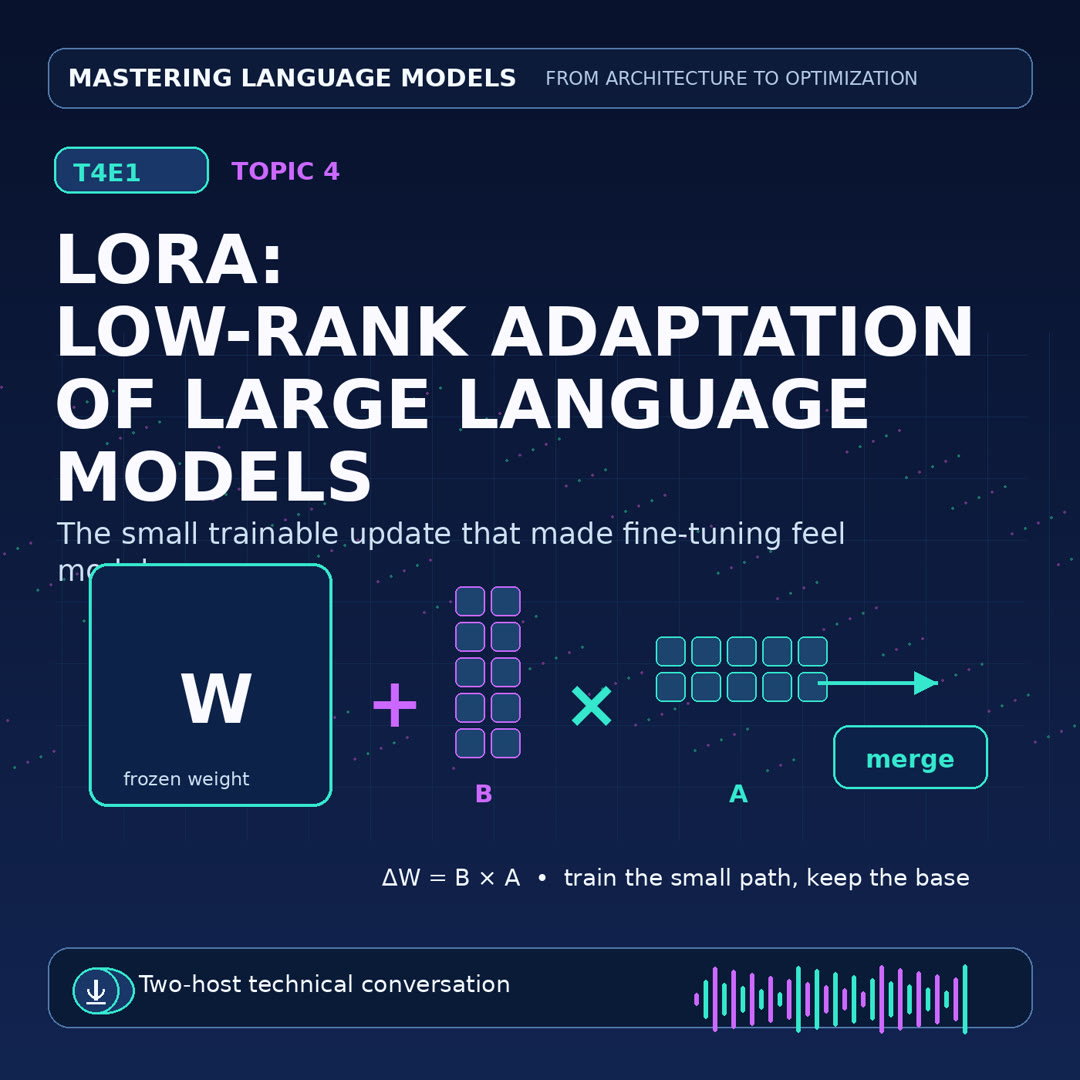
MayaExactly. LoRA turns that intuition into an engineering method. In a normal linear layer, you have a weight matrix W. During full fine-tuning, W itself changes. LoRA keeps W frozen and adds a trainable update, delta W.
LeoBut delta W could be as big as W, right?
MayaIt could. LoRA says: do not learn delta W directly. Approximate it as the product of two smaller matrices, usually called B and A. So the layer behaves like W plus B times A.
LeoIf W is huge, A and B can still be much smaller because the rank is low.
MayaRight. Suppose W maps from 4,096 dimensions to 4,096 dimensions. A full update matrix has more than sixteen million entries. But a rank-eight LoRA update uses one matrix from 4,096 to 8 and another from 8 back to 4,096. That is around sixty-five thousand parameters, not sixteen million.
LeoThat is not a rounding error. That is a different business model.
MayaYes. And the LoRA paper reports dramatic reductions in trainable parameters and memory compared with full fine-tuning, while often matching or beating full fine-tuning on their experiments.
LeoLet’s slow down on the math. If the normal output is W times x, LoRA adds B times A times x. A first compresses the input into a small rank-sized bottleneck. B expands it back.
MayaAnd there is usually a scaling factor, often written alpha over r, where r is the rank. That helps control the strength of the adapter update.
LeoSo rank controls capacity, alpha controls volume, and the frozen W remains the original instrument.
MayaNice. Another practical detail: LoRA does not have to be attached everywhere. In Transformers, people often apply it to attention projection matrices, such as query and value projections, and sometimes to other projection layers.
LeoWhy not every layer, every matrix?
MayaYou can, but every attachment increases training memory and storage. The art is choosing where small changes create the most useful behavior shift.
LeoThat sounds like one of the expert disagreements: target modules. Some practitioners say attention projections are enough. Others say for instruction tuning, domain adaptation, or reasoning behavior, you may want LoRA on more modules.
MayaExactly. The strongest argument for a smaller target set is simplicity and efficiency. The strongest argument for broader coverage is expressiveness. If the model needs a deeper behavior change, a tiny adapter in only a few places may be too weak.
LeoThere is another detail I love: LoRA can be merged for inference.
MayaYes. After training, because the adapter is just an additive matrix update, you can combine W and B times A into a single effective weight for deployment. That means no extra inference path is needed if you choose to merge.
LeoCompared with some adapter methods that add extra layers and can add latency.
MayaThat was one of LoRA’s practical selling points. It gives you modular training and storage, without necessarily paying a runtime penalty after merging.
LeoBut if you merge, do you lose the ability to swap adapters quickly?
MayaYou can keep the adapter separate or merge it depending on serving needs. If you have one task and need maximum simplicity, merge. If you serve many users with different adapters on the same base model, keep adapters separate and swap or route them.
LeoLet’s use a real system example. A software company has a base code model. One customer wants it tuned for S Q L migration. Another wants Terraform review. Another wants customer-support macro generation. Instead of three full model copies, the company trains three LoRA adapters.
MayaAnd each adapter is like a small task cartridge. The base model is shared; the adapter expresses the specialization.
LeoThat is elegant. But where does it break?
MayaFirst, data quality. LoRA does not magically fix weak training data. If the examples are noisy, contradictory, or too narrow, the adapter will learn that. Second, rank selection. Too low and the adapter underfits. Too high and you lose efficiency or overfit. Third, evaluation. You need to check not only the target task but also side effects.
LeoSide effects even though the base weights are frozen?
MayaYes, because the combined model behavior changes. Freezing W protects the base file on disk, but the active model with the adapter can still become worse at some behaviors.
LeoThat is a good distinction: frozen storage is not frozen behavior.
MayaExactly. Another pitfall is adapter stacking. Teams sometimes want one adapter for domain, one for style, one for safety, one for customer. Combining adapters is tempting, but interactions can be messy.
LeoLike installing four steering wheels in one car.
MayaSometimes it works; sometimes the signals conflict. There are methods for adapter composition, but you still need evaluation.
LeoLet’s talk about why “low rank” was plausible. The paper connects to the idea that model adaptation may have low intrinsic rank or low intrinsic dimension. In plain language: the useful change may lie along a few directions, not everywhere.
MayaRight. Think of a pretrained model as a giant map. A new task does not require redrawing every road. It may require emphasizing a few routes, blocking a few wrong turns, and adding some local signs. LoRA learns those signs with a compact update.
LeoHere is a question: when should someone not use LoRA?
MayaIf the domain shift is very large, full fine-tuning or continued pretraining may be better. If you need to change tokenizer behavior or absorb a large new knowledge distribution, LoRA alone might not be enough. If the deployment environment cannot support adapter routing, a merged fine-tune might be simpler. And if your task is mostly about fresh facts, retrieval may be better than changing weights.
LeoThere is the R A G connection again. Fine-tune behavior; retrieve facts.
MayaThat rule is not perfect, but it is useful. LoRA is great for teaching a model how to behave in a task pattern. It is less ideal as a database update mechanism.
LeoAnother expert disagreement: should LoRA be the default for enterprise customization?
MayaPro-LoRA people say yes because it is cheap, modular, reversible, and widely supported. Skeptics say enterprises often confuse fine-tuning with product reliability. They fine-tune before fixing prompts, retrieval, data cleaning, or evaluation.
LeoSo the best argument against careless LoRA is not that LoRA is bad. It is that LoRA is easy enough to misuse.
MayaExactly. It lowered the barrier, which is powerful and dangerous. More teams can adapt models, but more teams can also create brittle specialized behavior.
LeoLet’s summarize the mechanism in one pass. Start with a pretrained model. Freeze its original weights. Pick target matrices inside the Transformer. Add small trainable low-rank matrices. Train only those matrices on task data. At inference, either keep them modular or merge them into the base weights.
MayaAnd the deeper lesson is that adaptation can be separated from ownership of the whole model. You can share the base and specialize with small deltas.
LeoThat idea changed open-model practice. People could publish adapters, not just full models. Teams could experiment faster. Researchers could study adaptation without massive hardware.
MayaLoRA also set up the next episode. If the adapter is small but the base model is still huge, memory is still a problem. QLoRA asks: can we compress the frozen base model to four bits, keep the LoRA training path, and fine-tune models that used to require far more hardware?
LeoSo LoRA says, “train fewer weights.” QLoRA says, “store the frozen weights more cheaply too.”
LeoOne thing we have not emphasized enough is how LoRA changes experimentation speed. With full fine-tuning, every experiment can feel like a major commitment. With adapters, a team can try different ranks, datasets, target modules, and instruction formats much faster.
MayaAnd that changes research behavior. You do not only save money; you increase the number of ideas you can test. A bad adapter can be thrown away. A promising one can be compared against another adapter. The base model remains the shared reference point.
LeoThat also helps collaboration. One person can work on a summarization adapter while another works on a code-review adapter. They are not both editing the same giant model copy.
MayaExactly. LoRA made specialization feel more like software versioning: small artifacts, repeatable experiments, and easier rollback. That is a big reason it became so influential outside the original paper.
MayaAnd the question for listeners: if you were adapting a model for one task today, which part of the behavior truly needs learning, and how large does that learning path need to be?
CreditsThanks for listening. The producer is William Liu. Join us for the next episode.
Source material
← Back to Mastering Language Models: From Architecture to Optimization