Transcript
Generated: 2026-05-09 02:17 UTC
---
MayaBefore we jump in, here's a quick setup for this episode on t4e0_finetuning_specialization_lora beyond. You'll hear Maya and Leo work through the topic together.
MayaImagine you just spent months training a giant model. It can write, translate, summarize, code, reason a little, and answer questions. Now a company asks, “Can it handle our support tickets, our legal forms, our medical terminology, and our internal tone?”
LeoAnd the old answer was, “Sure, retrain a copy of the model.” Which sounds simple until the model has billions of parameters and every copy becomes a separate warehouse full of weights.
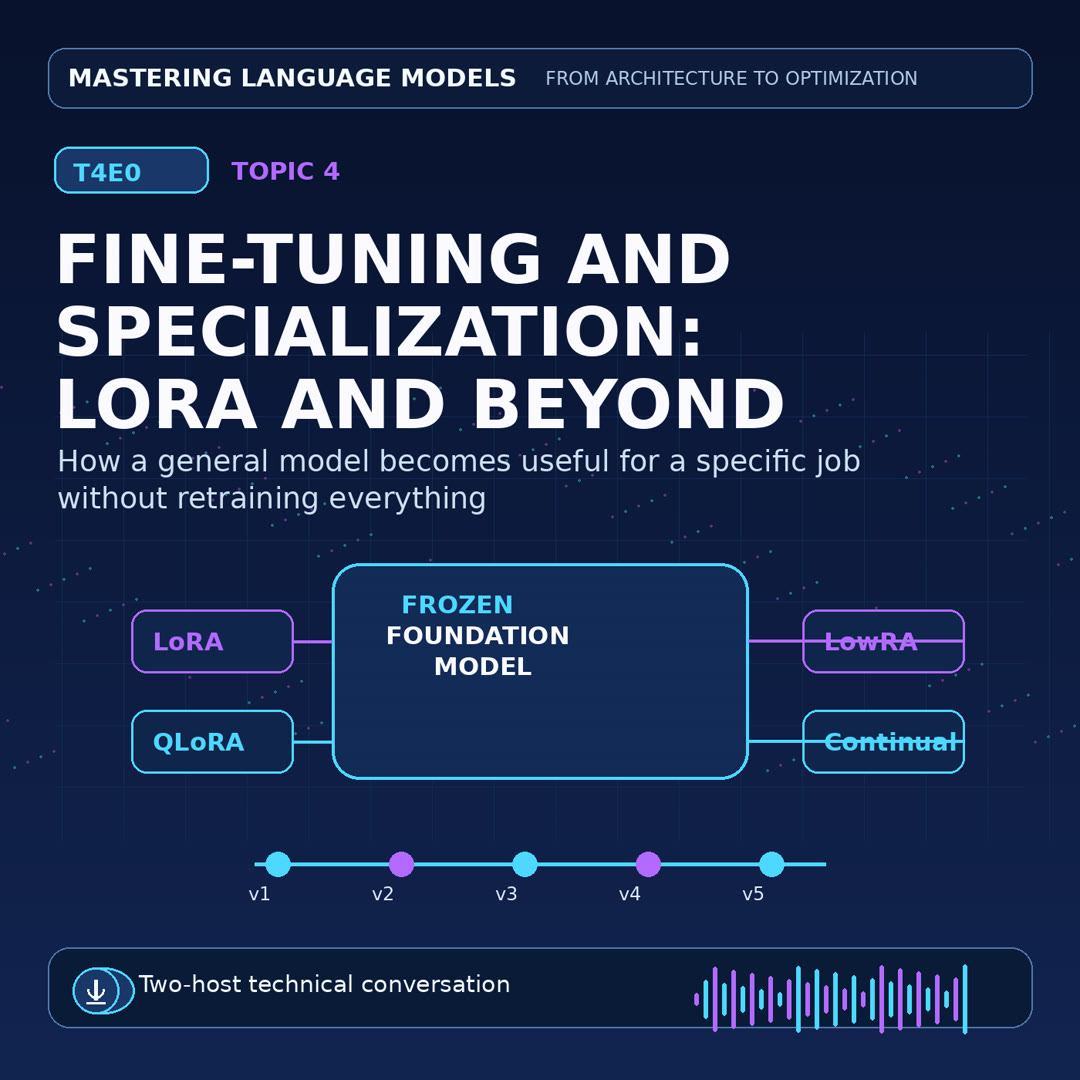
MayaThat is the heart of Topic 4. We are moving from building the foundation model to specializing it. Not “how do we make a model know everything,” but “how do we make this model useful for this task, this domain, this organization, this constraint.”
LeoNice connection to Topic 3, too. We just talked about distributed training, where the challenge was moving enough data through enough GPUs to train a huge system. Topic 4 asks a different question: once the expensive model exists, how do we adapt it without paying the original bill again?
MayaHere is the first expert mental model: fine-tuning is not just learning more facts. It is changing behavior. Sometimes you want the model to speak in a certain format. Sometimes you want it to classify data. Sometimes you want domain vocabulary. Sometimes you want it to follow instructions more reliably.
LeoSo fine-tuning is like taking a general-purpose employee and training them for a specific desk: customer support, compliance review, code migration, data labeling.
MayaExactly. And the second mental model is the one that makes LoRA so important: the useful change may be much smaller than the model itself.
LeoWait, that sounds suspiciously convenient. If the model has billions of weights, why would the update be small?
MayaBecause the base model already contains a lot of reusable structure. It already understands grammar, syntax, common reasoning patterns, and many world facts. For a new task, you often do not need to rewrite all of that. You need to steer the model along a new direction.
LeoSo the base model is the highway system, and fine-tuning is adding a few ramps and signs rather than rebuilding every road.
MayaThat is the intuition behind parameter-efficient fine-tuning, or Parameter-Efficient Fine-Tuning. You freeze most or all of the original model and train a much smaller set of parameters. LoRA is the most famous example in this topic.
LeoLow-Rank Adaptation. It sounds abstract, but the basic idea is friendly: instead of learning a giant update matrix, learn two skinny matrices whose product approximates the update.
MayaThe usual shorthand is: original weight matrix W stays frozen. The fine-tuning change is delta W. LoRA says, let delta W be B times A, where A and B are much smaller than W. So you train the low-rank path while the original model remains untouched.
LeoAnd “rank” becomes a knob. Low rank means fewer trainable parameters and lower memory use. Higher rank gives the adapter more room to express task-specific changes.
MayaThat knob is one of the big practical themes of Topic 4. In Topic 2, compute and data were the knobs. In Topic 3, memory and communication were the knobs. In Topic 4, the knobs are rank, precision, target layers, adapter placement, data quality, and whether the model needs to keep learning over time.
LeoThis is also where people start disagreeing. One camp says: use Parameter-Efficient Fine-Tuning whenever possible. It is cheaper, easier to store, easier to swap, and easier to serve many task-specific versions.
MayaTheir strongest argument is operational. If you have one base model and fifty customer-specific adapters, you can store fifty small deltas instead of fifty full copies. You can also roll back an adapter without touching the foundation model.
LeoThe other camp says: Parameter-Efficient Fine-Tuning can be too restrictive. Some tasks need full fine-tuning, especially when the required behavior is far from the base model’s distribution.
MayaTheir strongest argument is capacity. A small adapter may not be enough if you are changing language, modality, deep domain behavior, or safety-critical decision rules. If the required change is broad, freezing the base model can become a bottleneck.
LeoSo the debate is not “LoRA good, full fine-tuning bad.” It is: how much of the model needs to move?
MayaRight. And that leads to the third mental model: specialization is a budgeted intervention. You are always trading quality, memory, training cost, inference cost, deployment complexity, and risk of forgetting.
LeoForgetting is the scary one. Because if you train a model on new data, it may get better at the new domain and worse at old ones.
MayaCatastrophic forgetting. It is not new to machine learning, but it becomes more complex with Large Language Models because “old knowledge” is not a neat checklist. A model might preserve grammar but lose calibration. It might preserve broad chat ability but become too narrow. Or it might learn new policies that interfere with old tasks.
LeoThat is why this topic ends with continual learning. It asks: can a model keep adapting as the world changes without constantly erasing useful older behavior?
MayaBefore we get there, QLoRA asks a more hardware-centered question. If LoRA reduces trainable parameters, can we also compress the frozen base model enough to fine-tune very large models on much smaller hardware?
LeoQLoRA’s answer is yes: store the frozen base model in four-bit quantized form, then train LoRA adapters through it. The base model is compressed, the adapter remains trainable, and the memory bill drops dramatically.
MayaThe details matter: NF4, double quantization, paged optimizers. We will unpack those in the QLoRA episode, but the headline is simple. QLoRA made large-model instruction tuning feel much more accessible.
LeoThen LowRA pushes the precision question even further: if four bits helped, can LoRA-style fine-tuning survive under two bits?
MayaAnd that is where the topic becomes very engineering-heavy. Ultra-low-bit adaptation is not just “round every number harder.” You need careful mapping, threshold choices, precision assignment, and fast kernels. Otherwise the math becomes cheap but the model quality collapses.
LeoThere is another expert disagreement here: how far should we compress? One side says memory is the bottleneck, so squeeze aggressively. If a small device or low-budget team can fine-tune, the ecosystem opens up.
MayaThe other side says precision is not free. Compression can create subtle errors, and sometimes benchmark averages hide failures in long-tail cases. If the domain is high-stakes, a two-bit adapter might be the wrong place to cut corners.
LeoSo the practical question is not “what is the smallest adapter?” It is “what is the smallest adapter that still passes the evaluation that matters?”
MayaExactly. Evaluation is the fourth mental model. Fine-tuning is easy to celebrate when a leaderboard goes up. But a real system needs tests for format reliability, safety behavior, factuality, refusal behavior, domain-specific edge cases, latency, cost, and regressions.
LeoAnd maybe the most underrated test is: what got worse?
MayaYes. A fine-tuned model can become charmingly good at the demo and quietly worse everywhere else. That is why good teams keep a regression suite, not just a target-task score.
LeoLet’s make this concrete. Suppose a hospital wants a model to summarize discharge notes. Full fine-tuning might produce strong summaries, but it requires sensitive data handling, high compute, and careful deployment. LoRA might adapt tone and structure with fewer trainable parameters. QLoRA might let the team fine-tune a bigger base model on limited hardware. Continual learning might matter if medical guidelines change.
MayaAnd if the system later needs retrieval over current hospital policy, that might not be solved by fine-tuning at all. That may belong in a R A G system. So specialization is not always “change the weights.” Sometimes it is adapters. Sometimes prompts. Sometimes retrieval. Sometimes a new harness.
LeoAnother disagreement: one specialist model per task versus one general model with tools and retrieval. Specialist-model advocates say task-specific behavior is more reliable and cheaper at inference. Generalist-system advocates say you avoid maintaining a zoo of adapters and can update external knowledge without retraining.
MayaBoth sides are right in different environments. If the task is stable and high-volume, a tuned adapter can be excellent. If the knowledge changes daily, retrieval or harness logic may be better. If privacy requires local deployment, quantized Parameter-Efficient Fine-Tuning becomes attractive. If safety risk is high, you may need more conservative training and evaluation.
LeoSo Topic 4 is not just a method catalog. It is a decision framework.
MayaExactly. We will start with LoRA, the clean idea that a small low-rank update can steer a giant model. Then QLoRA, which combines LoRA with four-bit quantization. Then LowRA, which asks how far the precision budget can be pushed. Finally, continual learning, where the challenge is not one adaptation but a life of adaptations.
LeoHere is my takeaway: pretraining gives you a powerful general machine. Fine-tuning decides what job that machine is ready to do tomorrow morning.
MayaAnd the question for listeners is: in your own system, what should be learned into the weights, what should be kept as a removable adapter, and what should stay outside the model entirely?
CreditsThanks for listening. The producer is William Liu. Join us for the next episode.
Source material
← Back to Mastering Language Models: From Architecture to Optimization