Transcript
Generated: 2026-05-10 03:16 UTC
---
MayaBefore we jump in, here's a quick setup for this episode on t3e9_test_time_scaling_overtraining_compute optimal. You'll hear Maya and Leo work through the topic together.
MayaClassic scaling laws ask how to spend training compute. This paper asks a more deployment-minded question: what if inference compute is part of the bill too?
LeoLet’s make the invisible bottleneck visible: the bottleneck is not one thing. It is a stack of limits, and this episode picks one layer of that stack.
MayaSelf-Distillation expanded training efficiency into post-training data. Train-to-Test scaling expands it into deployment: model size, pretraining tokens, and number of inference samples all trade off.
LeoSo the listener should not picture a neat whiteboard equation only. They should picture a training job as a living system: chips, memory, network links, data loaders, kernels, and a clock that punishes every idle moment.
MayaExactly. A model is not only expensive when you train it. It is expensive every time you ask it to think, sample, retry, or vote across candidates.
LeoGive me the everyday version before we go technical.
MayaSuppose two models have the same training budget. One is larger and less overtrained; the other is smaller but trained longer. If deployment uses many samples per query, the smaller model may be cheaper to sample repeatedly, so “train longer, serve cheaper” can become the better total budget choice.
LeoNice. That makes the paper feel less abstract. But what is the specific move?
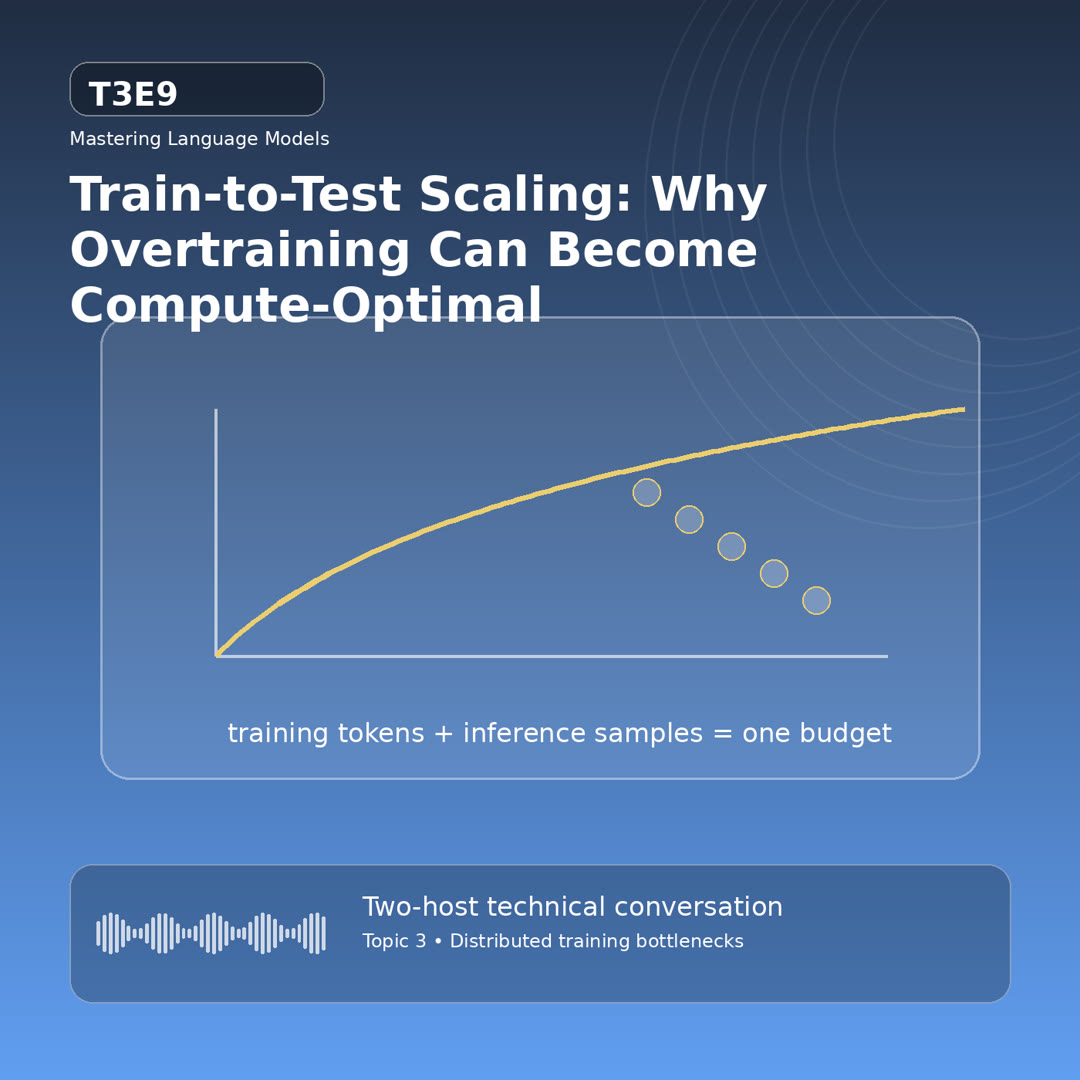
MayaFirst, the paper introduces Train-to-Test, or T², scaling laws that jointly optimize model size, training tokens, and number of inference samples under fixed end-to-end budgets.
LeoThat sounds small, but it changes the engineering picture. In other words, the system is not only asking, “Can we compute this?” It is also asking, “Can we store it, move it, and synchronize it before the GPUs go idle?”
MayaSecond, it argues that standard pretraining scaling laws such as Chinchilla do not address inference cost when systems use repeated sampling or other test-time scaling strategies.
LeoThat is the part many people miss. The win is not just academic elegance. The win is making a training run cross a hard boundary: fits versus does not fit, stalls versus keeps flowing, theoretical speed versus actual wall-clock speed.
MayaThird, across eight downstream tasks, the paper finds that accounting for inference cost can shift optimal pretraining decisions into an overtraining regime well outside standard pretraining scaling suites.
LeoSo we should treat this as a design pattern, not a one-off trick. The pattern is: find the hidden resource that is being wasted, then redesign the training loop around it.
MayaThe older compute-optimal story says: given a training compute budget, choose model size and tokens wisely. But deployed reasoning systems often sample multiple answers, use pass-at-k, or spend extra tokens thinking.
LeoSo a model that looks optimal during pretraining may not be optimal when you count the cost of asking it to solve tasks.
MayaRight. A smaller, more heavily trained model may give better total economics if it is cheaper to sample many times or cheaper to run through a test-time search process.
LeoThat connects back to distributed training because training decisions are not isolated. The deployment strategy can reach backward and change what model you should train in the first place.
MayaExactly. The lifecycle becomes one optimization problem: training compute, inference compute, task accuracy, and operating cost.
LeoHere is the expert disagreement I hear underneath this episode: Should we optimize for pretraining efficiency or total lifecycle efficiency?
MayaThe strongest arguments are both reasonable. Pretraining-only metrics are cleaner and easier to compare. Lifecycle efficiency is more realistic because deployed systems pay for inference millions or billions of times.
LeoAnd the practical answer is usually not ideological. It depends on the model shape, sequence length, hardware topology, training objective, and how much engineering time the team has.
MayaOvertraining here does not mean “bad training.” It means training beyond the token/model-size balance that would be compute-optimal if you only considered pretraining loss.
LeoLet’s add a concrete listener check. If you were debugging this in a real training run, what would you measure first?
MayaI would measure total task cost, not just one training metric: samples generated, fine-tuning compute, inference cost, accuracy, pass-at-k, and the cost of failed attempts.
LeoThat makes this episode useful beyond the paper. It gives the listener a diagnostic habit. Do not memorize the technique first. Find the bottleneck first.
MayaThe key accounting move is end-to-end budgeting. If a production system uses repeated sampling, tree search, verifier passes, or majority voting, then inference is not a small afterthought. It is part of the optimization target.
LeoThat makes the word overtraining less negative. A model may be overtrained relative to a pretraining-only law, but well-trained relative to a deployment system that needs cheap, repeated inference.
MayaThis also affects model comparisons. A larger model may win on one-shot accuracy but lose on cost-adjusted pass rate. A smaller overtrained model may be the better engine for test-time scaling.
LeoSo this paper turns scaling laws from a training recipe into a product-design question: what model should we train for the way we actually plan to use it?
MayaPass-at-k is a useful intuition. If a system can sample many candidate answers and check or select among them, then per-sample cost matters. A smaller model that is slightly weaker per sample can win if it supports many more samples for the same budget.
LeoThat changes the training target. Instead of asking for the best single forward pass, we ask for the best system under a budget: model size times training choices times inference strategy.
MayaThe paper’s overtraining point follows from that. Training more tokens into a smaller model can improve sample quality while keeping inference cost low enough for repeated attempts.
LeoSo it gives a formal reason for something practitioners already feel: deployment patterns should influence pretraining decisions.
MayaIt also connects to reasoning systems. If inference uses search, tool calls, verifiers, or multiple samples, the model is part of a larger computation graph. The compute-optimal model for that graph may differ from the compute-optimal model for pretraining loss alone.
LeoThat makes Train-to-Test scaling a natural endpoint for this topic. The bottleneck is no longer just inside training. It is across the whole path from training run to solved task.
MayaHere is a concrete product example. A coding assistant may generate several candidate patches, run tests, then ask the model to repair failures. In that system, the best base model is not necessarily the biggest one-shot model. It may be the model that gives the best cost-quality curve across repeated attempts.
LeoThat is where train-to-test thinking becomes practical. It helps teams decide whether to spend more budget on pretraining a larger model or on producing a model that is cheaper to sample many times.
MayaThe idea also interacts with post-training. A post-trained model may behave differently under sampling, reasoning, or verifier loops. So scaling laws have to survive the way models are actually used.
LeoThat makes this paper a bridge from training optimization to system optimization. It asks us to optimize not the model in isolation, but the model inside its usage pattern.
MayaBefore we close, let’s turn this into an implementation review. If a team brought you a Train-to-Test scaling plan, the first thing to ask is not whether the method sounds modern. It is whether the measurements show the right problem being solved.
LeoThe review checklist would include training FLOPs, model size, training tokens, inference samples, pass-at-k, and total task cost. That list sounds detailed, but it prevents one-dimensional thinking. A training run can improve one metric and quietly damage another.
MayaAnother review habit is to compare against the simplest baseline. If the fancy method beats a weak baseline but loses to a tuned simple setup, the story is not finished. Distributed training papers are strongest when they cross a hard boundary and still preserve efficiency.
LeoAnd the hardest question is: What model is compute-optimal for the system we will actually deploy? That question keeps the listener grounded in engineering reality instead of buzzwords.
MayaI also like asking what the method makes easier for future work. Some techniques are valuable because they train one model faster. Others are valuable because they let many teams explore model sizes, sequence lengths, or training recipes that were previously out of reach.
LeoThat is the broader theme of Topic 3. Distributed training is not just about bragging rights. It changes the experiments researchers can afford to run, and those experiments shape the models everyone else later uses.
MayaHere is the one-sentence version: A model is not only expensive when you train it. It is expensive every time you ask it to think, sample, retry, or vote across candidates.
LeoAnd for anyone who wants to go deeper, we’ll include the primary material and extra reading notes in the episode metadata. This is one of those topics where diagrams, source links, and implementation notes really help.
MayaWhen evaluating a model, should the unit of comparison be training FLOPs, inference dollars, or the full cost of solving a task correctly?
LeoHold onto that question. In the next episode, we keep following the same theme: find the bottleneck, then decide whether to split, shard, move, recompute, or rethink the training plan.
CreditsThanks for listening. The producer is William Liu. Join us for the next episode.
Source material
← Back to Mastering Language Models: From Architecture to Optimization