Transcript
Generated: 2026-05-10 03:16 UTC
---
MayaBefore we jump in, here's a quick setup for this episode on t3e8_ssd_self_distillation_code generation. You'll hear Maya and Leo work through the topic together.
MayaThis one sounds almost suspiciously simple: let the model generate code, then train the model on its own generated code.
LeoHere is the useful tension for this episode: the bottleneck is not one thing. It is a stack of limits, and this episode picks one layer of that stack.
MayaThe last episodes were about hardware efficiency. Self-Distillation moves the bottleneck to data and post-training: can a model improve without expensive human labels, a stronger teacher, or a verifier?
LeoSo the listener should not picture a neat whiteboard equation only. They should picture a training job as a living system: chips, memory, network links, data loaders, kernels, and a clock that punishes every idle moment.
MayaExactly. Self-distillation treats the model’s own generations as a training signal. The surprising part is not that generated data helps sometimes; it is that unverified raw outputs can still reshape the model in useful ways.
LeoGive me the everyday version before we go technical.
MayaFor code, a model often needs creativity at the plan level and precision at the syntax level. Sampling can explore plans, but it may also wander into bad tokens. Self-Distillation tries to train the model so useful exploration remains while distracting low-precision tails get suppressed.
LeoNice. That makes the paper feel less abstract. But what is the specific move?
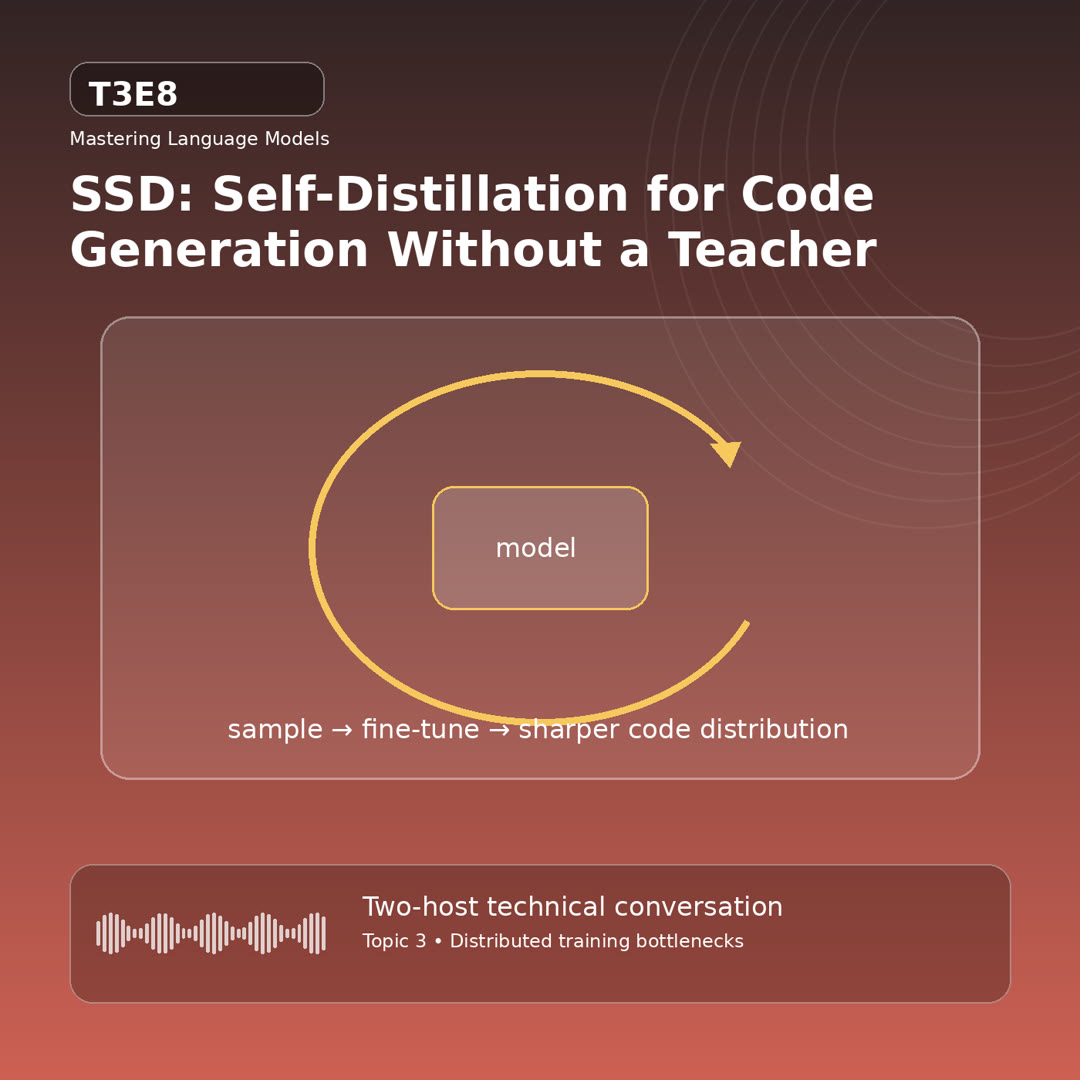
MayaFirst, the Self-Distillation paper asks whether an Large Language Model can improve at code generation using only its own raw outputs, without a verifier, teacher model, or reinforcement learning.
LeoI want to slow that down. In other words, the system is not only asking, “Can we compute this?” It is also asking, “Can we store it, move it, and synchronize it before the GPUs go idle?”
MayaSecond, the method samples solutions under chosen temperature and truncation settings, then fine-tunes on those samples with standard supervised fine-tuning.
LeoThat is the part many people miss. The win is not just academic elegance. The win is making a training run cross a hard boundary: fits versus does not fit, stalls versus keeps flowing, theoretical speed versus actual wall-clock speed.
MayaThird, the paper reports improving Qwen3-30B-Instruct from 42.4 percent to 55.3 percent pass at 1 on Live Code Bench v6, with gains concentrated on harder problems, and attributes the effect to a precision-exploration conflict in decoding.
LeoSo we should treat this as a design pattern, not a one-off trick. The pattern is: find the hidden resource that is being wasted, then redesign the training loop around it.
MayaThe authors frame a precision-exploration conflict. During decoding, sometimes the model needs to explore possible solution paths. Other times, especially in code, it needs to be extremely precise about tokens, syntax, and small implementation details.
LeoSampling helps exploration but can hurt precision. Greedy decoding helps precision but can get stuck in a mediocre plan.
MayaSelf-Distillation tries to convert exploratory samples into a training signal that improves the distribution itself. Instead of only changing the decoding strategy at inference time, it fine-tunes the model to prefer better token behavior in context.
LeoThat feels related to efficiency because good self-generated data might reduce dependence on expensive labels or external verifiers.
MayaExactly. It is not distributed training, but it belongs in this topic’s broader bottleneck story: compute is not only hardware; it is also how many attempts, labels, checks, and post-training cycles you need.
LeoHere is the expert disagreement I hear underneath this episode: Is self-generated data dangerous because it can amplify errors?
MayaThe strongest arguments are both reasonable. Yes, poor self-training can reinforce mistakes. The strongest counterargument is empirical: with the right sampling setup and task, the model’s own distribution contains useful traces that supervised fine-tuning can consolidate.
LeoAnd the practical answer is usually not ideological. It depends on the model shape, sequence length, hardware topology, training objective, and how much engineering time the team has.
MayaDo not confuse Self-Distillation with reinforcement learning or execution-verified code training. The simplicity is the point: no reward model, no teacher, no verifier loop in the core recipe.
LeoLet’s add a concrete listener check. If you were debugging this in a real training run, what would you measure first?
MayaI would measure total task cost, not just one training metric: samples generated, fine-tuning compute, inference cost, accuracy, pass-at-k, and the cost of failed attempts.
LeoThat makes this episode useful beyond the paper. It gives the listener a diagnostic habit. Do not memorize the technique first. Find the bottleneck first.
MayaA useful comparison is knowledge distillation. Classic distillation often uses a stronger teacher model to train a smaller student. Self-Distillation removes the teacher. The model is both generator of training data and recipient of the update.
LeoThat makes the result provocative. If the model is learning from itself, the obvious concern is collapse or error amplification. The paper’s claim is that, for code generation, the sampled distribution still contains useful structure.
MayaFor listeners, the operational question is data quality control. Even when the core method does not use a verifier, teams applying this idea would still need to monitor benchmark transfer, failure modes, and whether improvements are concentrated or broad.
LeoSo Self-Distillation is best heard as a low-friction post-training direction, not as proof that labels, execution, or human feedback no longer matter.
MayaLet’s separate three ideas: sampling, selection, and fine-tuning. Self-Distillation samples from the model under chosen decoding settings. It does not rely on an external teacher to label outputs, and it does not require a verifier to prove correctness before using the samples.
LeoThat makes the result feel almost like recycling. The model produces attempts, and the training loop turns those attempts into a new supervised dataset.
MayaThe code-generation setting is special because the output distribution has sharp constraints. One token can break syntax. A small wrong branch can fail tests. So reshaping token probabilities can matter a lot.
LeoAnd the reported gains concentrating on harder problems suggest the method is not merely polishing easy cases. It may be changing how the model handles uncertain solution spaces.
MayaStill, listeners should be cautious. Self-distillation is not automatically safe for every domain. If the model’s generated data is systematically biased or wrong, training on it can preserve that pattern.
LeoSo the engineering question is: where does the model’s own distribution contain enough useful signal, and how do we detect when it does not?
MayaThis episode also opens a philosophical question about data. In supervised learning, we often treat external labels as the source of truth. In self-distillation, the model’s own behavior becomes part of the training corpus.
LeoThat can sound circular, but it is not automatically empty. A model distribution can contain good attempts, mediocre attempts, and noisy attempts. Training can change which regions of that distribution become more likely.
MayaFor code, there is another angle: many problems require both exploration and exactness. The model may generate a promising algorithm but fail on details. If fine-tuning shifts probability mass away from distracting token tails, pass rates can improve.
LeoSo Self-Distillation is not saying every generated sample is correct. It is saying the collection of samples may contain enough structure to improve the model when used carefully.
MayaBefore we close, let’s turn this into an implementation review. If a team brought you an Self-Distillation experiment, the first thing to ask is not whether the method sounds modern. It is whether the measurements show the right problem being solved.
LeoThe review checklist would include sample generation settings, fine-tuning cost, benchmark transfer, error amplification, and hard-problem gains. That list sounds detailed, but it prevents one-dimensional thinking. A training run can improve one metric and quietly damage another.
MayaAnother review habit is to compare against the simplest baseline. If the fancy method beats a weak baseline but loses to a tuned simple setup, the story is not finished. Distributed training papers are strongest when they cross a hard boundary and still preserve efficiency.
LeoAnd the hardest question is: Are self-generated samples improving the model broadly, or only teaching it to repeat its own habits? That question keeps the listener grounded in engineering reality instead of buzzwords.
MayaI also like asking what the method makes easier for future work. Some techniques are valuable because they train one model faster. Others are valuable because they let many teams explore model sizes, sequence lengths, or training recipes that were previously out of reach.
LeoThat is the broader theme of Topic 3. Distributed training is not just about bragging rights. It changes the experiments researchers can afford to run, and those experiments shape the models everyone else later uses.
MayaSo the compressed takeaway is: Self-distillation treats the model’s own generations as a training signal. The surprising part is not that generated data helps sometimes; it is that unverified raw outputs can still reshape the model in useful ways.
LeoAnd for anyone who wants to go deeper, we’ll include the primary material and extra reading notes in the episode metadata. This is one of those topics where diagrams, source links, and implementation notes really help.
MayaIf a model can learn from its own attempts, where is the boundary between cheap improvement and self-reinforcing noise?
LeoHold onto that question. In the next episode, we keep following the same theme: find the bottleneck, then decide whether to split, shard, move, recompute, or rethink the training plan.
CreditsThanks for listening. The producer is William Liu. Join us for the next episode.
Source material
← Back to Mastering Language Models: From Architecture to Optimization