Transcript
Generated: 2026-05-10 03:15 UTC
---
MayaBefore we jump in, here's a quick setup for this episode on t3e5_distributed_training architecture. You'll hear Maya and Leo work through the topic together.
MayaA single scaling technique is like a good engine part. A training architecture is the whole race car, the pit crew, and the track conditions.
LeoLet’s make the invisible bottleneck visible: the bottleneck is not one thing. It is a stack of limits, and this episode picks one layer of that stack.
MayaSo far, we have looked at pipeline parallelism, tensor parallelism, memory sharding, and F S D P. Now we zoom out: how do these pieces become a real distributed training architecture?
LeoSo the listener should not picture a neat whiteboard equation only. They should picture a training job as a living system: chips, memory, network links, data loaders, kernels, and a clock that punishes every idle moment.
MayaExactly. A large-model training run is a distributed system with machine-learning math inside it. You have compute, memory, network, storage, failures, monitoring, and scheduling all entangled.
LeoGive me the everyday version before we go technical.
MayaImagine training across many racks. GPUs inside one node may communicate over very fast links. GPUs across racks may be slower. A good layout keeps frequent communication local and pushes less frequent communication across slower links. The topology shapes the training algorithm.
LeoNice. That makes the paper feel less abstract. But what is the specific move?
MayaFirst, the 2025 A C M source in the series frames efficient distributed learning as necessary for large-scale language models in Natural Language Processing.
LeoThat sounds small, but it changes the engineering picture. In other words, the system is not only asking, “Can we compute this?” It is also asking, “Can we store it, move it, and synchronize it before the GPUs go idle?”
MayaSecond, architecture-level design must coordinate data parallelism, model parallelism, communication patterns, hardware topology, checkpointing, data loading, and fault recovery.
LeoThat is the part many people miss. The win is not just academic elegance. The win is making a training run cross a hard boundary: fits versus does not fit, stalls versus keeps flowing, theoretical speed versus actual wall-clock speed.
MayaThird, the biggest challenge is not choosing one best parallelism method; it is composing methods so the slowest bottleneck does not dominate the entire run.
LeoSo we should treat this as a design pattern, not a one-off trick. The pattern is: find the hidden resource that is being wasted, then redesign the training loop around it.
MayaArchitecture-level thinking also changes how we read benchmark numbers. A paper might report great G P U utilization, but that number sits on top of choices about batch size, sequence length, topology, precision, checkpointing, and failure handling.
LeoSo if someone says, “We trained on thousands of GPUs,” the follow-up is not just “how many?” It is “how were they connected, and what communication pattern did the algorithm create?”
MayaPrecisely. The network can become the bottleneck. Storage can become the bottleneck. Checkpoint writing can become the bottleneck. Even the input pipeline can starve expensive accelerators.
LeoAnd failures become normal at scale. If a small job runs for a few hours, maybe nothing breaks. If a huge job runs for weeks, the system has to expect restarts, degraded nodes, and recovery.
MayaThat is why distributed training is really a reliability discipline too.
LeoHere is the expert disagreement I hear underneath this episode: Should training architecture be designed around the model or around the cluster?
MayaThe strongest arguments are both reasonable. Model-first design gives cleaner algorithms. Cluster-first design often wins in production because the interconnect, failure rate, available memory, and job scheduler decide what is actually efficient.
LeoAnd the practical answer is usually not ideological. It depends on the model shape, sequence length, hardware topology, training objective, and how much engineering time the team has.
MayaMany diagrams show parallelism as clean boxes, but real systems have jitter, stragglers, dataloader stalls, checkpoint delays, kernel launch overhead, and node failures.
LeoLet’s add a concrete listener check. If you were debugging this in a real training run, what would you measure first?
MayaI would inspect utilization over time, communication traces, dataloader stalls, memory peaks, and checkpoint timing. Averages hide too much. The shape of the stalls tells you what the system is really doing.
LeoThat makes this episode useful beyond the paper. It gives the listener a diagnostic habit. Do not memorize the technique first. Find the bottleneck first.
MayaOne hidden architecture issue is checkpointing. Saving model state is necessary, but checkpointing huge models can stall training if storage bandwidth or coordination is poor. A training run that looks compute-bound during normal steps can become storage-bound every time it saves.
LeoAnd the failure story matters. At small scale, a crash is an interruption. At large scale, failures are expected events. The architecture needs recovery paths, not just a happy-path training loop.
MayaAnother hidden issue is data supply. If tokenization, streaming, shuffling, or preprocessing cannot feed the GPUs fast enough, the most sophisticated parallelism strategy still waits on input.
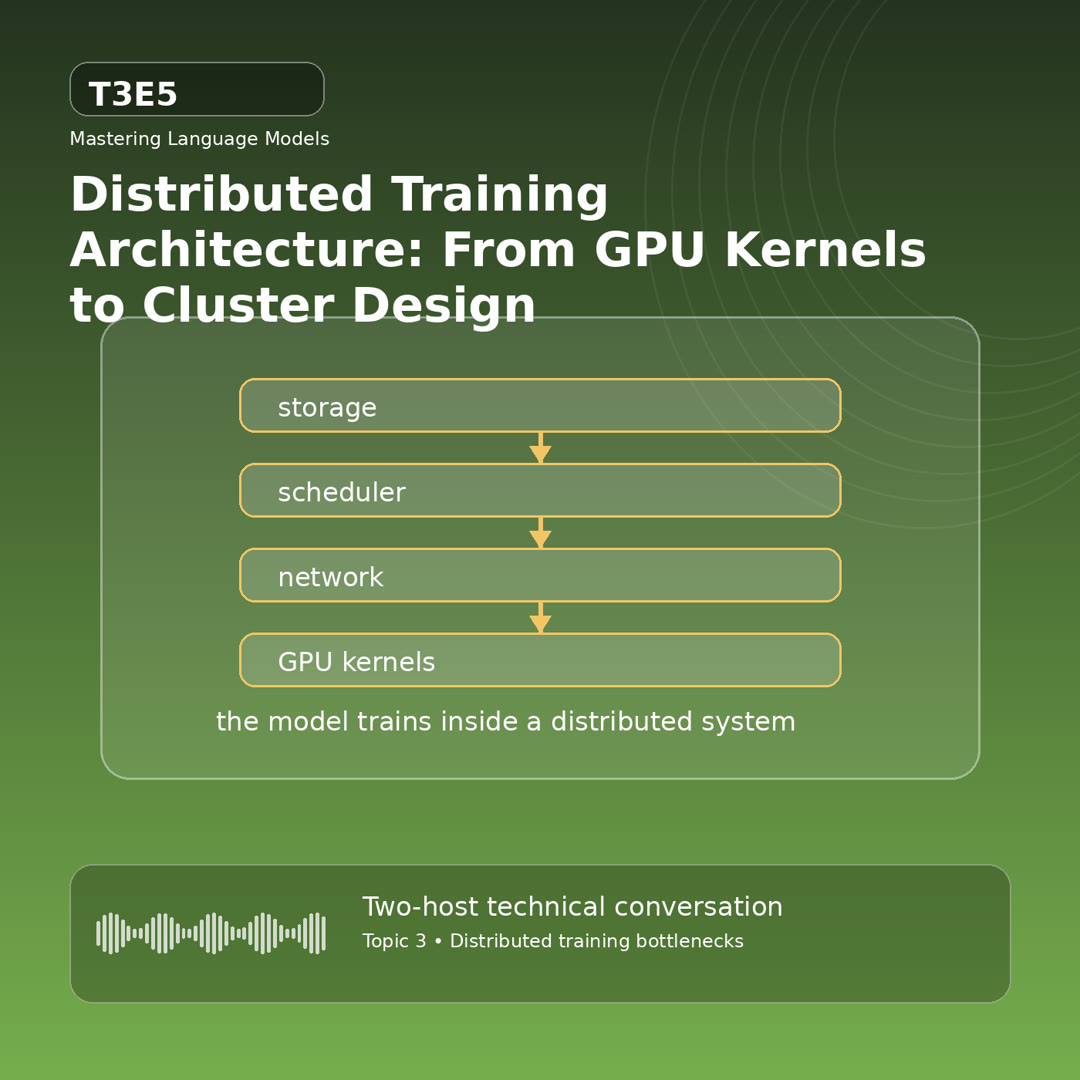
LeoThat is why system diagrams should include storage and data pipelines, not only G P U boxes. The model trains at the speed of the slowest necessary subsystem.
MayaAt architecture level, topology becomes a first-class design object. A node may have fast local G P U links, while cross-node traffic is slower. A good training layout keeps high-frequency communication inside the fastest neighborhood whenever possible.
LeoThat is why two clusters with the same number of GPUs can behave differently. The count is the headline. The interconnect is the story underneath.
MayaScheduling also matters. Large jobs may need placement guarantees so parallel groups land on nearby hardware. If the scheduler spreads a tightly synchronized job poorly, the algorithm pays for it every step.
LeoAnd the storage system is part of training too. Datasets have to stream, checkpoints have to land, and logs have to be available for debugging without drowning the system.
MayaMonitoring closes the loop. Without traces, teams only see final throughput. With traces, they can identify network contention, memory spikes, stragglers, slow checkpoint windows, or input starvation.
LeoSo a mature distributed-training architecture is not just faster. It is observable. It gives engineers evidence when something slows down.
MayaA full training architecture also has people in the loop. Researchers need experiment tracking. Infrastructure teams need alerts. Data teams need lineage. Security teams may need access controls. The larger the run, the more the model becomes an organizational system.
LeoThat is a great point. We often talk like the training run is only math, but production-scale training is also operations. Someone has to know whether a throughput drop is a model change, a network issue, a data issue, or a failing node.
MayaThis is also why reproducibility is hard. Re-running the same recipe months later may involve new drivers, new kernels, different node placement, changed datasets, or different failure patterns.
LeoSo architecture is partly about reducing surprises. It gives teams stable ways to launch, observe, recover, and compare training runs.
MayaBefore we close, let’s turn this into an implementation review. If a team brought you a distributed architecture, the first thing to ask is not whether the method sounds modern. It is whether the measurements show the right problem being solved.
LeoThe review checklist would include topology, storage, scheduling, input pipeline, checkpointing, logging, and failure recovery. That list sounds detailed, but it prevents one-dimensional thinking. A training run can improve one metric and quietly damage another.
MayaAnother review habit is to compare against the simplest baseline. If the fancy method beats a weak baseline but loses to a tuned simple setup, the story is not finished. Distributed training papers are strongest when they cross a hard boundary and still preserve efficiency.
LeoAnd the hardest question is: Can we explain a slowdown from traces instead of guessing? That question keeps the listener grounded in engineering reality instead of buzzwords.
MayaI also like asking what the method makes easier for future work. Some techniques are valuable because they train one model faster. Others are valuable because they let many teams explore model sizes, sequence lengths, or training recipes that were previously out of reach.
LeoThat is the broader theme of Topic 3. Distributed training is not just about bragging rights. It changes the experiments researchers can afford to run, and those experiments shape the models everyone else later uses.
MayaHere is the one-sentence version: A large-model training run is a distributed system with machine-learning math inside it. You have compute, memory, network, storage, failures, monitoring, and scheduling all entangled.
LeoAnd for anyone who wants to go deeper, we’ll include the primary material and extra reading notes in the episode metadata. This is one of those topics where diagrams, source links, and implementation notes really help.
MayaIf the model is the headline, what hidden part of the system would you inspect first before trusting a training-speed claim?
LeoHold onto that question. In the next episode, we keep following the same theme: find the bottleneck, then decide whether to split, shard, move, recompute, or rethink the training plan.
CreditsThanks for listening. The producer is William Liu. Join us for the next episode.
Source material
← Back to Mastering Language Models: From Architecture to Optimization