Transcript
Generated: 2026-05-10 03:14 UTC
---
MayaBefore we jump in, here's a quick setup for this episode on t3e4_fsdp_fully_sharded_data parallel. You'll hear Maya and Leo work through the topic together.
MayaF S D P is the moment sharding stops feeling like a research trick and starts feeling like a daily engineering tool.
LeoHere is the useful tension for this episode: the bottleneck is not one thing. It is a stack of limits, and this episode picks one layer of that stack.
MayaZeRO taught us to stop replicating everything. F S D P brings the same family of ideas into a practical data-parallel training workflow.
LeoSo the listener should not picture a neat whiteboard equation only. They should picture a training job as a living system: chips, memory, network links, data loaders, kernels, and a clock that punishes every idle moment.
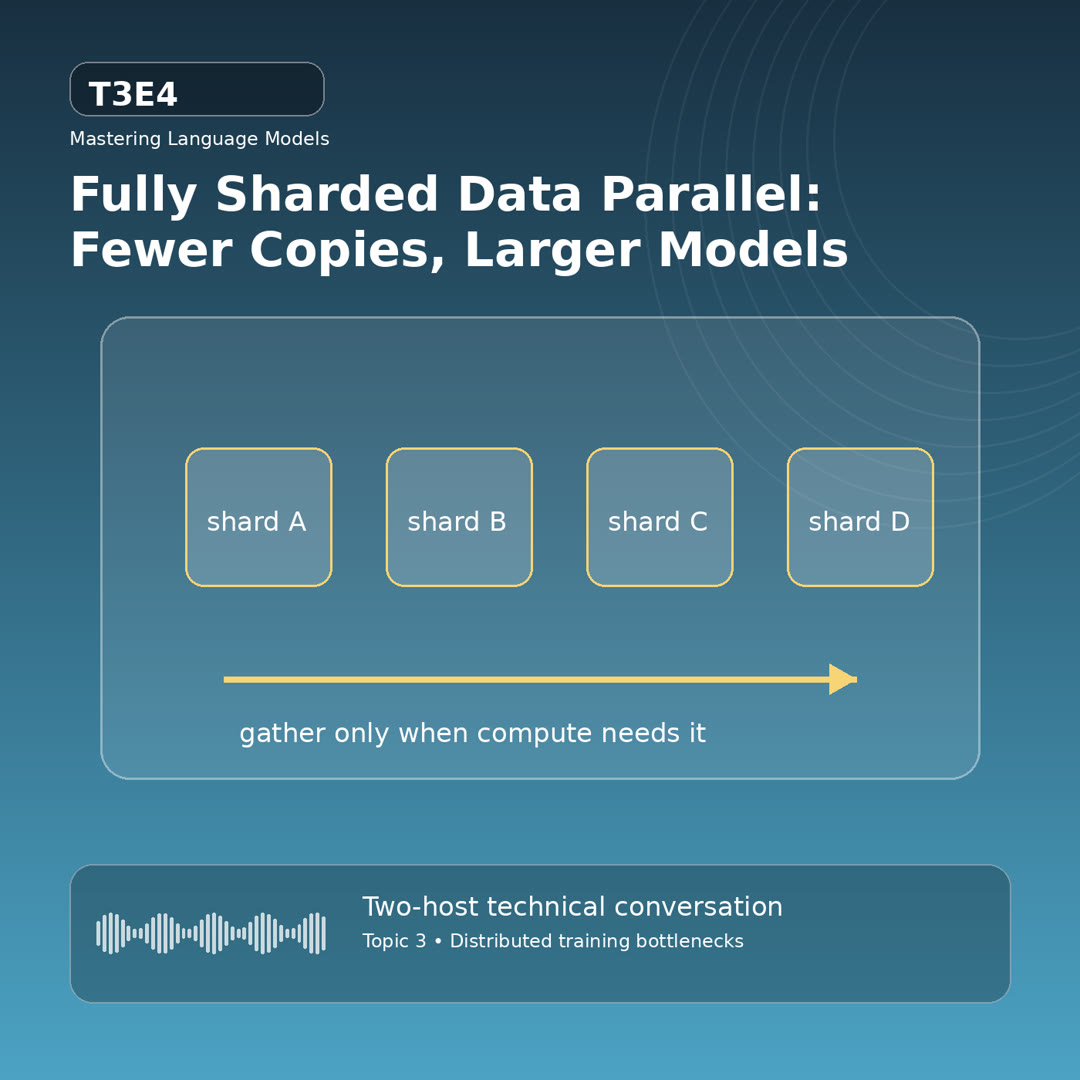
MayaExactly. Fully Sharded Data Parallel keeps the data-parallel rhythm, but it shards the model states across workers and materializes full pieces only when computation needs them.
LeoGive me the everyday version before we go technical.
MayaThink of a team editing a huge textbook. In naive data parallelism, everyone carries the entire textbook plus notes plus revisions. In F S D P, each person stores a section. When chapter six is being edited, the relevant pages are temporarily assembled, used, and then released.
LeoNice. That makes the paper feel less abstract. But what is the specific move?
MayaFirst, meta’s F S D P writeup describes it as a data-parallel training algorithm that shards model parameters across data-parallel workers and can optionally offload parts of training computation to CPUs.
LeoI want to slow that down. In other words, the system is not only asking, “Can we compute this?” It is also asking, “Can we store it, move it, and synchronize it before the GPUs go idle?”
MayaSecond, although parameters are sharded across GPUs, computation for each microbatch remains local to each G P U worker after the needed parameters are gathered.
LeoThat is the part many people miss. The win is not just academic elegance. The win is making a training run cross a hard boundary: fits versus does not fit, stalls versus keeps flowing, theoretical speed versus actual wall-clock speed.
MayaThird, the practical promise is training larger models more efficiently, often with fewer GPUs than naive data parallelism would require.
LeoSo we should treat this as a design pattern, not a one-off trick. The pattern is: find the hidden resource that is being wasted, then redesign the training loop around it.
MayaIn practice, F S D P became attractive because engineers do not always want to manually design a custom model-parallel layout. They want something that composes with ordinary training code.
LeoBut the phrase fully sharded can sound like every problem is solved.
MayaIt is more like every problem becomes negotiable. You can choose how modules are wrapped, when parameters are gathered, whether activations are checkpointed, and how communication overlaps with compute.
LeoThe system is hiding complexity, but not deleting it.
MayaExactly. A good framework makes the common path sane. Expert tuning still matters when throughput, memory, and stability all have to be pushed.
LeoHere is the expert disagreement I hear underneath this episode: Should engineers use F S D P-like automation or write custom parallel layouts?
MayaThe strongest arguments are both reasonable. F S D P is powerful because it integrates with common training code. Custom layouts can still beat it when a model has unusual architecture, extreme sequence lengths, or strict throughput targets.
LeoAnd the practical answer is usually not ideological. It depends on the model shape, sequence length, hardware topology, training objective, and how much engineering time the team has.
MayaF S D P is not a magic memory eraser. The all-gather timing, wrapping policy, activation checkpointing, batch size, and communication overlap all affect whether it speeds up training or merely fits the model.
LeoLet’s add a concrete listener check. If you were debugging this in a real training run, what would you measure first?
MayaI would measure peak memory by category: parameters, gradients, optimizer state, activations, temporary buffers, and communication buffers. Then I would check whether sharding just moved the pain into network time.
LeoThat makes this episode useful beyond the paper. It gives the listener a diagnostic habit. Do not memorize the technique first. Find the bottleneck first.
MayaF S D P also highlights the value of wrapping policy. Engineers choose which modules are sharded as units. Wrap too coarsely and memory spikes may be too high. Wrap too finely and communication overhead may become annoying.
LeoThat is a great practical knob. The abstraction says fully sharded, but the performance depends on boundaries: where one wrapped unit ends, when gathering happens, and when memory is released.
MayaAnother knob is activation checkpointing. F S D P reduces model-state memory, but activations can still dominate for long sequences. Recomputing activations can pair well with sharding, as long as the extra compute is acceptable.
LeoSo F S D P is not just a memory technique. It is part of a recipe: sharding for states, checkpointing for activations, and careful overlap so communication does not become the new wall.
MayaA useful way to compare F S D P and naive data parallelism is to ask what sits in memory between layers. In naive data parallelism, every worker keeps full model state. With F S D P, a worker can hold shards and assemble full parameters for a wrapped module only when needed.
LeoSo memory rises during computation, then falls after release. The peak matters, but the timing of the peak matters too.
MayaExactly. That is why F S D P users care about wrapping decisions and prefetch behavior. If you gather too early, memory can spike. If you gather too late, the G P U waits.
LeoThat makes F S D P feel like a logistics system: the right boxes have to arrive at the right workstation before the worker is idle, but not so early that the room fills up.
MayaThe C P U-offload option adds another trade-off. It can reduce G P U memory pressure, but moving data between C P U and G P U can slow the run if the transfer path becomes hot.
LeoSo the practical lesson is not “turn on F S D P and forget it.” It is “use F S D P to enter a better trade-off space, then profile the shape of that trade-off.”
MayaIn production, F S D P’s appeal is partly psychological. Engineers can often keep thinking in modules: wrap this block, shard this state, checkpoint this activation path. That is easier than manually inventing a full model-parallel schedule from scratch.
LeoBut the simplicity is conditional. If the team ignores profiling, F S D P may hide the problem until throughput disappoints. A model can fit and still train too slowly.
MayaA good F S D P workflow usually starts with fitting the model, then measuring. Peak memory, all-gather time, reduce-scatter time, overlap, and step-time variance all matter.
LeoSo this episode should leave listeners with a nuanced view: F S D P democratizes large-model training, but expert performance still comes from understanding the sharding schedule.
MayaBefore we close, let’s turn this into an implementation review. If a team brought you an F S D P setup, the first thing to ask is not whether the method sounds modern. It is whether the measurements show the right problem being solved.
LeoThe review checklist would include wrap policy, all-gather timing, reduce-scatter timing, activation checkpointing, and peak memory. That list sounds detailed, but it prevents one-dimensional thinking. A training run can improve one metric and quietly damage another.
MayaAnother review habit is to compare against the simplest baseline. If the fancy method beats a weak baseline but loses to a tuned simple setup, the story is not finished. Distributed training papers are strongest when they cross a hard boundary and still preserve efficiency.
LeoAnd the hardest question is: Does the model merely fit, or does it train with healthy throughput? That question keeps the listener grounded in engineering reality instead of buzzwords.
MayaI also like asking what the method makes easier for future work. Some techniques are valuable because they train one model faster. Others are valuable because they let many teams explore model sizes, sequence lengths, or training recipes that were previously out of reach.
LeoThat is the broader theme of Topic 3. Distributed training is not just about bragging rights. It changes the experiments researchers can afford to run, and those experiments shape the models everyone else later uses.
MayaSo the compressed takeaway is: Fully Sharded Data Parallel keeps the data-parallel rhythm, but it shards the model states across workers and materializes full pieces only when computation needs them.
LeoAnd for anyone who wants to go deeper, we’ll include the primary material and extra reading notes in the episode metadata. This is one of those topics where diagrams, source links, and implementation notes really help.
MayaWhen should a training system feel invisible, and when should engineers intentionally expose the knobs?
LeoHold onto that question. In the next episode, we keep following the same theme: find the bottleneck, then decide whether to split, shard, move, recompute, or rethink the training plan.
CreditsThanks for listening. The producer is William Liu. Join us for the next episode.
Source material
← Back to Mastering Language Models: From Architecture to Optimization