Transcript
Generated: 2026-05-10 03:14 UTC
---
MayaBefore we jump in, here's a quick setup for this episode on t3e1_gpipe_pipeline parallelism. You'll hear Maya and Leo work through the topic together.
MayaThe first trick today is almost physical: if the model is too tall to fit on one chip, slice it into floors and put each floor on a different chip.
LeoLet’s make the invisible bottleneck visible: the bottleneck is not one thing. It is a stack of limits, and this episode picks one layer of that stack.
MayaIn the overview, we separated the bottlenecks. GPipe focuses on one of the easiest bottlenecks to visualize: the model is too large for a single accelerator, so split layers across accelerators.
LeoSo the listener should not picture a neat whiteboard equation only. They should picture a training job as a living system: chips, memory, network links, data loaders, kernels, and a clock that punishes every idle moment.
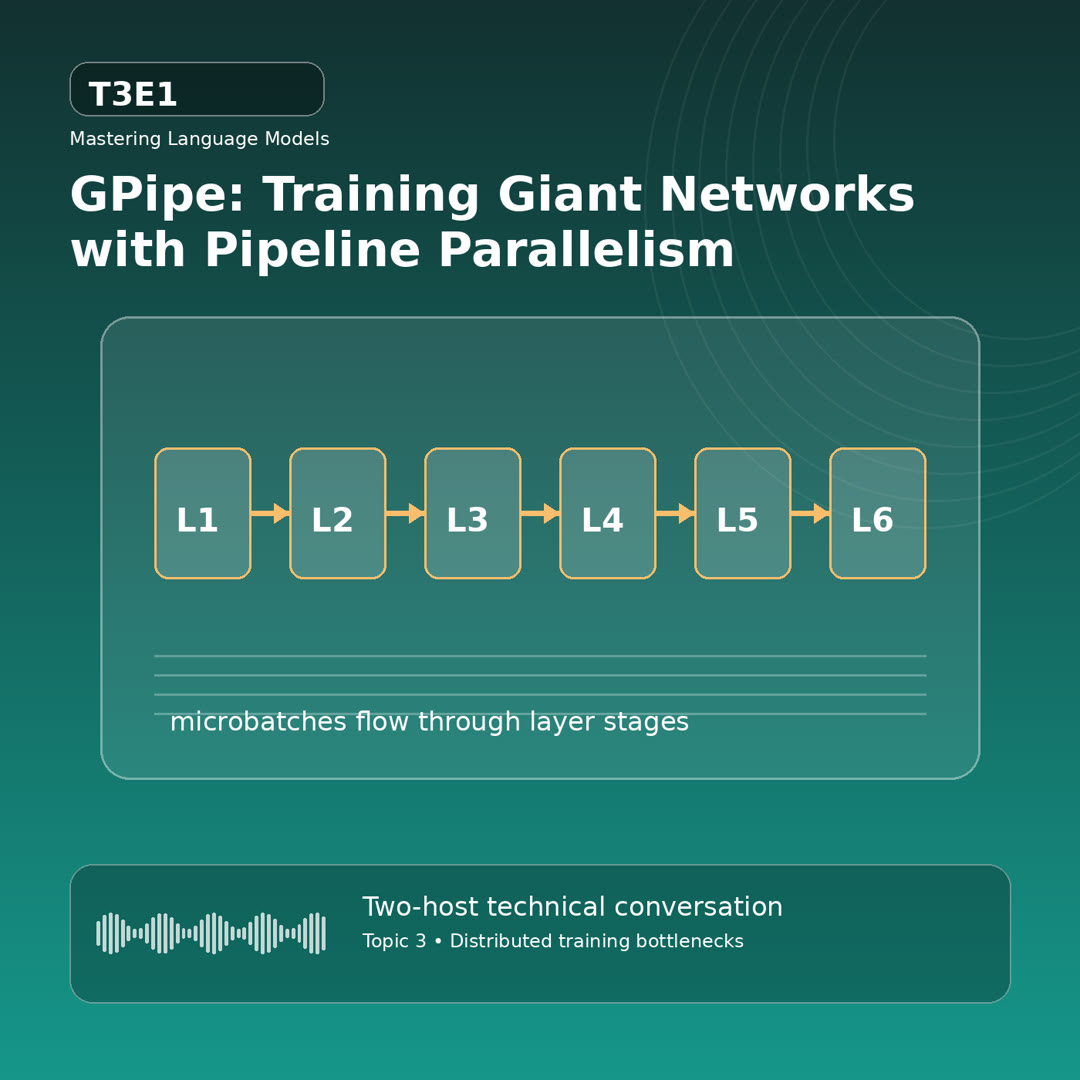
MayaExactly. Pipeline parallelism treats the neural network like an assembly line. Each device owns a stage, and microbatches move through the stages like trays on a conveyor belt.
LeoGive me the everyday version before we go technical.
MayaPicture a translation model with 128 layers. Rather than asking one G P U to hold the whole stack, GPipe might put layers 1 through 16 on G P U one, 17 through 32 on G P U two, and so on. Each microbatch enters the pipeline, and the goal is to keep every stage busy.
LeoNice. That makes the paper feel less abstract. But what is the specific move?
MayaFirst, g Pipe partitions a network that can be expressed as a sequence of layers and pipelines microbatches through those partitions.
LeoThat sounds small, but it changes the engineering picture. In other words, the system is not only asking, “Can we compute this?” It is also asking, “Can we store it, move it, and synchronize it before the GPUs go idle?”
MayaSecond, the paper reports almost linear speedup when the model is partitioned across multiple accelerators and demonstrates large examples including a 557-million-parameter Amoeba Net and a 6-billion-parameter, 128-layer Transformer for multilingual translation.
LeoThat is the part many people miss. The win is not just academic elegance. The win is making a training run cross a hard boundary: fits versus does not fit, stalls versus keeps flowing, theoretical speed versus actual wall-clock speed.
MayaThird, g Pipe also uses activation recomputation to reduce memory: instead of storing every intermediate activation, it can recompute some of them during the backward pass.
LeoSo we should treat this as a design pattern, not a one-off trick. The pattern is: find the hidden resource that is being wasted, then redesign the training loop around it.
MayaThe key detail is microbatching. Instead of sending one huge batch through stage one, then stage two, then stage three, GPipe slices the batch into smaller microbatches. That keeps the pipeline moving.
LeoLike sending several small trays through the kitchen instead of one giant cart.
MayaExactly. The forward pass flows from early layers to later layers. The backward pass flows back. The schedule has to manage both directions without letting devices sit empty.
LeoWhere does recomputation fit?
MayaActivations are the intermediate values needed for backpropagation. They can consume a lot of memory. GPipe can discard some activations during the forward pass and recompute them later during the backward pass, trading extra compute for lower memory.
LeoSo the paper is not only splitting the model. It is also choosing which intermediate facts to remember and which to regenerate.
LeoHere is the expert disagreement I hear underneath this episode: Is pipeline parallelism elegant or awkward?
MayaThe strongest arguments are both reasonable. It is elegant because it maps naturally onto layer stacks. It is awkward because pipeline bubbles, uneven stage times, and dependency between forward and backward passes can leave expensive devices idle.
LeoAnd the practical answer is usually not ideological. It depends on the model shape, sequence length, hardware topology, training objective, and how much engineering time the team has.
MayaThe pipeline bubble is the sneaky cost. At the beginning and end of a batch, not every device has work yet. More microbatches reduce bubbles, but they also affect batch size, memory, and optimizer behavior.
LeoLet’s add a concrete listener check. If you were debugging this in a real training run, what would you measure first?
MayaI would measure pipeline bubble time, per-stage compute time, activation memory, and whether the number of microbatches is high enough to keep stages busy without destabilizing training.
LeoThat makes this episode useful beyond the paper. It gives the listener a diagnostic habit. Do not memorize the technique first. Find the bottleneck first.
MayaThere is also a balancing problem. If one pipeline stage owns layers that take twice as long as the others, every other device can end up waiting. Partitioning by layer count is not always enough; partitioning by compute time and activation size can matter more.
LeoAnd that makes pipeline parallelism feel less like cutting a cake into equal slices and more like assigning jobs to specialists. The equal-looking slice may not be the equal-cost slice.
MayaGPipe also teaches a broader lesson about sequential models. If a model is naturally a chain of layers, layer-wise partitioning is intuitive. But if the model has complicated branches, routing, or uneven blocks, pipeline planning becomes more subtle.
LeoSo the listener should remember both the charm and the catch: pipelines make giant layer stacks trainable, but only when the schedule, microbatching, and stage balance keep the assembly line full.
MayaLet’s walk through a tiny pipeline. Microbatch one enters stage one. Then it moves to stage two while microbatch two enters stage one. After a few steps, every stage has work. That middle part is where the pipeline earns its keep.
LeoAnd the beginning and ending are where the bubble appears. At the start, later stages are empty. At the end, earlier stages run out of work. The pipeline is only fully occupied in the middle.
MayaExactly. If there are too few microbatches, the bubble is large compared with useful work. If there are many microbatches, utilization improves, but the training dynamics and memory schedule may change.
LeoThat gives the listener a knob: microbatch count. It is not just a batch-size detail. It is how the system hides dependency between stages.
MayaAnother knob is recomputation. Storing all activations is fast in the backward pass but costly in memory. Recomputing activations spends extra compute to unlock bigger models or larger batches.
LeoSo GPipe is a clean example of trading one scarce resource for another: memory is scarce, compute may be available, and the pipeline schedule decides whether the trade is worth it.
MayaA practical GPipe question is how to split the layers. Equal numbers of layers might be wrong if some layers are heavier, if attention cost grows with sequence length, or if activation sizes vary. Good partitioning is based on measured stage time, not just layer count.
LeoSo a pipeline can have a slowest station. If the plating station takes twice as long as cooking, the line backs up behind plating. In a model, the slowest stage defines how fast microbatches can flow.
MayaThat is also why pipeline parallelism can pair with tensor parallelism. If a single stage is too heavy, you may split that stage internally. The techniques compose because one divides the stack and the other divides the math inside a block.
LeoThe clean mental picture is: GPipe solves depth, tensor parallelism solves width, and sharding solves state. Real systems mix all three.
MayaBefore we close, let’s turn this into an implementation review. If a team brought you a pipeline-parallel run, the first thing to ask is not whether the method sounds modern. It is whether the measurements show the right problem being solved.
LeoThe review checklist would include stage balance, bubble size, microbatch count, activation memory, and recomputation overhead. That list sounds detailed, but it prevents one-dimensional thinking. A training run can improve one metric and quietly damage another.
MayaAnother review habit is to compare against the simplest baseline. If the fancy method beats a weak baseline but loses to a tuned simple setup, the story is not finished. Distributed training papers are strongest when they cross a hard boundary and still preserve efficiency.
LeoAnd the hardest question is: Are stages actually busy, or does the schedule merely look parallel on a diagram? That question keeps the listener grounded in engineering reality instead of buzzwords.
MayaI also like asking what the method makes easier for future work. Some techniques are valuable because they train one model faster. Others are valuable because they let many teams explore model sizes, sequence lengths, or training recipes that were previously out of reach.
LeoThat is the broader theme of Topic 3. Distributed training is not just about bragging rights. It changes the experiments researchers can afford to run, and those experiments shape the models everyone else later uses.
MayaHere is the one-sentence version: Pipeline parallelism treats the neural network like an assembly line. Each device owns a stage, and microbatches move through the stages like trays on a conveyor belt.
LeoAnd for anyone who wants to go deeper, we’ll include the primary material and extra reading notes in the episode metadata. This is one of those topics where diagrams, source links, and implementation notes really help.
MayaIf a model is an assembly line, what would you rather optimize first: shorter stages, fewer bubbles, or a better balance between stages?
LeoHold onto that question. In the next episode, we keep following the same theme: find the bottleneck, then decide whether to split, shard, move, recompute, or rethink the training plan.
CreditsThanks for listening. The producer is William Liu. Join us for the next episode.
Source material
← Back to Mastering Language Models: From Architecture to Optimization