Transcript
Generated: 2026-05-10 03:14 UTC
---
MayaBefore we jump in, here's a quick setup for this episode on t3e0_advanced_distributed_training overview. You'll hear Maya and Leo work through the topic together.
MayaA giant model is not trained on one heroic G P U. It is trained by a crowd of machines trying very hard not to trip over each other.
LeoHere is the useful tension for this episode: the bottleneck is not one thing. It is a stack of limits, and this episode picks one layer of that stack.
MayaLast time, scaling laws made compute feel like a clean budget. This topic is where that budget turns into cables, memory pressure, synchronization, and engineering trade-offs.
LeoSo the listener should not picture a neat whiteboard equation only. They should picture a training job as a living system: chips, memory, network links, data loaders, kernels, and a clock that punishes every idle moment.
MayaExactly. Distributed training is not just “use more GPUs.” It is the art of deciding what to copy, what to split, what to move, and what to recompute.
LeoGive me the everyday version before we go technical.
MayaImagine a restaurant serving a city. One kitchen cannot cook every meal, so you split the work: one station preps, one cooks, one plates, one handles delivery. But if plating waits for cooking, or delivery waits for addresses, the whole system slows down. Distributed training has the same choreography problem.
LeoNice. That makes the paper feel less abstract. But what is the specific move?
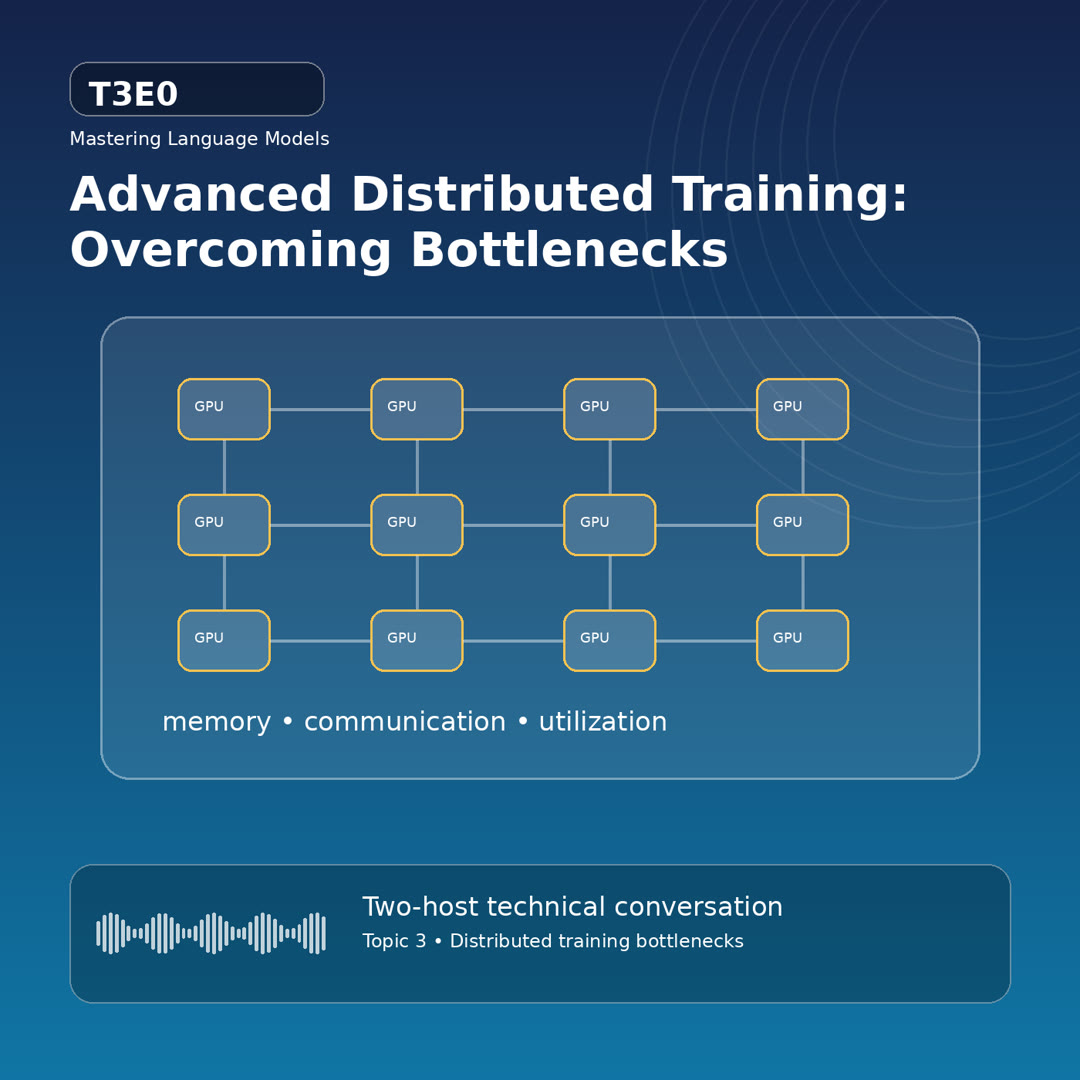
MayaFirst, the big bottlenecks are model-state memory, activation memory, G P U-to-G P U communication, pipeline idle time, and data movement between high-bandwidth memory and on-chip memory.
LeoI want to slow that down. In other words, the system is not only asking, “Can we compute this?” It is also asking, “Can we store it, move it, and synchronize it before the GPUs go idle?”
MayaSecond, g Pipe, Megatron-L M, ZeRO, F S D P, Flash Attention, and Flash Attention-2 each attack a different part of that bottleneck map.
LeoThat is the part many people miss. The win is not just academic elegance. The win is making a training run cross a hard boundary: fits versus does not fit, stalls versus keeps flowing, theoretical speed versus actual wall-clock speed.
MayaThird, the final two papers in this topic, Self-Distillation and Train-to-Test scaling, stretch the idea of “training efficiency” beyond the cluster: they ask how generation data and test-time compute change the cost equation.
LeoSo we should treat this as a design pattern, not a one-off trick. The pattern is: find the hidden resource that is being wasted, then redesign the training loop around it.
MayaLet’s build the map. GPipe is about layer-wise pipeline parallelism. Megatron-L M is about tensor parallelism inside Transformer layers. ZeRO and F S D P are about memory sharding. Flash Attention and Flash Attention-2 are about making attention respect the G P U memory hierarchy.
LeoAnd the last two episodes stretch the word efficiency. Self-Distillation asks whether a model can improve from its own generated code, and Train-to-Test scaling asks whether training decisions change once inference sampling cost is counted.
MayaThat is why Topic 3 is not merely a bag of tricks. It is a bottleneck tour. Every paper is saying, “The old limit was here; let’s move it somewhere else.”
LeoBut moving a bottleneck is not the same as eliminating bottlenecks.
MayaRight. If attention gets faster, communication may dominate. If memory is sharded, all-gather timing matters. If the model fits, checkpointing and data loading may become visible.
LeoHere is the expert disagreement I hear underneath this episode: Should distributed training systems hide complexity behind automatic frameworks, or should researchers control the parallelism strategy by hand?
MayaThe strongest arguments are both reasonable. Automation reduces mistakes and makes giant models accessible; hand control can still win because the best layout depends on architecture, batch size, sequence length, interconnect, optimizer, and training objective.
LeoAnd the practical answer is usually not ideological. It depends on the model shape, sequence length, hardware topology, training objective, and how much engineering time the team has.
MayaA common beginner mistake is to say “more GPUs equals faster training.” More GPUs can also mean more communication, more synchronization, more failure modes, and more time spent waiting.
LeoLet’s add a concrete listener check. If you were debugging this in a real training run, what would you measure first?
MayaI would inspect utilization over time, communication traces, dataloader stalls, memory peaks, and checkpoint timing. Averages hide too much. The shape of the stalls tells you what the system is really doing.
LeoThat makes this episode useful beyond the paper. It gives the listener a diagnostic habit. Do not memorize the technique first. Find the bottleneck first.
MayaA useful expert habit is to separate capacity from throughput. Capacity asks whether the model and states fit. Throughput asks how fast useful training tokens move through the system. A technique can solve capacity while hurting throughput, or improve throughput only after capacity is already solved.
LeoThat distinction prevents confusion. A memory-saving method can be a breakthrough even if it adds communication, because fitting the run at all may be the first constraint. But after it fits, the next question becomes whether the training job uses expensive hardware efficiently.
MayaAnother expert habit is to look for composition. Real training stacks combine tensor parallelism, pipeline parallelism, sharding, activation checkpointing, fused kernels, mixed precision, and attention kernels. The art is arranging them so their communication patterns do not collide.
LeoSo Topic 3 is really a vocabulary for reading systems papers. Whenever someone reports a massive model, we can ask: what was split, what was sharded, what was recomputed, what was fused, and what was still the bottleneck?
MayaLet’s also name the four classic levers. Data parallelism copies the model and splits examples. Pipeline parallelism splits layers. Tensor parallelism splits operations inside layers. Sharding splits model state so every worker does not carry the same memory burden.
LeoAnd those levers are not ranked from beginner to advanced. They answer different questions. Data parallelism asks how to process more examples. Pipeline asks how to fit a deep stack. Tensor parallelism asks how to split one big operation. Sharding asks how to stop repeating state.
MayaThat also explains why expert teams profile before they prescribe. If memory is the problem, tensor parallelism might be overkill. If communication is the problem, sharding more aggressively might make the run worse. If attention I/O dominates, Flash Attention may matter more than adding devices.
LeoSo the diagnostic sequence is: identify the bottleneck, estimate the trade-off, then choose the technique. The reverse order is dangerous because each method brings its own overhead.
MayaAnother shared mental model is that utilization has layers. A G P U can be busy but doing inefficient memory movement. A cluster can have many GPUs allocated but many waiting at barriers. A job can report high peak throughput but still waste time around checkpoints or restarts.
LeoThat is why we keep saying wall-clock. The user does not pay for theoretical elegance. They pay for a model that trains reliably, reaches target quality, and does not waste the hardware budget.
MayaLet’s imagine a team planning a run. The first engineer says the model does not fit. The second says the GPUs are underutilized. The third says checkpointing takes too long. The fourth says the dataloader cannot keep up. They are all talking about distributed training, but not the same failure.
LeoThat is why a shared vocabulary matters. Without it, teams argue past each other. One person proposes more GPUs, another proposes activation checkpointing, another proposes a faster attention kernel. Each fix may be reasonable for a different bottleneck.
MayaFor this topic, we want listeners to practice asking one question before every solution: what resource is scarce right now? Memory, bandwidth, arithmetic throughput, wall-clock time, data freshness, or inference budget?
LeoAnd the answer can change over the course of a project. Early on, fitting the model is the crisis. Later, throughput is the crisis. Near deployment, cost per useful answer may become the crisis.
MayaBefore we close, let’s turn this into an implementation review. If a team brought you a full distributed run, the first thing to ask is not whether the method sounds modern. It is whether the measurements show the right problem being solved.
LeoThe review checklist would include memory fit, sustained utilization, stable checkpoints, and predictable recovery. That list sounds detailed, but it prevents one-dimensional thinking. A training run can improve one metric and quietly damage another.
MayaAnother review habit is to compare against the simplest baseline. If the fancy method beats a weak baseline but loses to a tuned simple setup, the story is not finished. Distributed training papers are strongest when they cross a hard boundary and still preserve efficiency.
LeoAnd the hardest question is: Which bottleneck is dominant this week, not which technique is fashionable? That question keeps the listener grounded in engineering reality instead of buzzwords.
MayaI also like asking what the method makes easier for future work. Some techniques are valuable because they train one model faster. Others are valuable because they let many teams explore model sizes, sequence lengths, or training recipes that were previously out of reach.
LeoThat is the broader theme of Topic 3. Distributed training is not just about bragging rights. It changes the experiments researchers can afford to run, and those experiments shape the models everyone else later uses.
MayaSo the compressed takeaway is: Distributed training is not just “use more GPUs.” It is the art of deciding what to copy, what to split, what to move, and what to recompute.
LeoAnd for anyone who wants to go deeper, we’ll include the primary material and extra reading notes in the episode metadata. This is one of those topics where diagrams, source links, and implementation notes really help.
MayaWhen you hear about a new trillion-parameter system, ask: which bottleneck did they remove, and which new bottleneck did they create?
LeoHold onto that question. In the next episode, we keep following the same theme: find the bottleneck, then decide whether to split, shard, move, recompute, or rethink the training plan.
CreditsThanks for listening. The producer is William Liu. Join us for the next episode.
Source material
← Back to Mastering Language Models: From Architecture to Optimization