Transcript
Generated: 2026-05-01 01:45 UTC
---
MayaBefore we jump in, here's a quick setup for this episode on t2e2_training_compute_optimal_large_language_models_the_chinchilla lesson. You'll hear Maya and Leo work through the topic together.
MayaThe Chinchilla lesson is easy to say and hard to fully absorb: for a fixed compute budget, bigger is not always better if the model has not studied enough.
LeoThe paper is called Training Compute-Optimal Large Language Models. We’ll include it in the show notes as extra reading, especially because the tables comparing model size and training tokens are useful.
MayaLast episode, we covered scaling laws that made language model progress feel predictable. This paper revisits the budget question and says many large language models were trained with too many parameters and too few tokens.
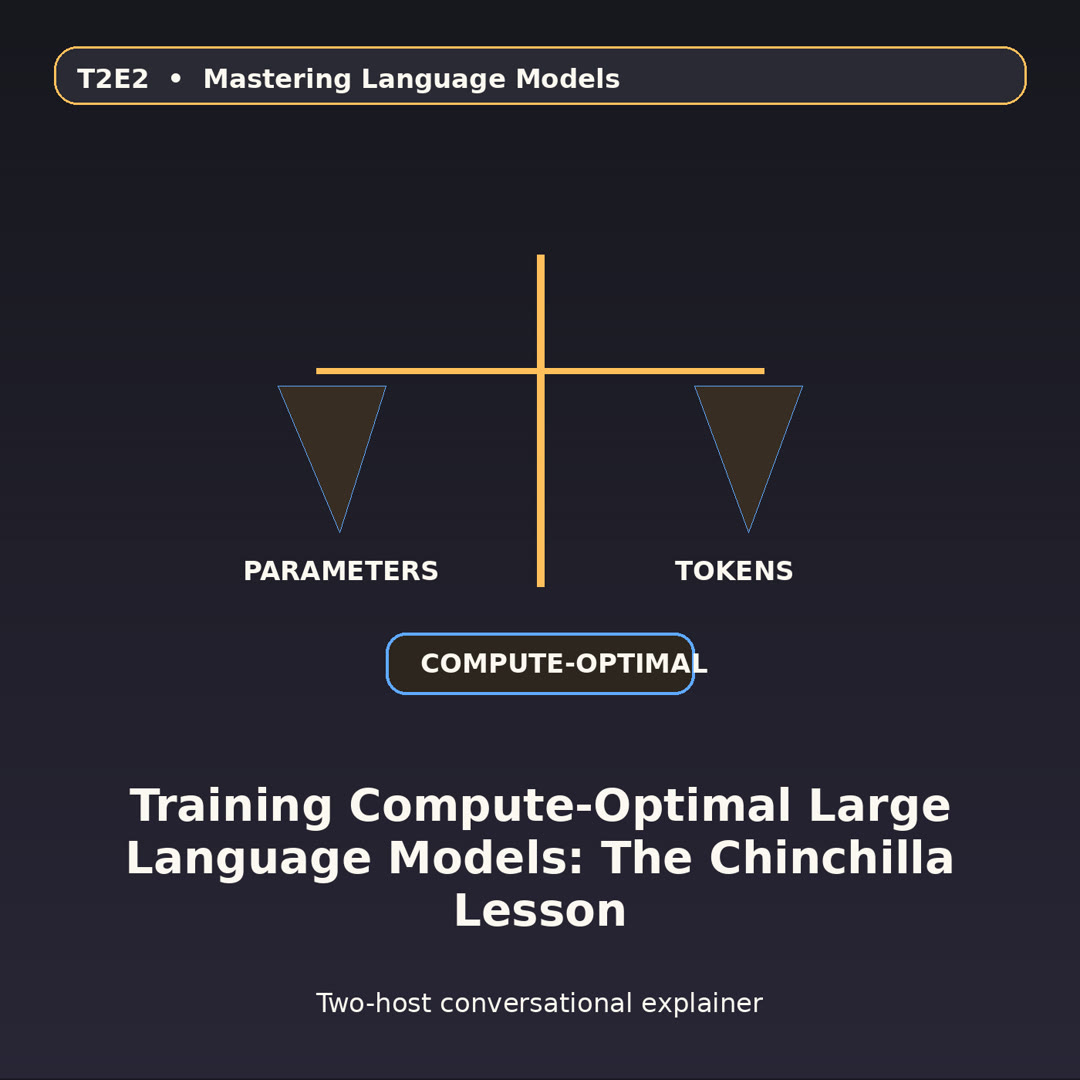
LeoLet’s define “compute-optimal.” It means: given a fixed amount of training compute, what model size and dataset size should you choose to get the lowest loss?
MayaNot the largest model. Not the most impressive parameter count. The best trade-off for the budget.
LeoThe paper trains hundreds of models across different parameter counts and token counts, then fits new scaling relationships. Its main conclusion is that model size and training tokens should scale roughly together.
MayaSo if you double the model size, you should also roughly double the number of training tokens. That is a different recommendation from “make the model enormous and stop early.”
LeoThe famous demonstration is Chinchilla: a 70-billion-parameter model trained on far more data than older models of similar compute budget. It outperformed much larger models like Gopher in many evaluations.
MayaThe important comparison is not “70B beats every bigger model forever.” It is “a smaller, better-trained model can beat a larger undertrained model at the same training budget.”
LeoLet’s use the student analogy again, but sharpen it. Imagine one student has a huge brain but only reads one textbook chapter. Another has a smaller brain but reads the whole course carefully. The second student may do better on exams.
MayaAnd in deployment, the smaller student is cheaper to ask questions. That matters. A 70B model is much easier to serve than a 280B model, even if training compute was comparable.
LeoThis is where training cost and inference cost meet. Compute-optimal pretraining can also produce a model that is more practical after training.
MayaLet’s talk about why the field had drifted toward undertraining. One reason is that parameter count was a visible headline number. Bigger models sounded more advanced.
LeoAnother reason is that earlier scaling guidance suggested large models were highly sample-efficient. If bigger models learn more per token, it made sense to spend compute on parameters.
MayaChinchilla does not deny sample efficiency. It says the optimal balance changes when you look carefully across model sizes and token budgets.
LeoA key expert mental model here is opportunity cost. Every training F L O P spent updating a huge model on too few tokens could have been spent training a smaller model longer.
MayaF L O P means floating point operation, basically a unit of numerical computation. You do not need to count each one as a listener; just hear “training effort.”
LeoThe paper’s recipe pushed the field toward more tokens per parameter. After Chinchilla, people started asking not just “How many parameters?” but “How many training tokens?”
MayaAnd that created a new problem. If models need more tokens to be compute-optimal, where do all those high-quality tokens come from?
LeoExactly. Chinchilla points directly to the data bottleneck. If you scale both parameters and tokens, data demand grows fast.
MayaLet’s introduce the disagreement. One side says Chinchilla-style compute optimality is a major correction: do not chase parameter count; train balanced models. The strongest argument is practical: smaller, better-trained models can be both stronger and cheaper.
LeoThe other side says the story is more complicated. Frontier labs may train larger models than compute-optimal for reasons beyond training loss: future fine-tuning, tool use, multimodal capacity, emergent abilities, or serving different product tiers.
MayaThere is also the inference angle. A model that is compute-optimal for training may not be optimal for serving. Sometimes you want a smaller model because it is cheaper to run. Sometimes you accept a bigger one because quality matters more than latency.
LeoSo compute-optimal is not business-optimal, product-optimal, or safety-optimal by default.
MayaAnother disagreement is about data quality. The paper focuses on token counts and scaling. But if extra tokens are lower quality, the simple balance can break. More text is not automatically more education.
LeoRight. Ten excellent books are different from ten thousand spam pages. That is why modern pretraining recipes care about filtering, deduplication, code data, multilingual balance, and synthetic data.
MayaLet’s make a practical scenario. A company wants a domain-specific legal model. Should they train a huge model on a modest legal corpus? Or a smaller model on more general plus legal data? Chinchilla says: check whether your model is undertrained. Do not assume the bigger parameter count wins.
LeoIt also says budget experiments matter. You can train smaller models at different token counts, fit curves, and estimate the better frontier.
MayaOne thing I like about Chinchilla is that it made “model size” less glamorous. It forced people to ask whether a model’s education matched its capacity.
LeoAnd it shifted the bragging rights. A meaningful model card should include parameters, tokens, data mixture, training compute, and evaluation suite.
MayaLet’s connect back to the Transformer. Transformers made scale practical. Scaling laws made progress predictable. Chinchilla made the allocation more balanced.
LeoAnd then data-constrained scaling asks: what if the balanced recipe demands more fresh data than the world can provide?
MayaBefore we move there, let’s name the paper’s main lesson in plain language. A large model is not automatically well-trained. If you do not feed it enough diverse tokens, you may be paying for capacity the training run never fully uses.
LeoThat line matters for model buyers too. When someone says a model has a certain parameter count, ask: how was it trained? How much data? What quality? What evaluations?
MayaThe parameter number is like the size of a university campus. It tells you something, but not whether the classes were good.
LeoGreat analogy. A giant campus with empty classrooms is not a great education.
MayaLet’s also discuss why this paper influenced open models. Many open model releases started reporting token counts more prominently, and teams began training smaller models longer to get strong performance within realistic budgets.
LeoIn some ways, Chinchilla democratized part of the strategy. Not everyone can train the biggest model, but many teams can think carefully about the data-to-parameter ratio.
MayaThat does not make training cheap. It just makes bad budget allocation more avoidable.
LeoAnd it leads to a final caution: compute-optimal laws are based on a loss objective. If your downstream goal is coding, math, medicine, or customer support, you still need task evaluations.
MayaSo the paper’s practical advice is: balance parameters and tokens, measure, and do not confuse a headline number with an optimized system.
LeoSummary: Chinchilla showed that many large models were undertrained, and that scaling model size and training tokens together could produce better models under the same compute budget. It shifted the field from “how big is it?” to “how well was the budget spent?”
MayaThere is a useful product lesson hiding here. If two models have similar quality, the smaller one often wins in the real world because it is cheaper, faster, and easier to host.
LeoThat is why Chinchilla’s lesson traveled beyond research labs. It influenced how teams thought about model families: maybe offer several sizes, and make each size well-trained rather than treating parameter count as the whole story.
MayaIt also changed how people read leaderboards. A huge model that scores well might be impressive, but a smaller model that scores nearly as well could be more valuable for developers.
LeoAnother nuance: more tokens can mean more opportunities to learn, but also more opportunities to absorb bad data. So Chinchilla-style scaling increases the importance of dataset construction.
MayaWhich means the data team becomes central. Crawling, filtering, deduplicating, mixing domains, removing benchmark leakage — those are not housekeeping tasks. They are part of model capability.
LeoAnd if the model trains for many more tokens, any systematic data flaw can be repeated at scale. A biased source mix, a duplicated corpus, or contaminated benchmark examples can distort the result.
MayaSo the balanced recipe is not “just add tokens.” It is “add enough useful tokens to match the model’s capacity.”
MayaHere is another way to say the lesson: parameter count is capacity, not education. If you buy capacity without supplying enough useful training experience, the unused capacity becomes expensive decoration.
LeoAnd in a production system, expensive decoration is painful. It slows responses, raises serving bills, and increases hardware requirements without necessarily improving answers.
MayaFinal question: when you see a model announcement, what would you rather know first — parameter count, training tokens, data quality, or inference cost?
CreditsThanks for listening. The producer is William Liu. Join us for the next episode.
Source material
← Back to Mastering Language Models: From Architecture to Optimization