Transcript
Generated: 2026-05-01 01:45 UTC
---
LeoBefore we jump in, here's a quick setup for this episode on t2e1_scaling_laws_for_neural_language_models_predicting progress. You'll hear Leo and Maya work through the topic together.
LeoIn machine learning, a lot of things feel messy. Change the model, change the data, change the training setup, and suddenly results jump around.
MayaThe Scaling Laws for Neural Language Models paper made a striking claim: under broad conditions, language model loss improves in predictable patterns as you scale model size, dataset size, and compute.
LeoWe’re linking the paper in the show notes, and this is definitely one where the plots are worth seeing. The curves are part of the argument.
MayaQuick bridge from the Topic 2 overview. We said scaling is resource allocation. This paper tries to turn that allocation problem into something measurable.
LeoThe key metric is cross-entropy loss. For a language model, lower loss means the model is assigning higher probability to the correct next token on average.
MayaFor listeners: loss is not the same as “usefulness,” but it is a clean training signal. It tells you how surprised the model is by real text.
LeoThe paper studies how loss changes when you vary three things: number of parameters, amount of training data, and amount of compute.
MayaAnd the headline is power laws. That means improvement follows smooth mathematical curves. The gains get smaller as you scale, but they do not suddenly stop in the ranges studied.
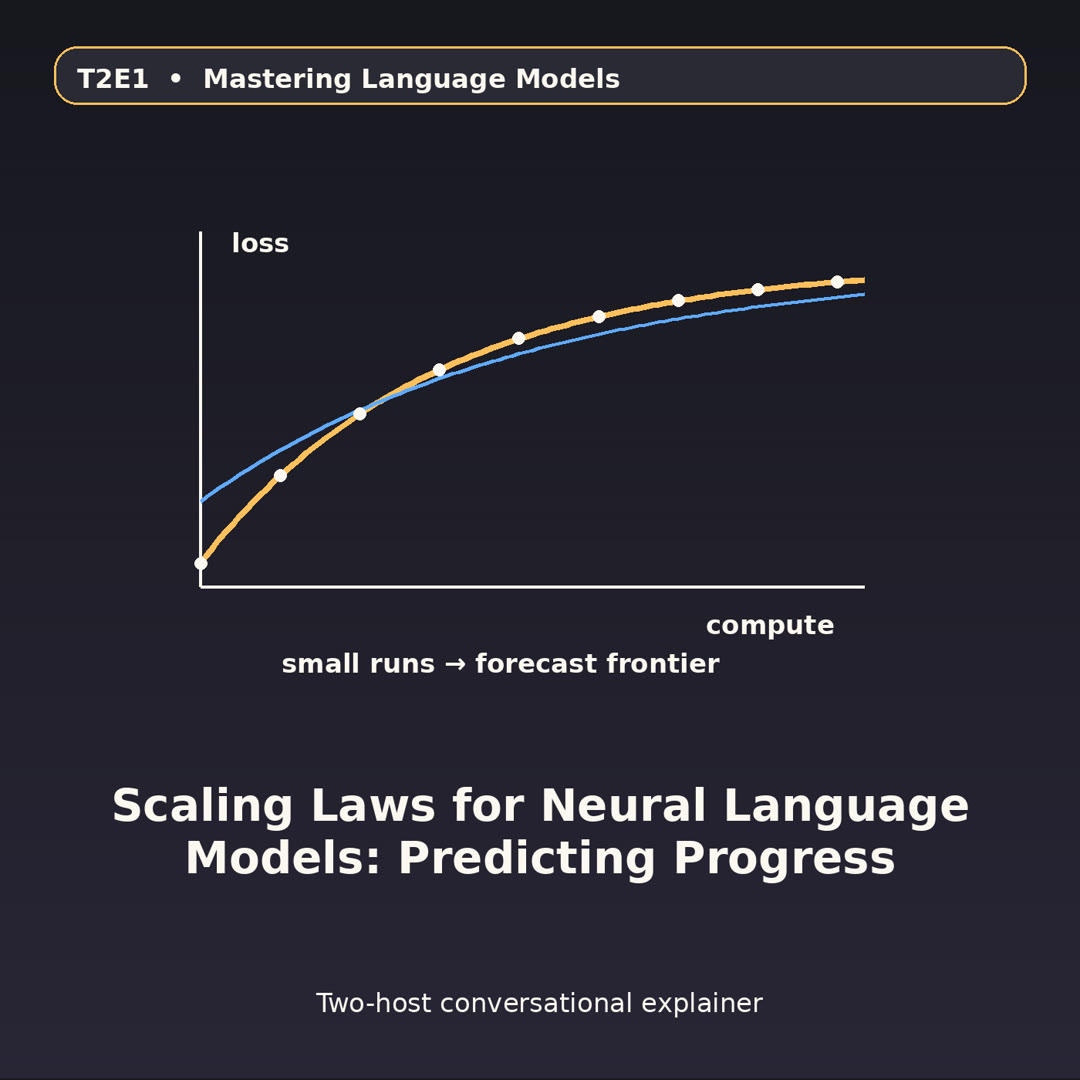
LeoSo if you plot loss against compute on a log scale, you get something surprisingly regular. That regularity is what made the paper influential.
MayaLet’s use a cooking analogy. Suppose you are improving a recipe. One ingredient is pan size, one is cooking time, one is ingredient quality. If every experiment is chaotic, you just guess. But if every doubling of effort gives a predictable improvement, you can plan.
LeoThe paper also argues that architectural details like depth versus width matter less than overall scale within a reasonable range. That does not mean architecture is irrelevant. It means once you use a competent Transformer setup, scale explains a lot.
MayaThat sentence created one of the great expert debates. Some people heard, “Architecture is over.” Others heard, “Architecture matters, but the scaling budget is the dominant variable.”
LeoI prefer the second reading. If your architecture cannot train, scaling will not save it. But among reasonable designs, the curves suggested bigger systems were a reliable route.
MayaAnother key result: larger models are more sample-efficient. That means a bigger model can learn more from each token, up to the relevant regime.
LeoWhich led to the paper’s compute-optimal suggestion at the time: for a fixed compute budget, train very large models on a modest amount of data and stop before convergence.
Maya“Stop before convergence” might sound wrong. In ordinary training, we often say train until performance stops improving. But here the idea is economic. If the next training step gives tiny improvement, maybe you should have spent that compute on a larger model.
LeoExactly. If you have a limited budget, you do not ask, “Can this model improve a little more?” You ask, “Is this the best place to spend the next unit of compute?”
MayaLet’s make the mental model tangible. Imagine teaching three students. One has a tiny notebook, one medium, one huge. The huge-notebook student can absorb more, but study time is limited. The paper suggests that in some regimes, giving a bigger student less-than-complete training can beat fully training a smaller one.
LeoThat was powerful, but later Chinchilla challenged part of the allocation recipe. Chinchilla argued that many large models were undertrained and should see more tokens per parameter.
MayaWhich is a good reminder: scaling laws are not sacred. They depend on experimental ranges, assumptions, and what costs you include.
LeoLet’s talk about why the paper mattered operationally. Training large models is expensive. You do not want to discover after spending millions that your budget split was poor. Scaling laws let teams run smaller experiments and extrapolate.
MayaIt is like using wind tunnel tests before building the airplane. You cannot remove all uncertainty, but you can reduce blind guessing.
LeoThe paper also framed language modeling as an empirical science of scale. Not just “try bigger and see,” but “fit curves, estimate frontiers, and choose budgets.”
MayaNow the limitations. First, loss is a proxy. Lower loss often correlates with better capabilities, but not perfectly. A model can have better loss and still fail on factuality, safety, tool use, or multi-step reasoning.
LeoSecond, data quality matters. The paper’s curves treat dataset size as a key variable, but later work increasingly asks: what kind of data? How duplicated? How filtered? How domain-balanced?
MayaThird, the world changes. As models scale, we care about new behaviors. A curve fitted to one regime may not predict every emergent or brittle capability.
LeoLet’s name the strongest argument from scaling-law believers. It is historical: predictable scaling helped guide real progress. Teams that understood these curves could allocate compute with more confidence.
MayaAnd the strongest skeptical argument: smooth loss curves can create false comfort. The social and product questions — hallucination, misuse, bias, reliability — are not solved by making loss smaller.
LeoBoth arguments can be true. Scaling laws are excellent for one part of the problem and incomplete for the whole problem.
MayaAnother nuance: compute is not just training FLOPs. Hardware utilization matters. If your cluster wastes time waiting for communication, your theoretical compute budget does not translate into useful training.
LeoThat is where Topic 3 comes in. Scaling laws say how compute should be allocated. Distributed training asks whether you can actually deliver that compute efficiently.
MayaI want to include a quick example. Suppose a team can run many small pilot trainings. They train models of different sizes on different token counts, measure validation loss, fit a curve, and estimate which full-scale run sits near the best frontier.
LeoThat pilot-first strategy is a direct cultural outcome of scaling-law thinking. It turns giant training into a forecast problem.
MayaBut the forecast can fail if the target distribution changes. For example, if your pilot data is clean web text and your production task is legal reasoning, the curve may still predict language loss but not legal usefulness.
LeoSo the practical lesson is: use scaling laws, but do not outsource judgment to them.
MayaThe paper’s deeper contribution may be psychological. It made big language model training feel less like alchemy. It showed that, at least for loss, the field had regularities.
LeoAnd those regularities shaped investment. If you believe better performance can be bought predictably with compute, you build bigger clusters, collect more data, and plan model generations.
MayaWhich leads to the next paper. Chinchilla asks: wait, were we buying the wrong mix? Maybe the problem was not that models needed to be huge, but that huge models needed more data.
LeoLet’s close with a compact summary. Kaplan and colleagues found that language model loss follows power-law trends with parameters, data, and compute. The paper made scaling predictable, argued for compute-optimal allocation, and influenced how the field planned large training runs.
MayaThe debate it opened is still alive: when curves tell us “more scale works,” what do they leave out?
MayaLet’s include one more technical caution. The paper studies trends over many orders of magnitude, but extrapolation is always a bet. A curve that fits past experiments can still bend when data quality changes, architecture changes, or the evaluation target changes.
LeoThat is the difference between interpolation and extrapolation. Interpolation says, “inside the range we tested, the pattern is stable.” Extrapolation says, “we believe it will keep going beyond that range.”
MayaIn frontier model training, teams often must extrapolate because the final run is too expensive to repeat casually. So the question becomes: how much evidence is enough before you trust the curve?
LeoAnother point: scaling laws are often about average loss. A small improvement in average loss may hide uneven changes. The model might improve common patterns but still fail rare tasks.
MayaThat is why downstream evaluations became so important. If you care about code, test code. If you care about medical question answering, test that carefully. If you care about agents, run agent benchmarks.
LeoStill, the paper’s optimism came from a real observation: language models were not hitting a clear wall in the measured regime. The returns diminished smoothly, which meant bigger budgets could be justified.
MayaIn business terms, it made the case for scaling from an art project into a capital planning exercise.
MayaAnd because the paper made prediction feel possible, it also changed risk. If a lab can forecast a more capable model, it can prepare infrastructure, safety evaluations, and deployment plans earlier.
LeoThat is the responsible version of scaling-law thinking: not just “we can predict improvement,” but “we can prepare for the consequences of that improvement.”
LeoFinal question: would you trust a smooth loss curve to choose your model, or would you demand a task-specific test before spending the budget?
CreditsThanks for listening. The producer is William Liu. Join us for the next episode.
Source material
← Back to Mastering Language Models: From Architecture to Optimization