Subscribe
Transcript
MayaI'll say it flat out — there's no such thing as one code-review benchmark. Hand the same pull request to eight of them and they don't even agree on what "good" means. One asks: did the agent write the comment a human reviewer would have written? Another: did it understand what the diff is doing at all? A third: did the developer actually apply the fix it suggested? Same patch, eight different questions.
LeoHold on — I'd push back on that. If they're all grading "review quality," surely they mostly overlap. An agent that's genuinely good at review should score well across the board, no?
MayaThat's the assumption I want to break. They don't overlap — the agent could ace one and flunk the next, because each one is secretly measuring a different skill.
LeoThen I'll bite. Show me where they split.
MayaThat's the whole point of today. So this isn't a deep dive on any single one. Today is the map — what the whole family of code-review benchmarks is shaped to see, and why no two probe quite the same skill.
LeoRight, and there's a piece we already have in hand — the scorecard for review *quality*. Coverage, line localization, severity, and that signal-to-noise idea where a noisy reviewer loses trust.
MayaRight. We've got the scorecard. Today's question is different: who actually *holds* that scorecard? Which benchmarks exist, what does each measure, and how is the whole group different from the patch-generation benchmarks we mapped earlier?
LeoOkay, so before we walk the family — what is a code-review benchmark, versus a SWE-bench-style one?
MayaA patch-generation benchmark gives the agent a broken repo and asks it to *write* a change that makes hidden tests pass. The agent produces a diff, and execution grades it — green or red. A code-review benchmark flips the seat. The diff already exists. The agent isn't writing code; it's *judging* code someone else wrote.
LeoSo one produces a patch and gets graded by a test runner. The other produces an opinion and gets graded on whether the opinion was any good.
MayaThat's the whole split. And "any good" has no green checkmark. There's no oracle that says "this review comment is correct." So every benchmark in this family has to invent its own ground truth — and that choice is exactly what makes them different instruments.
LeoLet me set my listening map so I don't lose the thread on a walk. How are you grouping them?
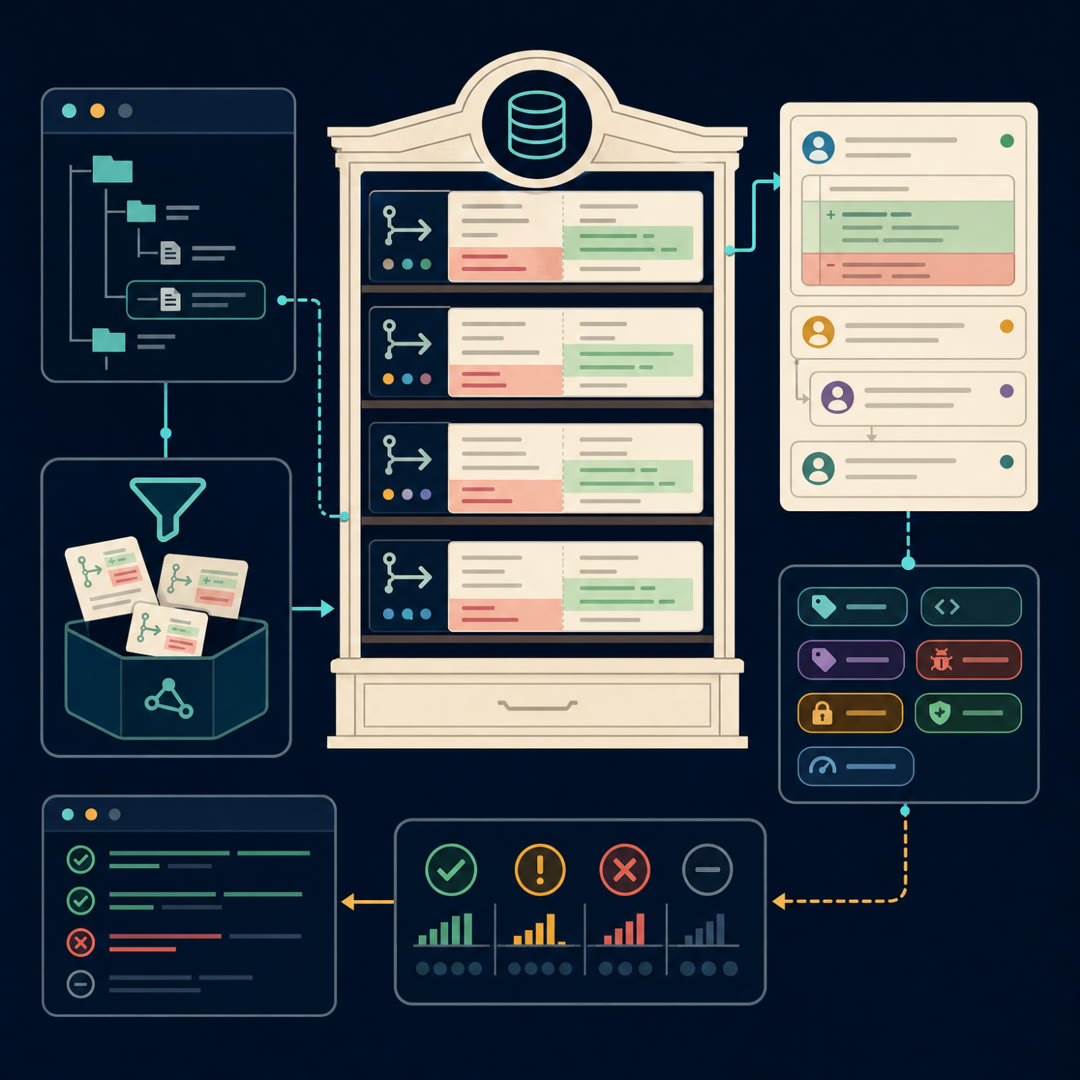
MayaFive rooms in one building. The comment room — can the agent write the review comment? The comprehension room — does it understand the diff before it speaks? The real-world room — is the review actually useful, noise and all? The pull-request room — did it find what real reviewers flagged on a whole PR? And the production room — at industrial scale, did developers accept and apply the fixes?
LeoComment, comprehension, real-world, pull-request, production. Five rooms. Got it.
MayaStart in the comment room. The oldest piece of furniture here is CodeReviewer — a paper about pretraining a model specifically on code-review activity. Its central move is treating review as a *learnable* capability in its own right, not a freebie you get from a model that can write code.
LeoSo the claim is: writing code and reviewing code are different muscles.
MayaThat's the founding bet of this entire family. CodeReviewer pretrains on the raw material of review — diffs paired with the comments humans actually left, and the follow-up changes those comments produced. Then it measures whether the model can predict that a diff needs a comment, generate that comment, and refine the code the way the human feedback did.

LeoSo it's "imitate the human reviewer" — generate the comment a person would have written.
MayaRight, and that's the room's defining lens. Comment *generation*, graded against real review history. The strength is it's grounded in genuine developer behavior. The limitation — and this matters — is that matching the comment a human happened to write isn't the same as catching the bug. Two reviewers flag different things on the same diff, so "did you match the reference comment" can punish a correct-but-different catch.
LeoHmm. So a high score there means "sounds like our reviewers," not necessarily "found the defect."
MayaWell put. Which is exactly why the next room exists.
MayaWalk next door to the comprehension room. This is CodeReviewQA. Its move is almost surgical: before you let an agent write a review, check whether it actually *understood* the change.
LeoWait — so it's not even grading the comment? It's grading the understanding underneath it?
MayaThat's the insight. CodeReviewQA decomposes review comprehension into a few sub-skills you can test one at a time. Can the model recognize what kind of change this is — a refactor, a bug fix, a new feature? Can it localize where the relevant change lives? And can it identify the right *solution* the review is pointing toward?
LeoOkay, why split it up like that? Why not just grade the final comment?
MayaBecause when an agent writes a bad review, you want to know *where* it broke. Misread the diff? Found the right spot but suggested the wrong fix? A single comment score blurs all that into one number. Decomposing it turns review into a question-and-answer format — hence the "QA" — so a wrong answer points at the specific missing skill.

LeoThat's diagnostic, not just a grade. The difference between "you failed the exam" and "you missed the chapter on localization."
MayaExactly. The trade-off is that comprehension isn't the same as usefulness. An agent could answer every sub-question and still produce a comment no developer would act on. Which — surprise — is the next room. [chuckle]
MayaThe real-world room is the busiest. Two instruments live here, and they're cousins. CodeFuse-CR-Bench and CR-Bench.
LeoAnd these are the ones we touched on around review quality, right?
MayaRight, they're the ones we'll deep-dive later, so today just the shape. CodeFuse-CR-Bench's move is *repository-level, end-to-end* review. Not one comment on one isolated hunk — the agent gets the whole repo as context and is scored across multiple quality dimensions at once, because in real life whether a change is okay depends on the rest of the codebase.
LeoSo context is the headline. A diff that looks fine alone might break a contract three files over.
MayaThat's the bet. And then CR-Bench — its title is literally about "the real-world utility of AI code review agents" — pushes further. It says even multi-dimensional quality scoring misses the thing that decides whether a developer keeps the tool: net utility. Did the reviewer earn its keep, or bury two real bugs under thirty-eight false alarms?
LeoSo this room is where false positives finally count against you.
MayaThat's the key difference from a patch benchmark. A patch benchmark mostly ignores false positives — your diff passes the hidden tests or it doesn't. A review benchmark *has* to count the wrong alarms, because the wrong alarms are what destroy the tool's value. CR-Bench makes signal-to-noise a first-class number.
LeoQuick recap for me: the comment room asks "did you sound like a reviewer," comprehension asks "did you understand the change," and the real-world room asks "were you actually worth listening to, noise included."
MayaAnd each of those is a strictly harder bar than the last.
MayaNow the pull-request room. This is SWE-PRBench. Its move is to scope the test to a *whole pull request* and ground the answer key in what real human reviewers actually flagged.
LeoSo the ground truth here is human-annotated — these are the comments real reviewers left on real PRs?
MayaThat's the anchor. Instead of imitating phrasing or answering comprehension questions, SWE-PRBench asks: given this entire pull request, does the agent surface the issues the human reviewers surfaced? Review at the unit the developer actually experiences — a PR, not a hunk.
LeoAnd I'd guess CodeReviewBench and the Martian one sit somewhere near here too?
MayaThey're adjacent, yes. CodeReviewBench leans on exact bug-line localization and fix suggestion — point at the precise line and propose the repair — and it deliberately balances coverage against validity across multiple languages. And Code Review Bench, the one from Martian, has a clever twist: it frames review as a *continuously refreshed* benchmark, grounded in comments that were actually accepted in the wild.
LeoContinuously refreshed — that's the contamination defense, right? Same idea we saw with the live patch benchmarks.
MayaExactly the same logic, carried into review. A static review benchmark can leak into training data, and then a high score is memorization. Refreshing from freshly-accepted real comments keeps it honest. So Martian's contribution is less a new capability and more a new *hygiene* discipline for the room.
LeoSo the pull-request room is really about realism — real PRs, real reviewer ground truth, and keeping the answer key fresh.
MayaThat's the through-line. Realism of scope and realism of the answer key.
MayaLast room, and it's the one with the factory floor: the production room. This is MetaMateCR.
LeoThe "at scale" one.
MayaRight. Its move is to leave the benchmark sandbox entirely and use industrial-scale evidence — AI-assisted *fixes* to code-review comments at scale, inside a real engineering organization, with whether developers accepted and applied them.
LeoOh — so the ground truth isn't a curated answer key anymore. It's developer behavior in production.
MayaThat's the highest bar in the building. The comment room asks "could you write the comment." The production room asks "when you did, did a busy engineer accept it and apply your fix — thousands of times over?" Those accept-and-apply signals are the closest thing we have to measuring trust directly.
LeoWait, so this is almost the opposite end from CodeReviewer. One pretrains on review history; the other measures what developers did with the suggestions.
MayaAnd that's the arc of the whole family. We start by treating review as a learnable skill, and end by measuring whether the skill earned developer trust on a production floor. The benchmarks aren't competing — they're a staircase from "understands the diff" up to "shipped value people accepted."
LeoLet me name a limitation, since every map owes one. What's the soft spot across this whole family?
MayaTwo, honestly. First, ground truth is fragile. "The comment a human reviewer left" is one reviewer's opinion — another good reviewer flags different things, so matching the reference can miss real catches and reward mimicry at once. Second, most of these are snapshots. Trust, the thing the production room reaches for, builds and erodes over weeks of living with the tool. No single benchmark run captures that arc.
LeoSo even the best instruments here are measuring a moment, not a relationship.
MayaThat's the honest caveat. And I want to be careful — I've described what each benchmark is *shaped* to measure, drawn from the curriculum behind this series and each project's own framing. The fine-grained metrics, the exact axes, the per-model results — those are the later deep-dive episodes. Today is the floor plan, not the furniture catalog.
LeoAppreciated. I'd rather know the rooms than pretend I know every drawer.
MayaAnd here's the memory hook before we close. Patch benchmarks ask, "can the agent fix the code?" This whole family asks a harder question: "can the agent *judge* code, the way a trusted teammate would?" Comment, comprehension, real-world utility, whole-PR realism, production trust — five rooms, one rising bar.
LeoAnd that ties straight back to the series promise — the score alone never tells you which question got answered. With review, you have to ask which room you're standing in.
MayaExactly. Pick the wrong room, and a great number means almost nothing.
LeoHere's the question I'll leave for everyone listening: if you were choosing one of these benchmarks to trust your team's review agent against, would you pick the one that best matches your human reviewers — or the one that best predicts which fixes your developers will actually apply?
Source material
← Back to Agentic Coding Capability: From Coding Models to Coding Agents