Subscribe
Show notes
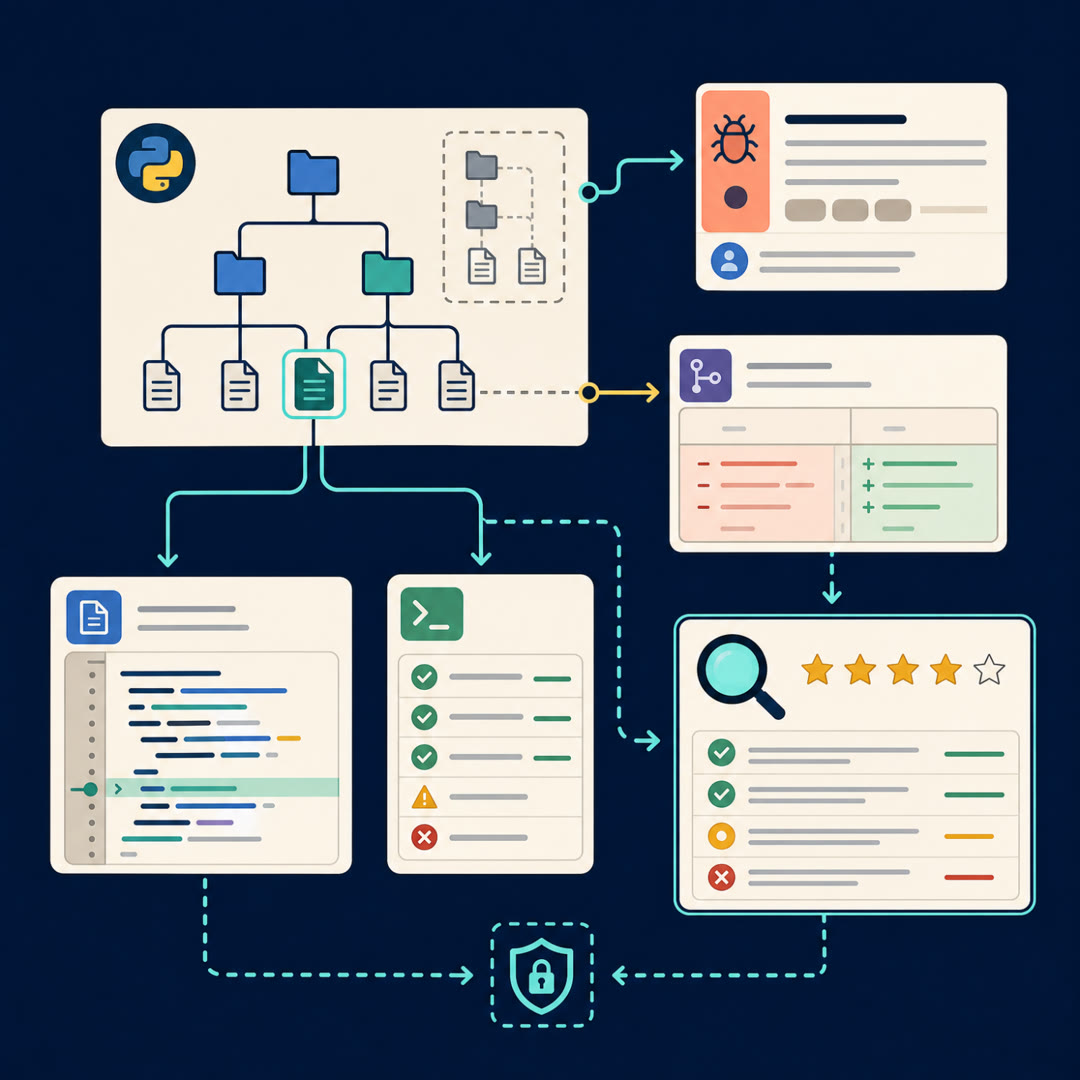
CodeFuse-CR-Bench attacks the 'reality gap' in code-review evaluation: instead of grading a clean snippet question, it drops a reviewer model into real pull requests with full repository context — the linked issue, the PR, the repo state — and grades the whole review end to end. Maya and Leo unpack the design: a fused rule-based checker (location, syntax) paired with a model-based quality judge, why no single model turns out to be well-rounded across review's dimensions, how redundant context becomes its own test of focus, and the benchmark's own limits (single language ecosystem, a model-as-judge with its own blind spots, and the gap that always remains between a frozen benchmark and a live reviewer).
Transcript
MayaPicture a reviewer who's brilliant at one narrow thing. Hand them a single diff, ask "is this line wrong?" — and they nail it. Now drop the same reviewer into a real pull request: the linked issue, three files of context, a repo they've never read, and a deadline.
LeoAnd suddenly the brilliant reviewer is lost.
MayaLost. Because the thing we tested was never the thing the job actually is. That gap — between the tidy little question and the messy real review — that's the whole story today.
LeoOkay, so last time we were on CodeReviewQA. That one took review comprehension and split it into pieces, right? Can the model recognize what changed, can it point to where, can it name the fix.
MayaExactly. CodeReviewQA was a microscope. It isolated comprehension into clean sub-questions you could grade one at a time. Very controlled.
LeoAnd today's paper basically says: that control is also the problem.
MayaThat's the pivot. Today we're looking at CodeFuse-CR-Bench, and its whole argument is that breaking review into isolated, context-poor sub-tasks measures something — but not the thing we deploy. They have a name for it. They call it the "reality gap."
LeoReality gap. Say what that means in plain language before we go further.
MayaSure. Most code-review benchmarks, including good ones, simplify. They hand the model a small, clean slice — here's a snippet, here's a question — and they grade the answer. The reality gap is the distance between that clean slice and what a human reviewer actually faces: the full repository state, the issue that triggered the change, the pull request as a whole, all of it at once.
LeoSo it's not that the old benchmarks were wrong. It's that they were... easy in a way real life isn't.
MayaRight. They were narrow on purpose, and narrow is great for diagnosis. But if every benchmark is narrow, you can have a model that aces all of them and still flops the first time it sees a real PR. CodeFuse-CR-Bench is built to close that distance.
LeoLet me anchor this to the example we've been carrying through the topic. The little team shipping a fix to an open-source data library.
MayaPerfect, use it. The patch passes the obvious tests. But buried in it, there's a side effect — it quietly disables refunds for one currency. The hidden tests might catch that. A human reviewer might catch it. But here's the thing — to catch it, the reviewer has to understand the repo, not just the diff.
LeoBecause the bug isn't visible in the changed lines alone. You have to know what those lines touch.
MayaThat's the heart of it. And that's exactly what a context-poor benchmark can't test. If you only show the reviewer the diff, they literally cannot see the refund logic three modules over. So a benchmark that hides the repo is grading a job that isn't the real job.
LeoOkay. So how do they actually build a benchmark that closes the gap? What's in it?
MayaThey go to real pull requests. Real Python projects — dozens of them — across a spread of problem domains. Not toy snippets. And for each instance, they keep the rich stuff around it: the associated issue, the PR details, the repository state.
LeoSo the model isn't reviewing a line. It's reviewing a situation.
MayaA situation. That's a good word for it. The reviewer agent gets dropped into something that looks like an actual review request, and it has to navigate it end to end.
LeoNow here's where I'd push. If you grade a real, open-ended review, how do you score it without it just becoming "the judge liked it"? Tests give you pass-fail. Real review is squishy.
MayaThat's the sharpest question, and it's where the design gets interesting. They don't pick one grading style. They use two, deliberately.
LeoTwo graders.
MayaThink of it as a pairing. One grader is rule-based — the strict, mechanical checker. Did you point at the right location? Is the output even syntactically valid? Things a machine can verify with no opinion involved.
LeoThat's the part that can't hallucinate. A line number is right or it isn't.
MayaExactly. And the other grader is model-based — an LLM judging the squishy part. Is this review actually good? Is the comment useful, does it reason about quality, the stuff a rule can't capture. So you get the strict mechanical floor and the judgment layer, working together.
LeoHmm. And that's the move, isn't it. Earlier benchmarks could lean on rules because the task was narrow enough. Once you make the task real and open-ended, rules alone can't reach it — but pure model-judgment alone is too soft. So they fuse them.
MayaThey fuse them. The rule-based part keeps the model-based part honest — it can't just vibe its way to a good score, because location and syntax are checked cold. And the model-based part reaches the quality that rules can't touch. That combination is what lets them grade a realistic review at all.
LeoLet me give the two graders names so I can hold them. The Strict Gate — location and syntax, no opinions. And the Judgment Lens — is this review actually worth reading.
MayaStrict Gate and Judgment Lens. I like that. And the reason both matter: a comment can be perfectly located and still useless, or genuinely insightful but pointing at the wrong line. You need both gates to tell those apart.
LeoOkay, so they run this on the current strong models. What falls out?
MayaA few things, and the first one I'd sit with. No single model wins everything.
LeoMeaning one model is great at finding the bug, another's great at, what, explaining it?
MayaSomething like that. Review isn't one skill — it's localization, plus judgment, plus handling all that surrounding context. And the models spread out across those. The one that's strongest overall isn't strongest on every dimension. Which is the entire argument for measuring multiple dimensions instead of one score.
LeoOh — that's the payoff of the whole design, isn't it. If you collapsed it to a single number, you'd literally hide the fact that no model is actually well-rounded.
MayaYou'd hide it completely. A single leaderboard number would crown a "best reviewer" that's secretly lopsided. The multi-dimensional view is what surfaces the lopsidedness. That's not a side finding — that's the thesis, confirmed by the results.
LeoYou said there was a second finding worth pausing on.
MayaYeah, and it's a little counterintuitive. Remember how the whole point was giving the model rich context — the issue, the repo, the PR? Turns out, more context isn't free.
LeoWait. I thought context was the good thing here. That was the fix.
MayaIt's the fix and it's a new hazard. Some of that context is redundant — stuff that's around but not relevant to the bug. And the models differ in how well they handle the noise. Some stay focused. Some get distracted by the irrelevant material and their review degrades.
LeoSo the very thing that makes the benchmark realistic — all that surrounding clutter — also becomes a test of whether you can ignore clutter.
MayaRight. Robustness to redundant context becomes its own measured skill. In our data-library example: if you bury the refund module under ten unrelated files, can the reviewer still find the currency bug, or does the noise drown it? Real reviewers face that every day. Now the benchmark does too.
LeoThat's a genuinely different thing to be good at than "spot the bug in a clean snippet."
MayaCompletely different. And it only becomes visible once you stop hiding the repo. The narrow benchmarks couldn't even ask the question.
LeoSo let me make sure I have the advance over the earlier work. CodeReviewQA — clean, decomposed, one sub-skill at a time. This one — whole real PRs, full context, end to end, graded by a strict checker and a judgment model together.
MayaThat's the jump. From "can you answer a review question" to "can you do a review." From a snippet to a situation. From one grading style to a fused one. And from a single score to a profile across dimensions.
LeoNow I want the honest part. Where does this benchmark itself fall short?
MayaGood — because it does have edges. The most obvious one: it's built on one language ecosystem. Python projects. That's a real, principled scope, but it means we don't yet know how the picture changes in other languages with other review cultures.
LeoRight, a review norm in one community isn't a review norm everywhere.
MayaExactly. The second edge is the model-based grader itself. The moment part of your score comes from an LLM judging quality, your benchmark inherits that judge's blind spots and biases. The rule-based half guards against some of that — but not the squishy half, which is exactly the half that's hardest to verify.
LeoSo the judge could quietly prefer a certain review style and you might not notice.
MayaYou might not. It's a known tension with any model-as-judge setup — you're measuring quality with an instrument that has its own opinions. The authors lean on the rule-based checks to anchor things, but it's a real limitation, not a solved problem.
LeoAnd there's a deeper one, isn't there. Even a perfectly realistic benchmark is still a benchmark. It's a frozen snapshot of past PRs.
MayaThat's the honest ceiling. They captured real situations, but they're captured. The actual deployment is a reviewer agent on tomorrow's PR, in a repo it's never seen, with a developer who may or may not trust it. Closing the reality gap is a huge step — but the last gap, between a faithful benchmark and a live reviewer someone actually relies on, that one's still open.
LeoWhich honestly sets up the rest of this part of the topic — the trust question.
MayaIt does. Today's contribution is the realism: stop grading a clean question, start grading the real situation, and use two graders so you can do that without it collapsing into "the judge liked it." That's CodeFuse-CR-Bench's move.
LeoSo here's what I'm left chewing on. If a review agent only ever practiced on clean little snippets, and then you drop it into your real repo — all that surrounding context it's never had to wade through — how much of what it "knew" do you think actually survives the noise?
Back to Agentic Coding Capability: From Coding Models to Coding Agents